
August was a dream
“August rain: the best of the summer gone, and the new fall not yet born. The odd uneven time.”

(I’m trying to work out if there was some kind of theme or unifying idea about what I absorbed over August…. Mainly I was busy experiencing actual life, the way Humans live it, so mere culture was demoted to what it usually is for everyone else - a pastime.)
The Lighthouse, 2019, Robert Eggers
Millers Crossing, 1990, The Cohen Brothers
Kowloon Generic Romance, Anime, 2025, Jun Mayuzuki
28 Collected, Dave Taylor
Baahubali 1 & 2, 2015, S. S. Rajamouli
Requiem, Vampire Knight, Omnibus, 2025, Pat Mills, Olivier Ledroit
Weird Fiction, an Anthology, 2025, Penguin
Fantastic Four, The Night of Doom Omnibus, 2025, Ryan North, Iban Coello
Eddington, 2025, Ari Aster

7th August - The Lighthouse
Emblematic monochrome scenes sleet past. Limitations in colour, frame and location mean every image is carefully composed. A square frame for a vertical film, and an unbelievably dark and shadowy film, as if wet ink had been spilled across the celluloid.
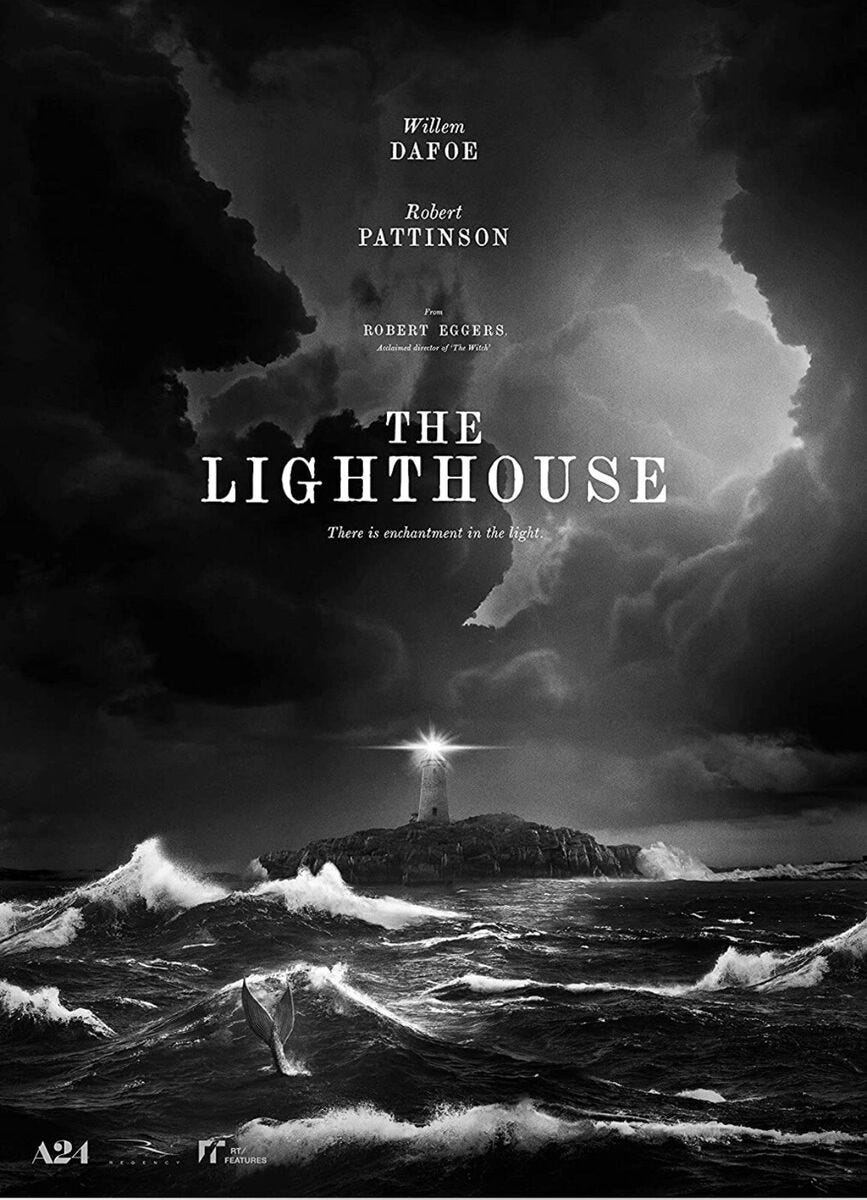
Scorsese once mocked the idea of a film made for phone screens, saying it was inevitable. The Lighthouse is not made for phones. In particular, its too dark to watch anywhere that isn't a cinema or a darkened room, and its use of sound and music is consuming, oppressive. But, in one respect, it is fit for a phone screen - its images are strong, simple, square, their compositions stark, and the flow of information they represent proceeds more like the linear letters of a sentence than the complex webs of signs and meanings other films might have. Each image tends to have a single overpowering meaning and while the arrangement of the images and the interpretation of them is expected to be complex, the 'sentence structure' of the story itself is not. This reminds me also a little of the 'gentleman’s prose' of Mallorys 'morte' which spoke in singular sequential concrete scenes, the images or scenes of 'The Lighthouse' are often less concrete, but a huge amount of the film is a man doing work, crawling, carrying, lifting, washing, cleaning, repairing - into this, dreams and nightmares intersperse themselves.
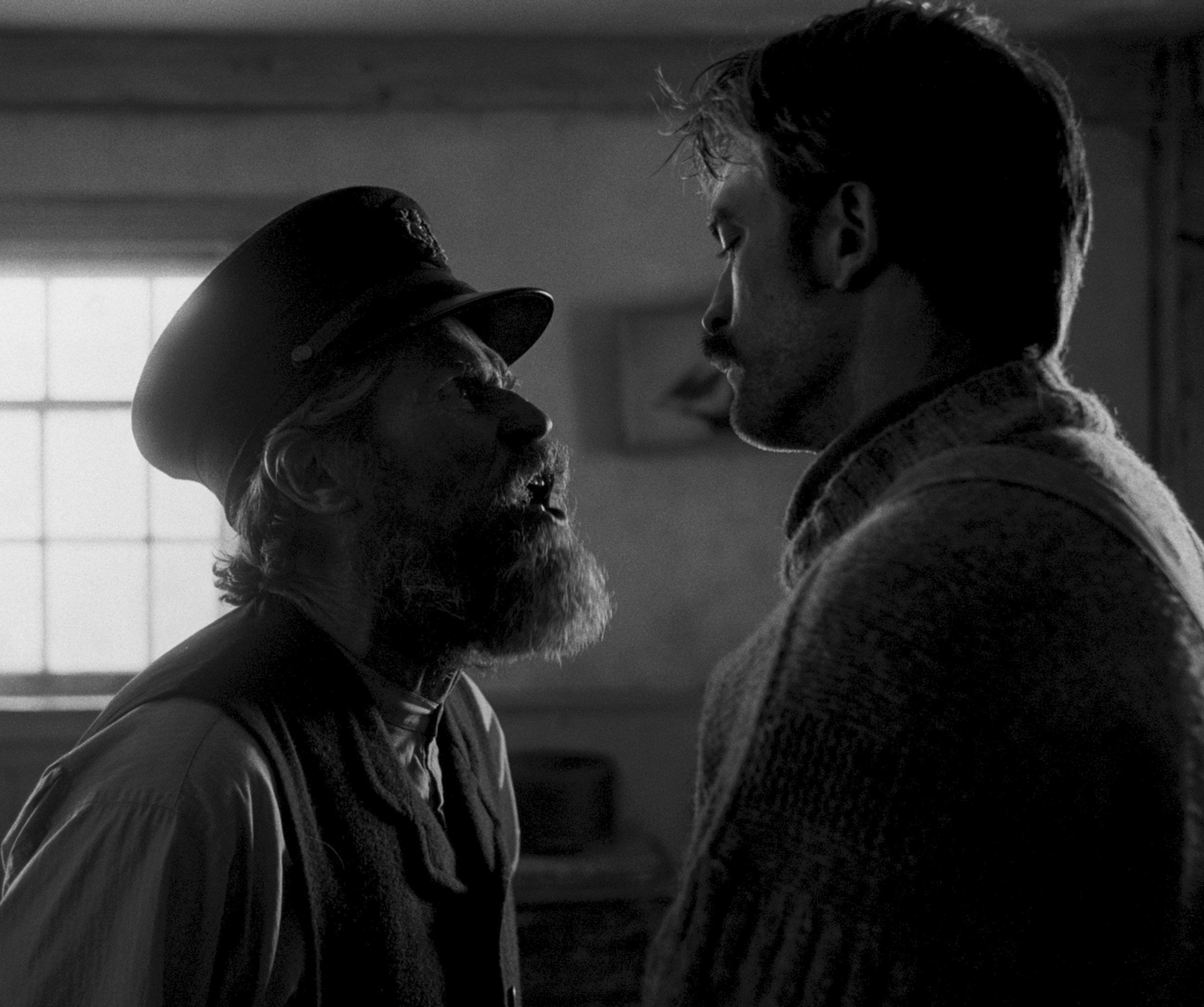
(I would be interested in a 'true silent' version of The Lighthouse. It might work quite well as a truly silent film. (Some of Willam Dafoes more labyrinthine speeches might have to be cut down, but most of those end up in strong and singular meanings too). Perhaps a cold 90 minute long version would be best.)
One thing I think we can all take away from 'The Lighthouse' is that health and safety rules at work are very important, and furthermore, no-one should be drinking on the job. The one element of horror that anyone can understand is 19th century working conditions - the film has a slight 'Mad Men' aspect where we all gawp at the absolutely shoddy ladder safety and inevitable coal dust poisoning - you can't run a global industrial empire on clean lungs son!
Both characters look, feel and seem exceptionally 19th/early 20th century. Film grain, deep shadows and moustaches help. A potent moustache roots and dominates Pattinsons model face, only the most extreme of emotions can get past.
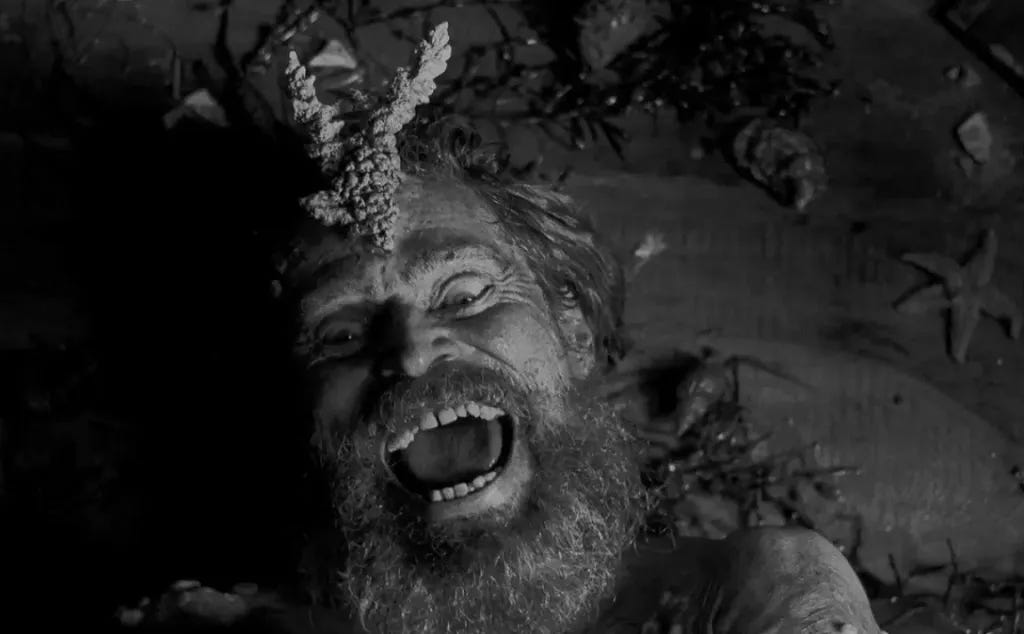
This doesn't bother Dafoe as he only ever has extreme emotions. His face is a mask and his beard is part of that mask. He gurns, grins, spits, heaves, fucks and Falstaff’s his way through the film vomiting eld polysyllaby. Cultist, cult leader, fool, madman, who knows; he is having sex with a tentacle.
THEORIES ERUPT LIKE BLISTERS
Two men trapped together on a lighthouse island, in an endless storm, seem to go mad and turn upon each other.
*What really happened*, or what combination of malfeasance, madness and Lovecraftian horror lead to such a doomed finish, we never quite know.
We imagine the interpretations like gospels, with varying levels of psychodrama, drunkenness and supernatural affect. Likewise we can imagine dual perspectives that favour one or the other as being either victim or oppressor
The one thing it’s really hard to imagine is the purely tragic version with no actual supernatural events, only booze, and no deliberate malignancy, or trickery, only misunderstanding and misreading. Surely, someone must have been up to something-? This can't be a film with no shenanigans.
The growing uncertainty and the eruption of possible truths plays an important role in the structure of the story and the general sense of horror and distortion.
The leading edge of 19th century industry; a kind of archipelago of anonymity where a man might go to remake himself, take on a new name, new papers, disappear from an atomised society and reappear as someone else, perhaps literally in this case.
Pattinsons Character admits he has changed names before coming here. Dafoe may have murdered and disposed of his previous second, or may in fact *be* that second, after having murdered and disposed of the true 'Wicky'.
'Wicky' is the title of a Lighthouse keeper but when asked for his name Dafoe gives his as 'Tom Wick', which is a little like claiming to be 'John Door'.
It’s possible for either man to be largely innocent, for either to be an innocent man trapped on an island with a crazed, malignant or deluded murderer, or for BOTH men to be crazed, deluded murderers trapped on an island together with a Lovecraftian entity, or more than one entity.
The supernatural elements are manifold, always suggested, rarely confirmed. A particularly nasty seagull may be the spirit of a murdered man, or its aggression the result of Pattinsons mental decay, or sharp temper. Its murder may bring down a curse, or there may simply be an unusual storm. There may be a mermaid haunting the island, actual, psychic emanation, or the illusion of horny lighthouse men. There may be some kind of sea-king, or sea-god, which embodies or enfolds all of these, or which is separate to them. Dafoe may be its prophet. He does CURSE Robert Pattinson, the most formal and archaic curse imaginable, with apparent effect, in a brutal argument over cooking. Curses, corpses, mermaids, visions. It may live within the light of the lighthouse lamp.
A symphony of overwhelming uncertainty and looming possible threat, and tragic emotion as, the two men slowly growing closer to each other, then repelling from each other, then growing closer, then lurching away, each change or revelation only deepens the trauma.
....
I was told this is a better film than 'Nosferatu', and, based on images and dramaturgy, it probably is, though I have a soft spot for the Vampire flick as we know what happens in the end and it has a goth Lilly Rose-Depp.
Just make a series of images I guess. Add some Harold Pinter, constrain the screen, the scene and the aesthetic, spend ages getting the shots right, add in some moody music, jobs a good-un.
I am not giving this five stars because you don’t find out what happened. Ambiguity is not that good.
9th August - Millers Crossing
'A handsome film about men in hats'
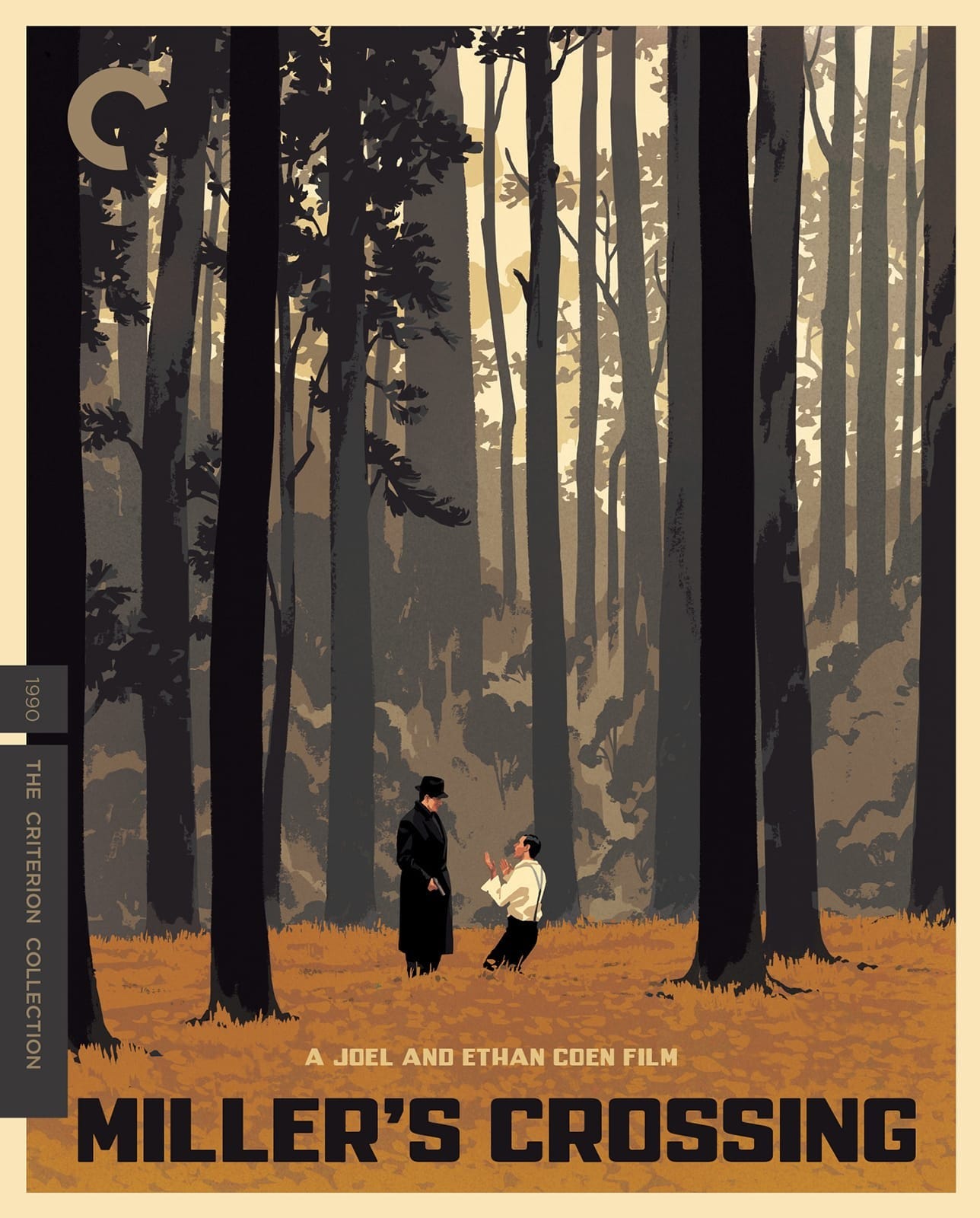
I just really like this film. Its my favourite.
An interesting comparison with the Lighthouse is that this also has its own language. Really a poetic sub-dialect, comprehensible but strange. The mild 'translation effect' of everyone talking in this hyper-stylised Dashiel Hammet gangster slang creates a very slight delayed or dual-comprehension sensation which reminds me of reading very old style English prose in its original spelling - it removes some of the minds shorthand and almost re-phoneticises the dialogue.
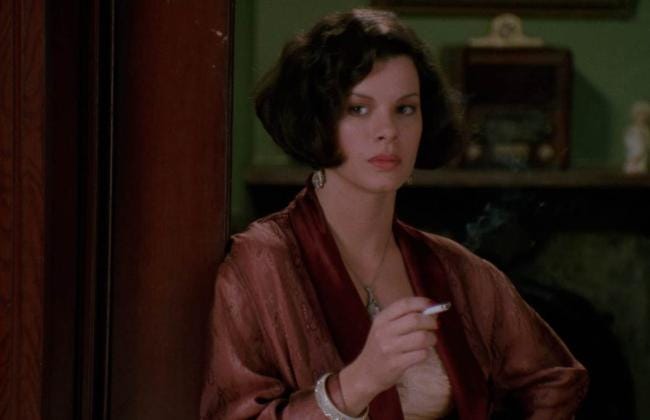
"There's always that wild card, where love is involved."
All the films major characters are motivated by genuine love, all except John Tuturro’s Bernie Bernbaum, (in a really amazing performance). Tom loves Leo, and possibly Verna. Leo loves Verna, and Tom. Verna loves Bernie. Eddie the Dane loves Mink Larouey. Mink, (apparently), loves, or at least is shacked up with Bernie.
Honour vs Love. Or some kind of honour, and some kind of love. Most of the film is Tom deciding between his love for his friend Leo, and that for Verna. He could have her if he chose. He even tells her he loves her. But watching back, judging only from actions, even if Tom himself seems confused from his words, his deeds make it no kind of contest, its Leo all the way.
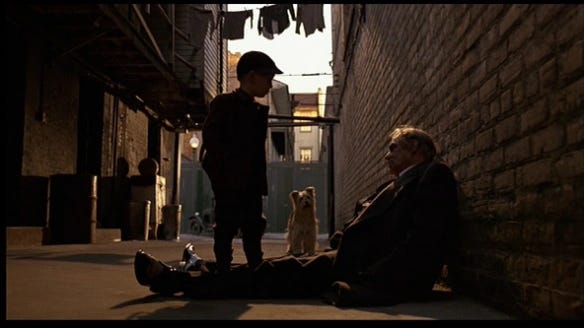
"An interesting ethical question."
Tom is only the second most dishonest person in the movie. Bernie is the alpha-liar and Verna sort-of lies to Leo, leading him along, but she does do this for a clear and simple reason; to protect her brother. Tom lies a lot. Almost everyone else in the film is pretty honest most of the time; Leo, Caspar, the Dane, the various goons, O'Doole and the Mayor, Tony behind the bar, they largely tell it like it is.
The 'enemy gangster' in the film really isn't the 'bad guy', or even a very bad guy himself. Johnny Caspar is described as a 'violent psychopath' but his impulsivity and violence seems no worse than anyone else in the story. He genuinely loves his family and outright refuses to double-cross Tom, even though Eddie the Dane recommends it, and even though it would have been the smartest play. If he had, he would still be alive. "You start double-crossing people, where does it end? An interesting ethical question." He was also completely right about wanting to whack Bernie Bernbaum at the start of the movie!
Bernie really is utter poison in this and John Tuturro does great work with him. He's barely in it! The character builds and builds from people talking about him and his spiderwork is everywhere as he pulls on every cord possible to keep himself alive, manipulating literally everyone he knows, but he's only really strongly present in three scenes. First begging Tom to spare his life as they walk together into the forest. Second, popping up in Toms apartment as the devil incarnate, utterly different. Its kind of amazing such a man could have any shame but Tutturo really does communicate his shame at his previous meltdown and makes him nearly almost slightly sympathetic for a moment. Then finally, one last scene in Toms apartment building. But his influence dominates the entire story. He's also the main cast member who doesn't love anyone, not even himself.
16th August - Kowloon Generic Romance
Two sweaty and attractive people work together in a small office in Kowloon Walled City. Will they bang? (Yes.) But is this real? No idea. Is anything real? Ask the shimmering tetrahedron hanging in the sky.
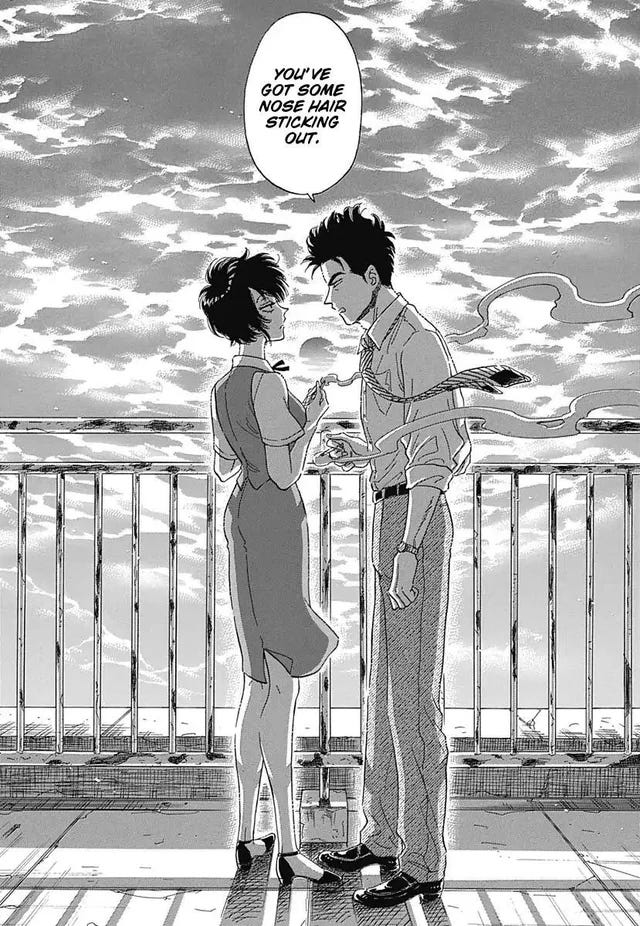
This is a science-fiction romance mystery series. It has enough plot for eight episodes but we get twelve, less of an offence than you might think as its very much a vibes based show.
The manga is beautiful but less strange and textured than 'real' Kowloon' with the anime doing its best but still a step down from the manga I think. Also, this is a deliberately somewhat-idealised version of Kowloon. Still, they are trying! and its very pretty when at its best.
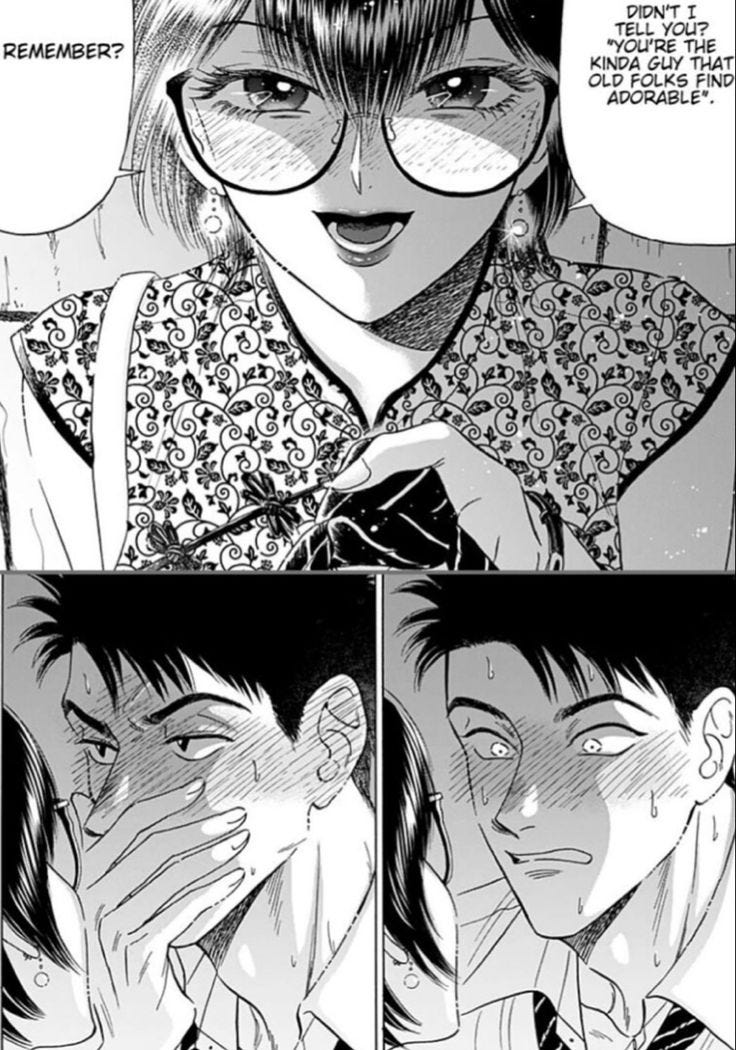
I WANT TO BECOME MY ABSOLUTE SELF
But what role do others actually play in that process? A light paradox there as the social human can only really become its full self in the eyes of others, but those same eyes are the cause and source of the many masks we wear.
A major part of the series is based on this paradox or dichotomy. Many different characters, especially the female lead Reiko Kujirai are driven to 'become themselves' and in many cases this drive comes from, or is prompted by, a relationship with or attachment to, the Other. Without this relationship there would be no challenge, no affection and no growth, yet this growth often separates 'us' from 'them', we grow and sometimes walk away.
All of this is built into the relations of the two main (young, sexy and mysteriously sweat-free (they are Japanese) characters. One, Hajime Kudou, is unchanging, bound and focused on the past, the other, Reiko Kujirai is changing restlessly, driven to grow and become - what drives her growth is her love and desire for her Other but that very growth, that becoming of self, separates as it teaches, pushing her also away from the object of her desire, and perhaps towards her death.
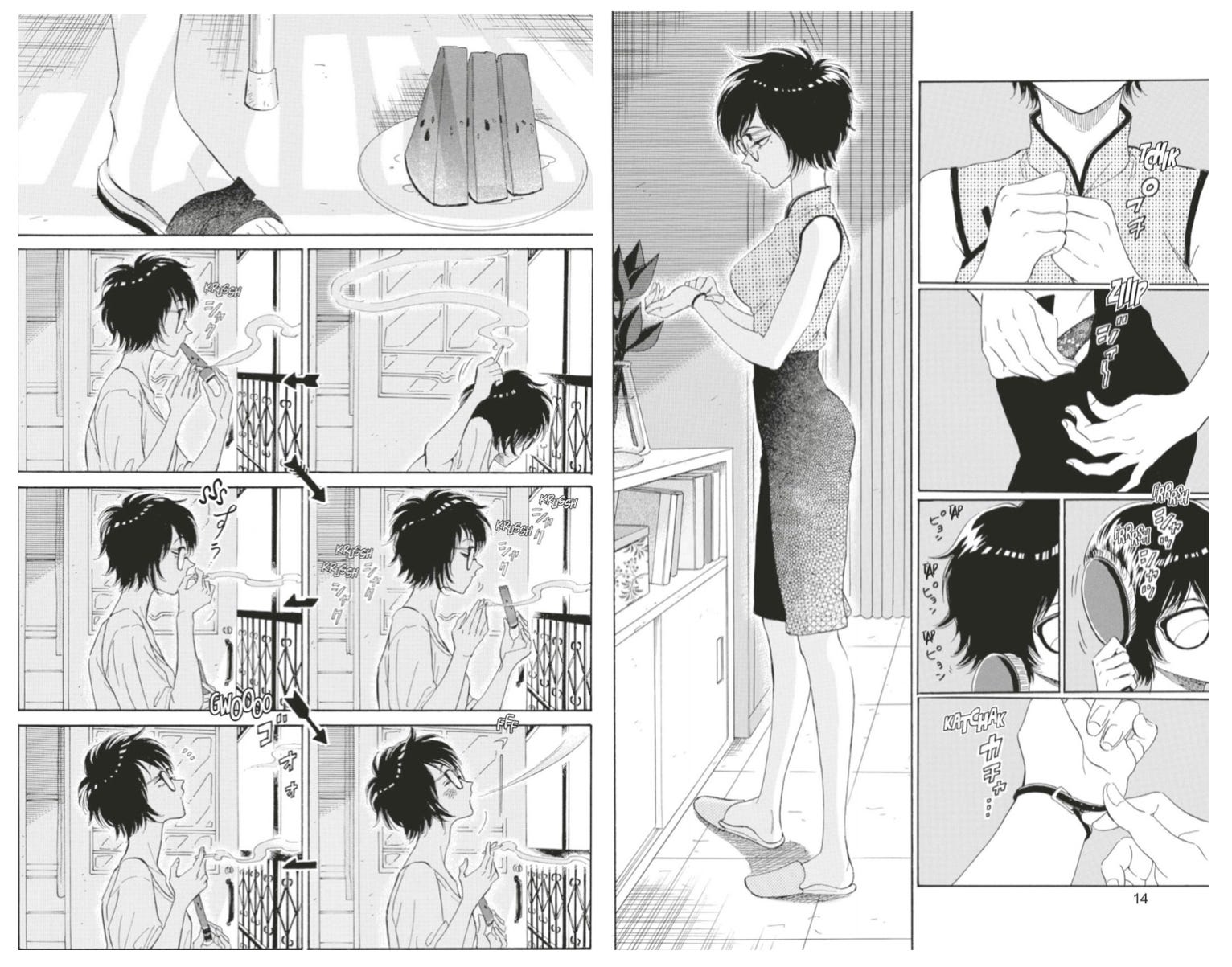
HORROR IN THE MATRIX
This is also a sci fi story, a THROBBING POLYGON rides the sky of Kowloon like an eternal moon, every so often characters look up at it and say "how about that throbbing polygon ey?"
Its something for the eyes to rest on, for the rest, Reiko Kujirai in the first few episodes realises she has no specific memories older than a few days, and a big part of the story is her working out what that means, what to do about it and how to feel about it. Its a false memory/melting reality drama and with the various twists and turns those things have I don't want to, and can't be bothered to, spoil it.
I'll review the end; it was pretty good. I am not sure if it made absolute sense but it did make emotional and moral sense for these characters and this situation. (By the end this would also be a really good horror story and its really only the framing and the fates of the characters we follow that mean it isn't. Many and serious MindCrimes may have been committed.)
18th August - 28 Collected
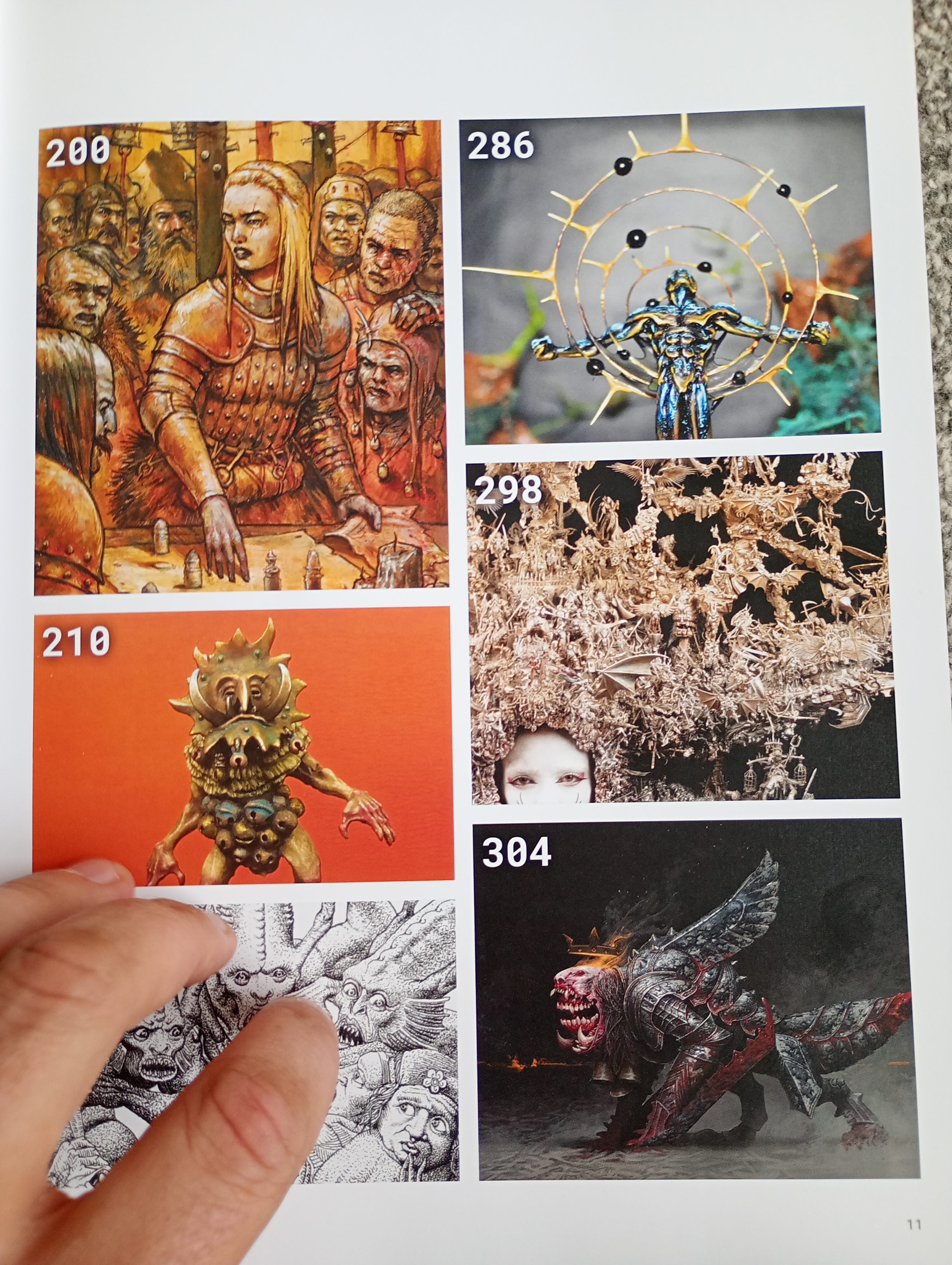
BEAUTY OF THE THING ITSELF
Lets assume you have no idea what this is or where it is from. Without any context, what is it you are looking at?
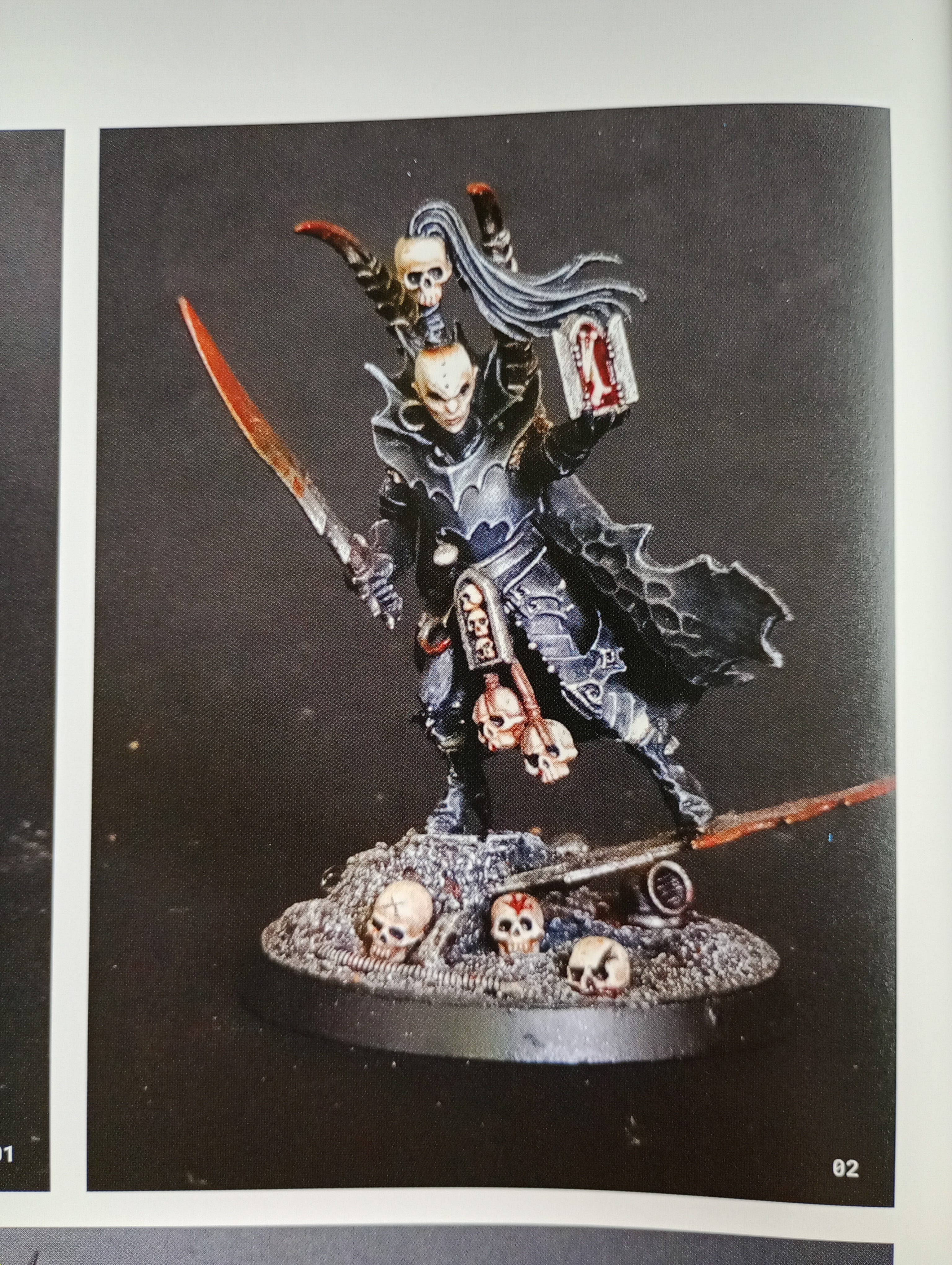
A hardback A4 book of over 300 pages, packed with full colour photography... of little miniatures? and art, and some essays and things. Really this is an art book, and wisely, boldly, (and rarely in many cases), it privileges its art. The pictures are BIG, the art is DOMINANT.
To you, my imaginary, ignorant observer, the very rare difficulty of painting anything this small to look good at this scale, and then the secondary difficulty of actually photographing it so it doesn't look like shit, would be completely invisible. You likely have no idea that these are, individually, very hard things to do, (I have probably never successfully done both), and that the existence of this book 'as art' depends on strong advances in the capacity and accessibility of photographic and layout technology over the last 30 years, and of the complex and necessary skills needed to utilise these things, and again of actually 'getting the things to photograph', - making the scenes and painting the minis - these are distinct art forms that have been growing in breadth, complexity and skill-ceiling again, for 30 or 40 years.
All this invisible to you, you poor ignorant sot. Do you have any idea how fucking SMALL these little guys are? How hard it is to get them looking good? You are like a peasant glancing across Hookes Micrographia
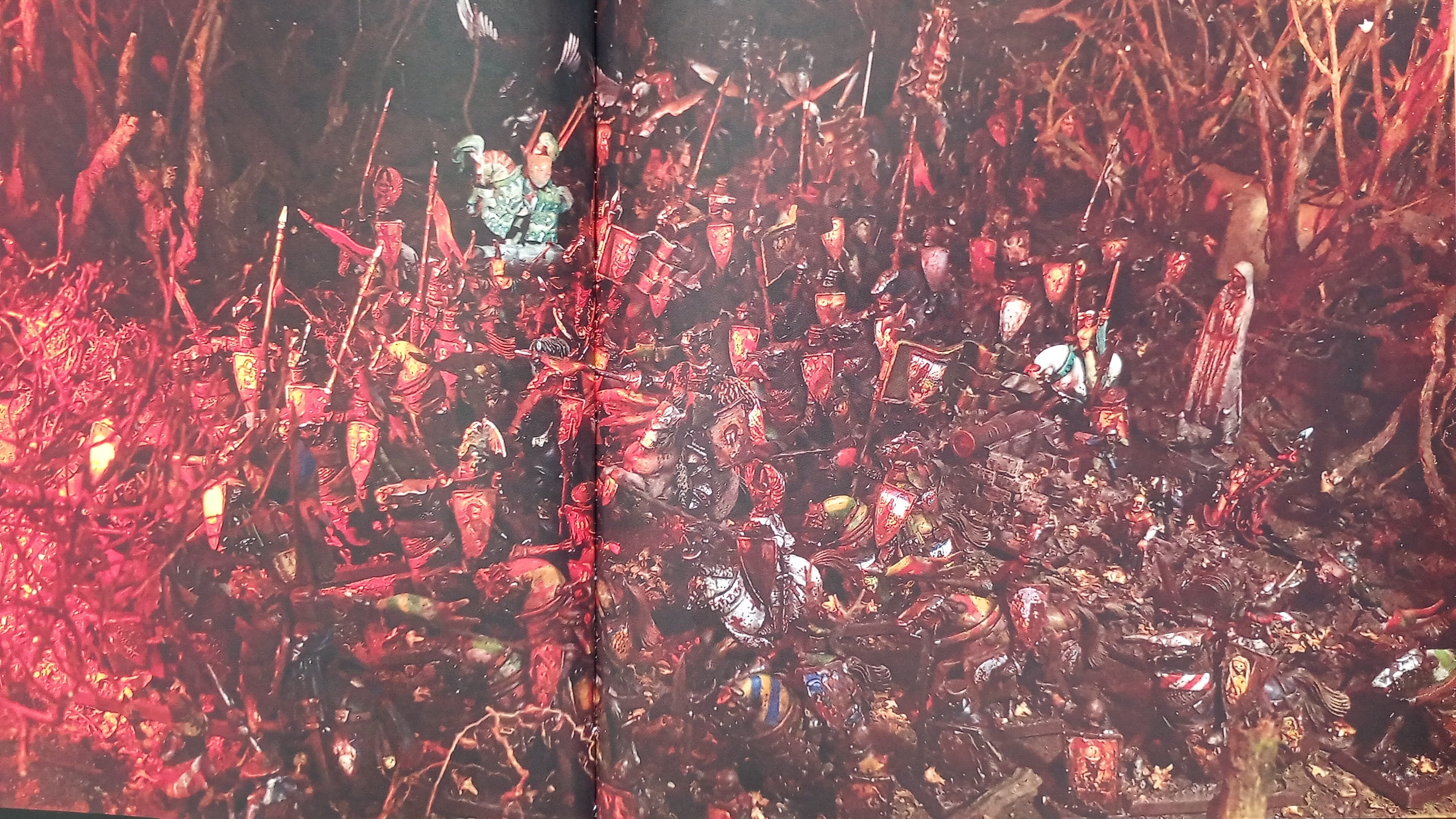
But putting aside that, what do we have? A rich gothic-bible art-book of textured grimy dark and sometimes grotesque, sometimes poetic and beautiful scenes and figures. Colours like Rembrandt, fields of motion and activity like Bruegel, grim scenes of dark futures - what’s this you say? A northern renaissance view of the middle ages, in SPACE? For this is no 'Merrie England' , (fragments of Chaucer may pop up), neither is it the more southern European and maybe pro-Catholic coded 'High Middle Ages', a time not actually that bad as a bunch of academics and Catholics will tell you. Instead this is the Middle Ages as seen though the eyes of a Protestant peasant living in some upper reach of Europe where the gloom is barely dispelled by a white sun before the Norns begin to knit it in the air again and where there is no gloom the light is pale, speaking of tone and texture more than spark and pattern.
All is ruin and its looking lovely. I hope you like metallics and muted tones, if you don't you are in the wrong place, (though some Italians have snuck in with hidden pallets loaded with bright pigments).
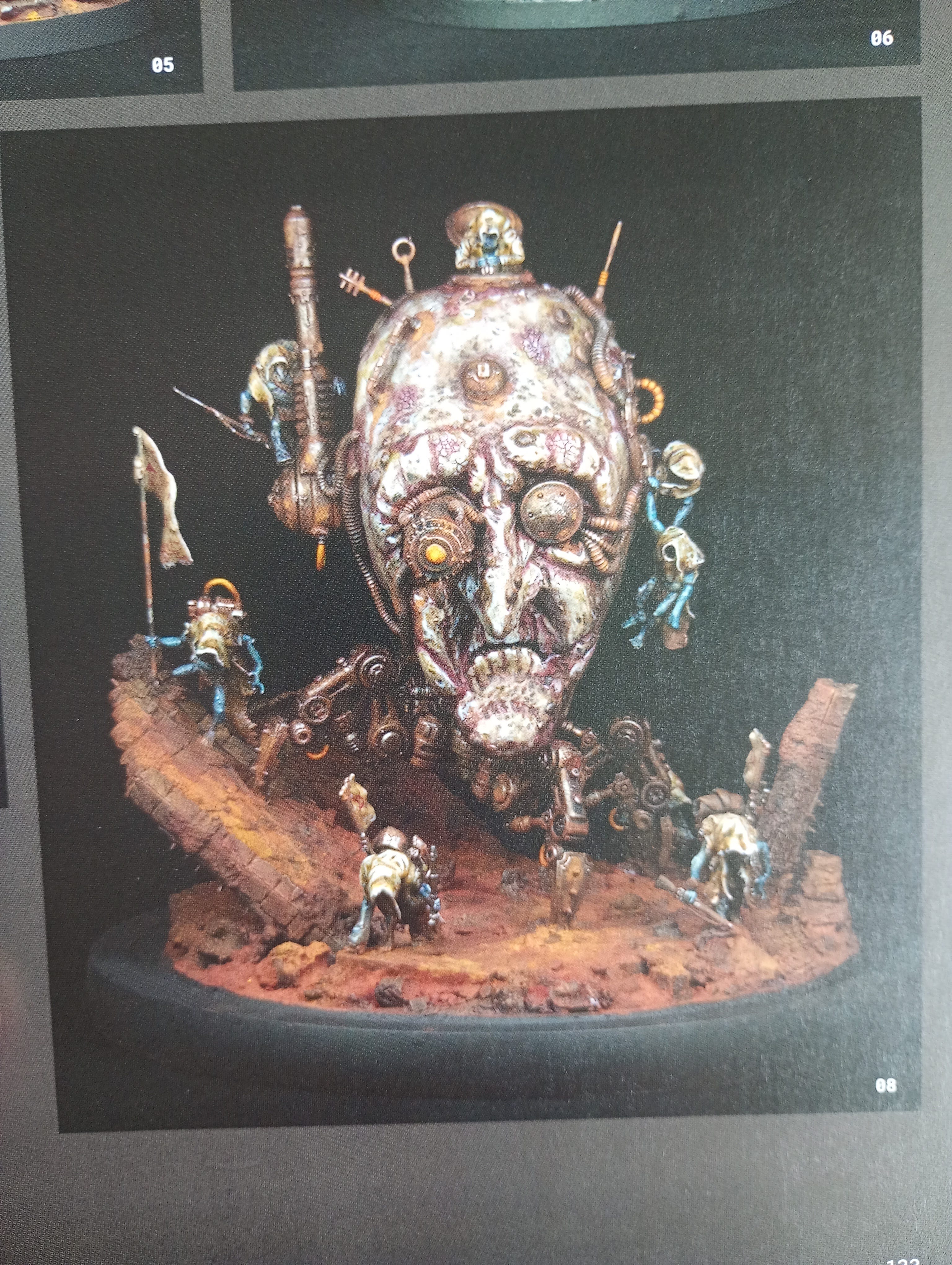
28 COLLECTED
I was in the Kickstarter for this. A book about the miniature art movement springing largely from the work of John Blanche, the former Art Director and 'genius loci' of Games Workshop, or 'the Warhammer Company'. A movement centred around kitbashing, sculpting, painting and sometimes playing with, 28mm scale minis in the dark, grim, textured, somewhat medieval future imagined by Blanche in his many works.
The 'movement' has been going, I suppose, since John Blanche first picked up a brush to start painting. It grew when the first person was inspired by John Blanche. It reached one plateaux in the late 2010's when White Dwarf included a sequence of articles in which varied artistic hobbyists, including Blanche himself, got together to play games set in specific worlds for which they made the miniatures to suit. Then, tragically, just before Covid, the Blanchitsu articles were banished from the pages of White Dwarf. But they clung together in the darkness and recoagulated themselves as 28 Magazine. These have been published as beautiful PDF's since 2019 and this is the first, physical, hardback collection of those articles.
Thus is the (public facing) story of the 28 movement, and since you can get all of these PDF magazines FREE, right now, why bother with this luxurious hardback?
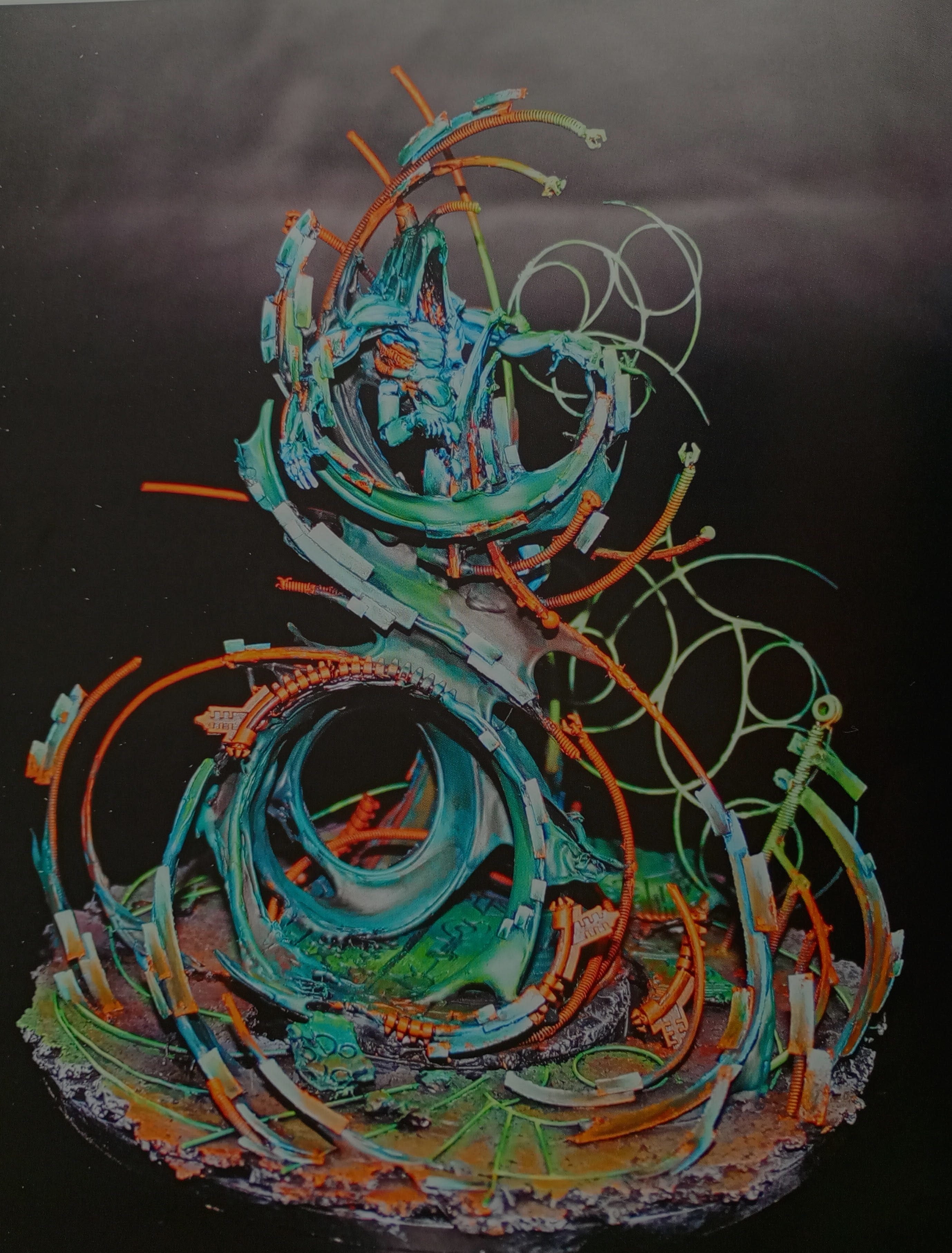
A TIRESOME OLD SAW ON THE VIRTUES OF PRINT
You can hold it in your hand. You can leaf through it. You can consider. It is slow, which, for these particular images, is ideal.
You can put it on your shelf. Most importantly this is a prototypical art status object, one you can happen to leave out for your normie artist friends
which they can glance over and you can say 'oh that old thing.. yes Warhammer is cool actually, with avante garde artists doing stuff... probably you hadn't heard".
'28 Collected' is somewhere between a wunderkammer and a 'greatest hits' album. Work has been done to include some of the most potent Archons of Blanchitsu, not merely a grouping of hobbyists but SUPER-HOBBYISTS, creators and sustainers of their own businesses, movements etc. Blanche himself, Tuomas Piernen, buff maker of Mordheim, Ian Miller, Andy Chambers, Trish Carden, Anna Polanacak.
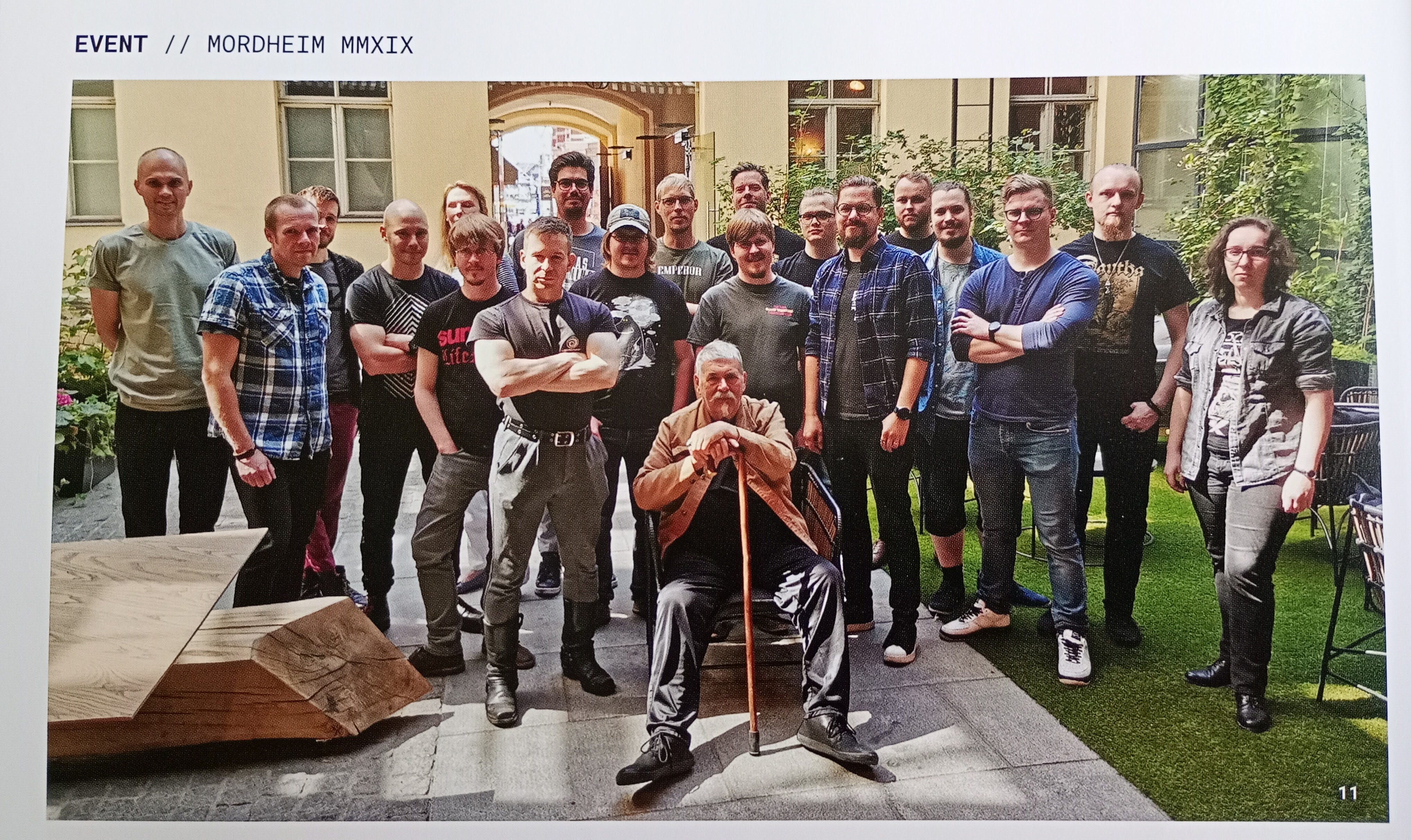
An arts and craft movement bound together and expressed through shared acts of play, the famous 'Invitationals', boutique worlds developed through art, text and miniatures to be played in single events; Mordheim 2019, Sunhold, Rot of Hondius, Turm 2023.
The skills on display range from the paired arts of Kitbashing and Sculpting. (One begins as one and sometimes ends as the other), as well as pure visual artists, worlbuilders and even Players, which can be a kind of creative skill.
It is now 'real', bound in hardback and exalted by visual design in a way a PDF magazine or online project wasn't. It has gained in status, the status of physical things, and can now be transported across cultures in a way impossible before, (for how can you transport a movement?)
Appropriately its even a memorial, one section is dedicated to art of the late Picta Mortis, and is a visual and textual elegy to his incredible talent for black.
WHAT IS 'BLANCHITSU?'
Only John Blanche can answer that and he says it doesn't exist. Its stuff a bit like John Blanche, or inspired by him.
In a sense this book 'is' Blanchitsu in a way that no other individual part can be. In the same way the bible can be a more effective condensation and declaration of an idea than the prophet that inspired it.
Blanche is the prophet but his reach is limited and his Evangelists finite. This book is the scripture and it can be replicated 100,000 times and sent here and there to Corinth or to Thebes
We have never been quite here before and will never be exactly here again. Blanchitsu, whatever its evolutions, is organic and personal to one man, there is not much blue in this book (though there is some); John Blanche doesn't like it, and though there are probably people in this book who have never thought _that much_ about what John Blanche does or does not like, and though its certain the Man Himself has little interest in Laying Down the Law, still, like a drop of ink that hits a white page, no matter what shape it takes, (and each will be unique), it can still only spread from that one central point and even those parts to whom that point is a stranger will still be bound invisibly to it.
Like a true Renaissance we have 'ancestral' texts; Mordheim, Inquisitor, Gorkamorka, Man O' War, examined and re-considered, they lead to a new flowering of worlds and games; Turnip 28 is a whole subgenre, the recently exalted Trench Crusade, the art movements of Folkhammer and Comfyhammer and the general design concepts of Non-Combat 28. There are more, many more. Throw a rock and hit a Grimdark ruleset.
That point is John Blanche, whether he wishes to be or not. He gives the group its identity. One day he will be gone and like Apostles, the group will splinter, and perhaps even schism, with claims of 'no True Blanchitsu' ringing out. A Blanchitsu movement breaking into open Heresy would be very on-point. Something to look out for!
19th August - Baahubali, parts 1 & 2
Starring (charismatically) Prabhas
Directed (notably), by S. S. Rajamouli
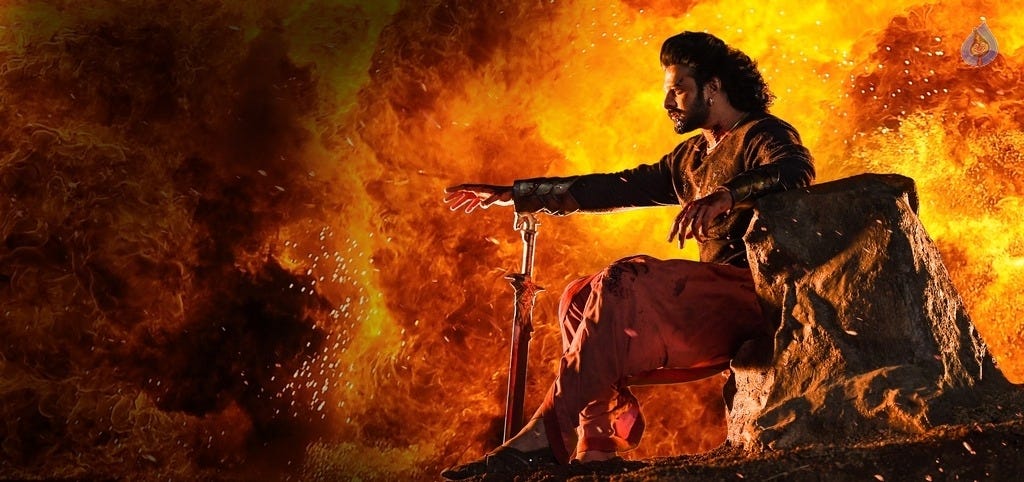
WHAT IS THIS?
It’s the story of Baahubali, both of him!
The simplest epic imaginable - the son of a noble prince betrayed by an evil half-brother is lost over a waterfall as a baby, he survives and grows to manhood with the good but simple forest people, climbs the waterfall, goes back to the palace and deposes the evil half-brother.
But get ready, because in the last part of Baahubali 'The Beginning', we cut to flashback; because the son is actually the reincarnation of the father who was betrayed, and almost the whole of the second film is one long flashback telling the story of the fathers betrayal.
Then at the end of the second, film, we flash forward again for the super-mega battle scene where Baahubali II fights the evil uncle and takes back the Kingdom.
(If you have seen memes or fragments of these films it’s probably from the final battle where Baahubali's army forms human barrels and are flipped by handy coconut tree catapults over into the enemy fortress, and while the whole film is definitely a _bit_ like this, this scene is the most 'Warner Brothers' moment in the movie and doesn't accurately represent the tone of the whole thing)
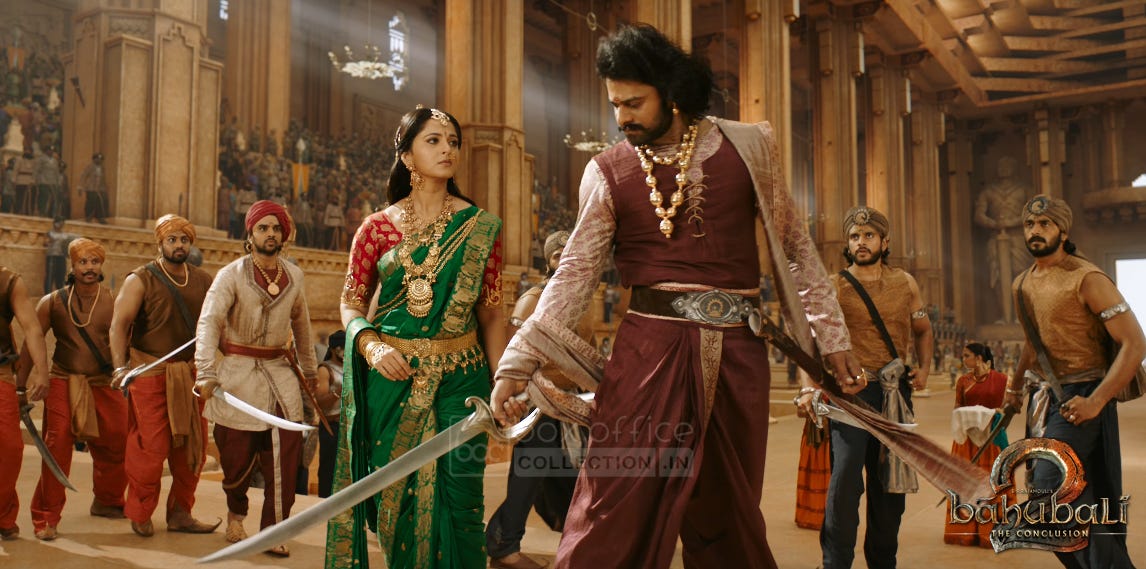
DRENCHED
This story is absolutely drenched in Indian, and probably location-specific, mythology, folklore and religion, as well as a whole long history of popular Indian film.
I don't know anything about any of these things!
I know a tiny amount about the Mahabharata and I saw Peter Jacksons Lord of the Rings films, and this definitely has bits of things that are a bit like the Mahabharata and, in its style at least, its scale and epic nature, and in its visuals, it does seem pretty strongly influenced by Jacksons LotR. At times whole visual motifs seem to have been yanked from those films.
But that is not to say that Baahubali can be called in anyway derivative of those films, I speak only of fragments and these two movies are absolutely bursting with ideas, visuals, complex storytelling actions, scenes, characters, really a cornucopia of inventive and interesting stuff. Perhaps someone more familiar with Indian cinema can call them derivative and tell me what they are derivative of but not I. For me they come like an Elephant - head-on.
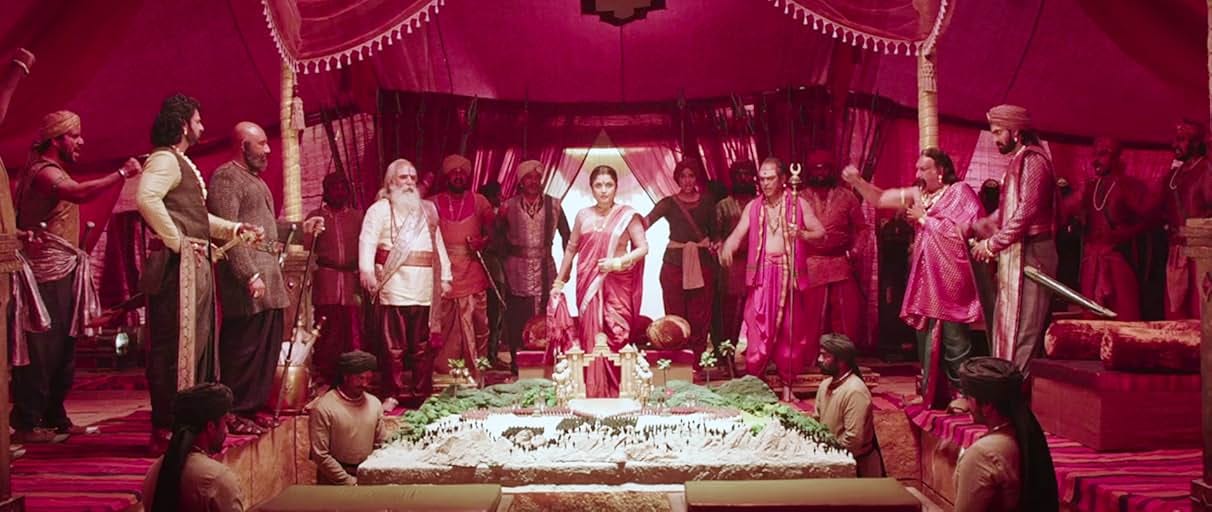
THE STORY OF SCOPE
The window is the window.
That is, the film does a lot of things but the best place to start thinking about them is through its use of scope, and how fully this illustrates how poorly and ineffectively scope is used in most modern western films.
(I have spoken about this before and I got the general concept from Moviewise but I think the idea is a good one. )
Widescreen, or Scope, got big in the 50s and was associated with high-status very-epic cinema. Since then, directors often go back to Scope for the aura of high prestige and epic-ness it brings, but they don't actually use it well.
Partly - there are certain things Scope does well; big flat deserts like Dune or Laurence of Arabia, huge Feudal, Dynastic or Family Dramas where characters can be spread all across the wide screen like jam. But for a lot of 'indoor' movies, or bleak movies, you are really not getting much out of it except some nice 'painterly' direction. The directors of 'The King' and 'Outlaw King' both did a lot of work to try to fill their Scope shots with stuff, but it was rarely story-relevant stuff.
Secondly - modern films will be shown over their lives in a variety of formats and the directors know this, so when they shoot Scope they put all the actually-useful story information right in the middle of the screen in a square box about the dimensions of a television - the rest is not really used - I mean by 'used' in that - nothing you see in those wings of the image will matter to the story, which happens only in the box. Now you have 'dead scope'.
That’s how most 'widescreen' films work now and Baahubali 1 and 2, are notable for how much they don't do any of that. Both films go to extraordinary lengths in storytelling, visuals and direction to not only fill that super wide screen with stuff but, and this is much more crucial, to have the story itself move through and across the screen in a huge variety of ways
The invention and creativity dedicated to this is really the best thing about Baahubali in terms of art and looking at ways this is done opens up one particular window on these very gigantic and packed movies.
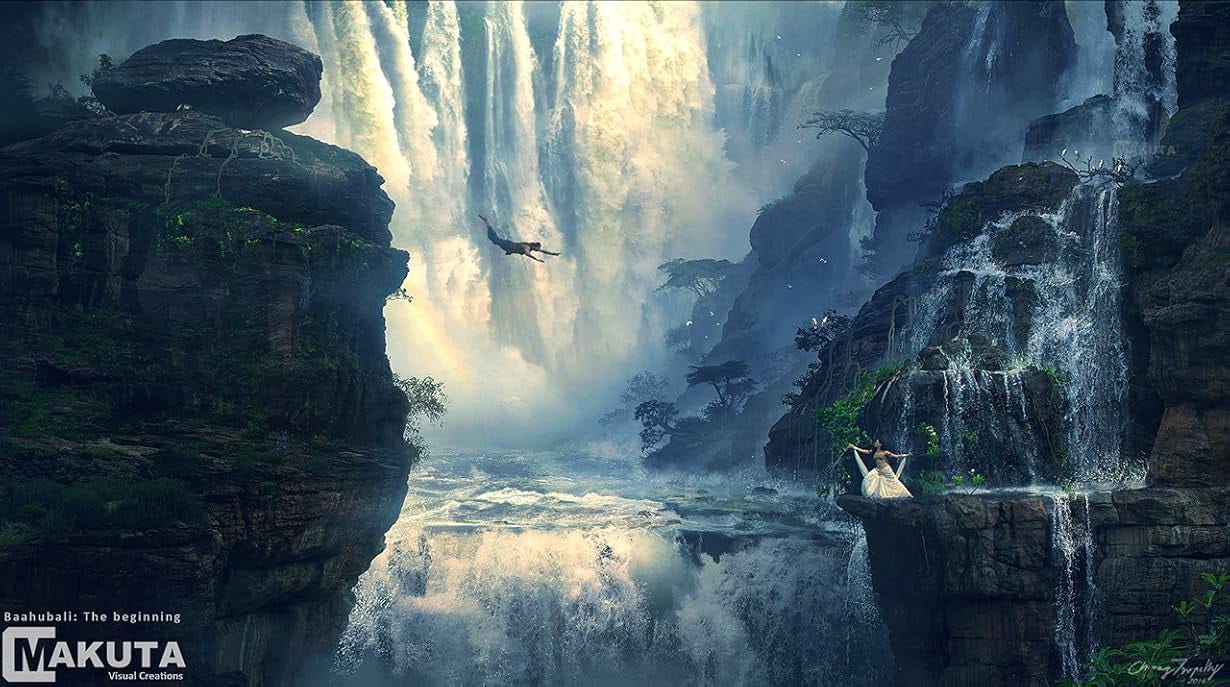
> Landscapes
An entry-level problem but one attacked with gusto here. This mythic India is rammed with vistas and situations, but more important is how people move through, across and round them. The film is probably never better than in the first act of the first film where Baahubali, growing to manhood at the base of an unclimbable waterfall, becomes obsessed with climbing it, trying again and again and again, with more and more daring, strength and creativity. The waterfall is the story in this first part and is captured in probably an hundred ways.
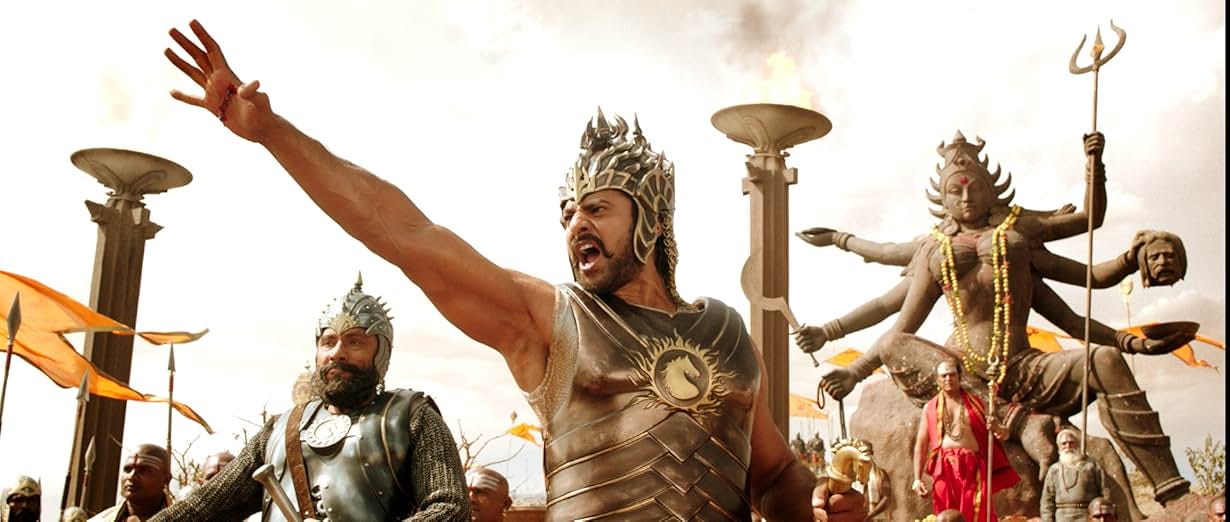
> Gangs of Dudes
We got Houses, we got families, we got feudal layers of authority and display. Turn this up to eleven in terms of size, WIDTH, numbers and colour. One reason it might be impossible for Hollywood to make 'true' widescreen technicolour movies now, is that it probably can't afford that number of extras for that number of scenes. Well Baahubali can afford them. AND can add CGI on top.
But most importantly is the way the film manages to weave story-energy and lines of narrative through and around these gigantic crowds. People leap, scheme, wave, gesture (this is a BIG gesture movie), slink, stride, promenade, fight, love, kiss, dominate and submit through and across these very packed and very wide screens jammed with information.
(The LEAPING, for instance, is one way this very theatrical and heightened film incorporates its operatic language of movement into it storytelling. Baahubali, father and son, will NEVER miss an opportunity to Catch Air. Those guys are going to LEAP, leaping across screens, down into crowds, up onto elephants and statues, through each other, at each other.. LEAPING. You couldn't do it in a normal film.)
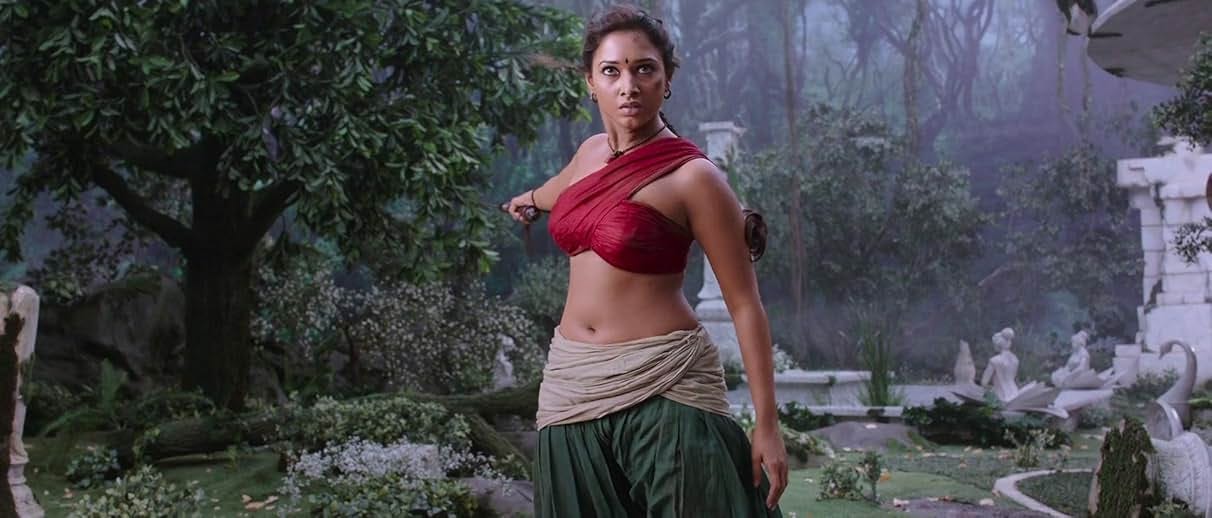
> Dancing
The romantic dance scenes, while ridiculous, are precise in their transmission of emotional exchange and the translation of the stages of a relationship and the deepening complexity between characters into almost purely action and visual aspects. (Though the crazy dance scene in Baahubali; The Beginning is a bit better at this, the romance scene in the second part is a little more purely visual and a little more ridiculous, however, that second romance does have an whole act of the film to do its work.)
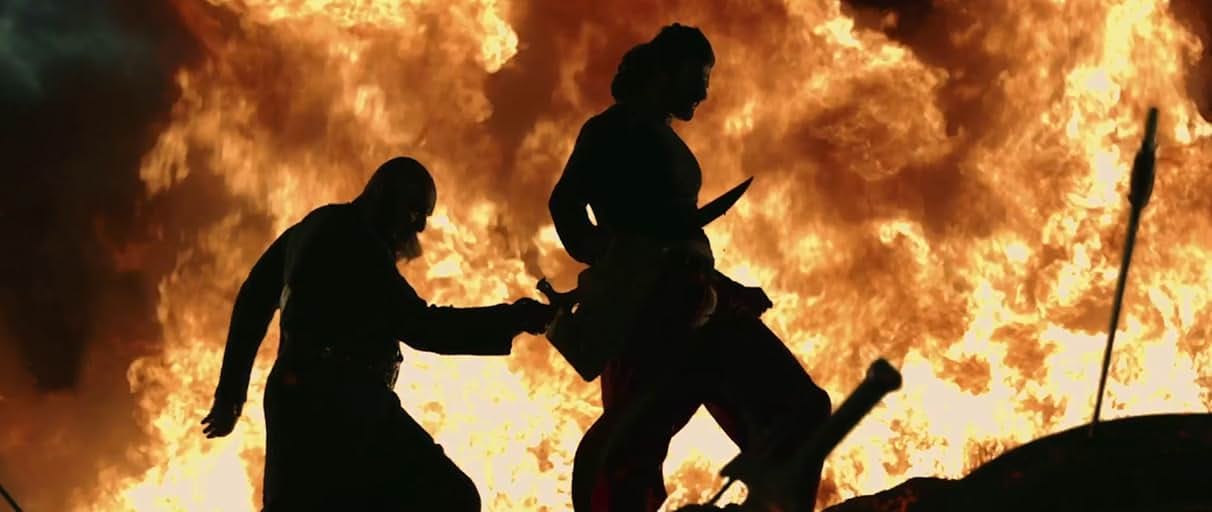
> Complex movements through the lateral
This is amongst the most important and the most difficult to explain without actually showing the film as these things don't show up in stills. What you can see in the stills is more the 'emblematic' moments, (of which there are a LOT), what I am talking about here are interesting and novel movements bodily movements across and through the axis of the frame that are also, and this is most important, story-telling elements.
The films integrate complex layered cross-lateral movement , and the story-telling elements being correct and appropriate for the film for the story at the moment of 'telling'. Its very operatic, even mythic, but it has to be to actually use Scope to tell the story.
The emotional language of the film; florid, theatrical, for western eyes somewhat childlike, lively, fun, expressive, declarative, synthesises with the language of actions and the visual capture of them.
If this were a less emotive and ridiculous film, there would be a lot less, physically, to show on screen. The access to a space indifferent to western cringe opens up a huge storehouse of invention in storytelling and action. If it wasn't exactly this film, from this culture, then its language of gesture, emotion, its storehouse of folkloric and mythic storytelling elements, would be less capacious, and would synthesise poorly.
The energy in this film feels like in some ways, a throwback to the colour, immensity and grandeur of 50s Hollywood, with the emblematic popular emotion of 20s and 30s Hollywood.
Both films are well worth watching, especially the first, and if you thought the 'flying barrel' scene was a bit too silly well that’s about as silly as it gets, and it’s near the end, and a guy gets set on fire right after.
23rd August - Requiem, Vampire Knight
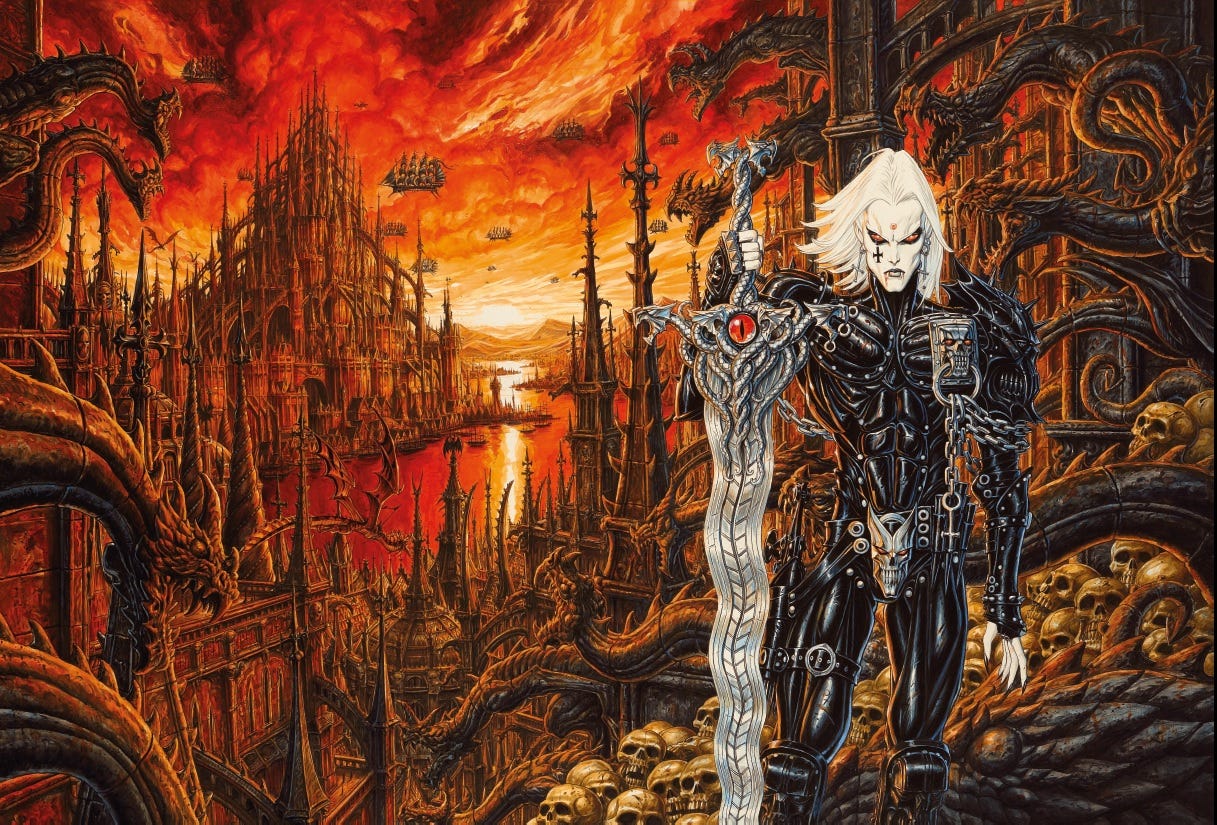
Get ready to cringe and cum at about the same time from the most fr*nch shit imaginable. Shameless, stupid, deranged. About as deep as a puddle of perfumed piss. Absolutely gorgeous though. This is like if a genius who is also an idiot teamed up with an idiot who is also a genius.
I feel like I read one of the albums for this a long time ago, picked it up in a second hand bookshop and was compelled, but also ashamed, I was slightly ashamed to be reading it and to be seen reading it. I am older now and sightly less ashamed and more appreciative of the insane baroque maximalism of the art.
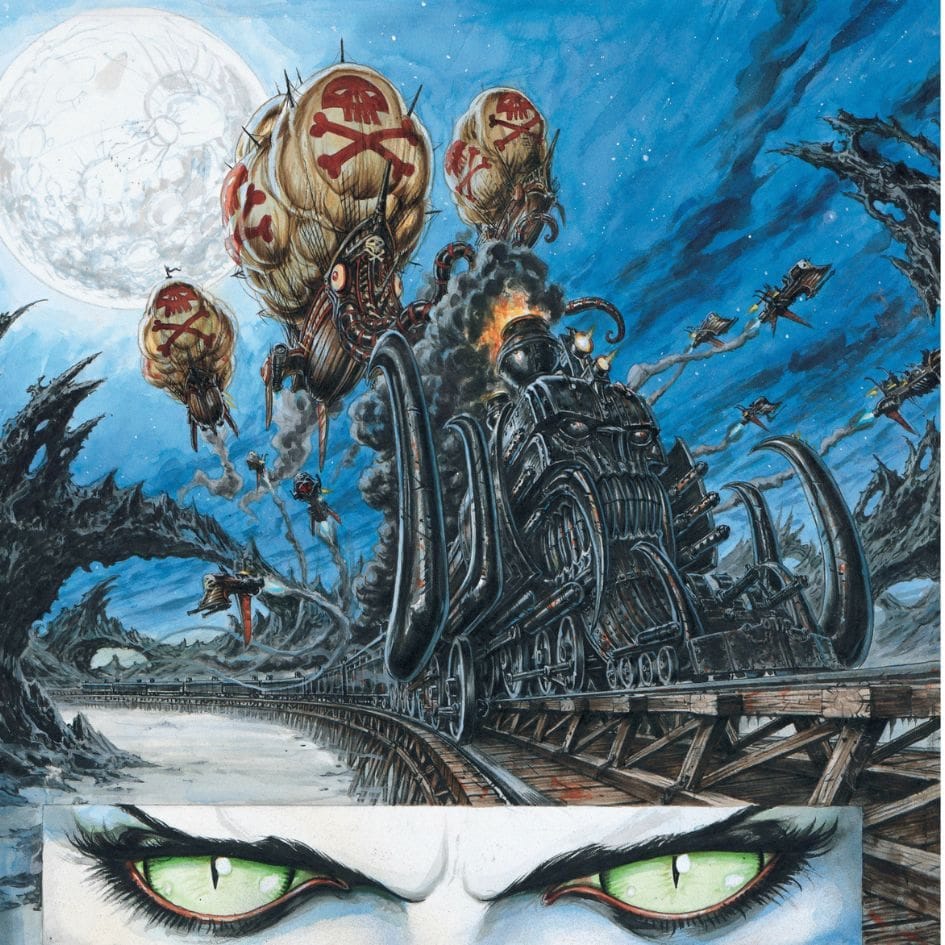
> Plot and Character Shifts
Each 'episode' took about a year to make. This likely has an effect on the wild shifts in character, plot and general direction between books - our main character goes through several alterations in background, personality, and the meaning behind his acts - this could be taken to be a literary affectation representing some deep intentional idea. It isn't, its Pat Mills changing his mind from year to year about what he wants the character to be and what he wants to write about. A lot doesn't make sense and bad ideas, or at least, less workable ideas, are abandoned between albums, to be replaced with louder ideas.
Look this is about a Nazi in love with a Jew, reincarnated in hell, which is a heavy metal album cover mixed with Dante and anything else Pat Mills could come up with, and the Nazi is reincarnated as a Vampire - making him extremely goth and cool, and joins the black leather Vampire gang lead by Dracula himself, BUT, the Jewish lady this Nazi was in love (or was he?), has ALSO been reincarnated as some kind of ghost and she is at war with Dracula.
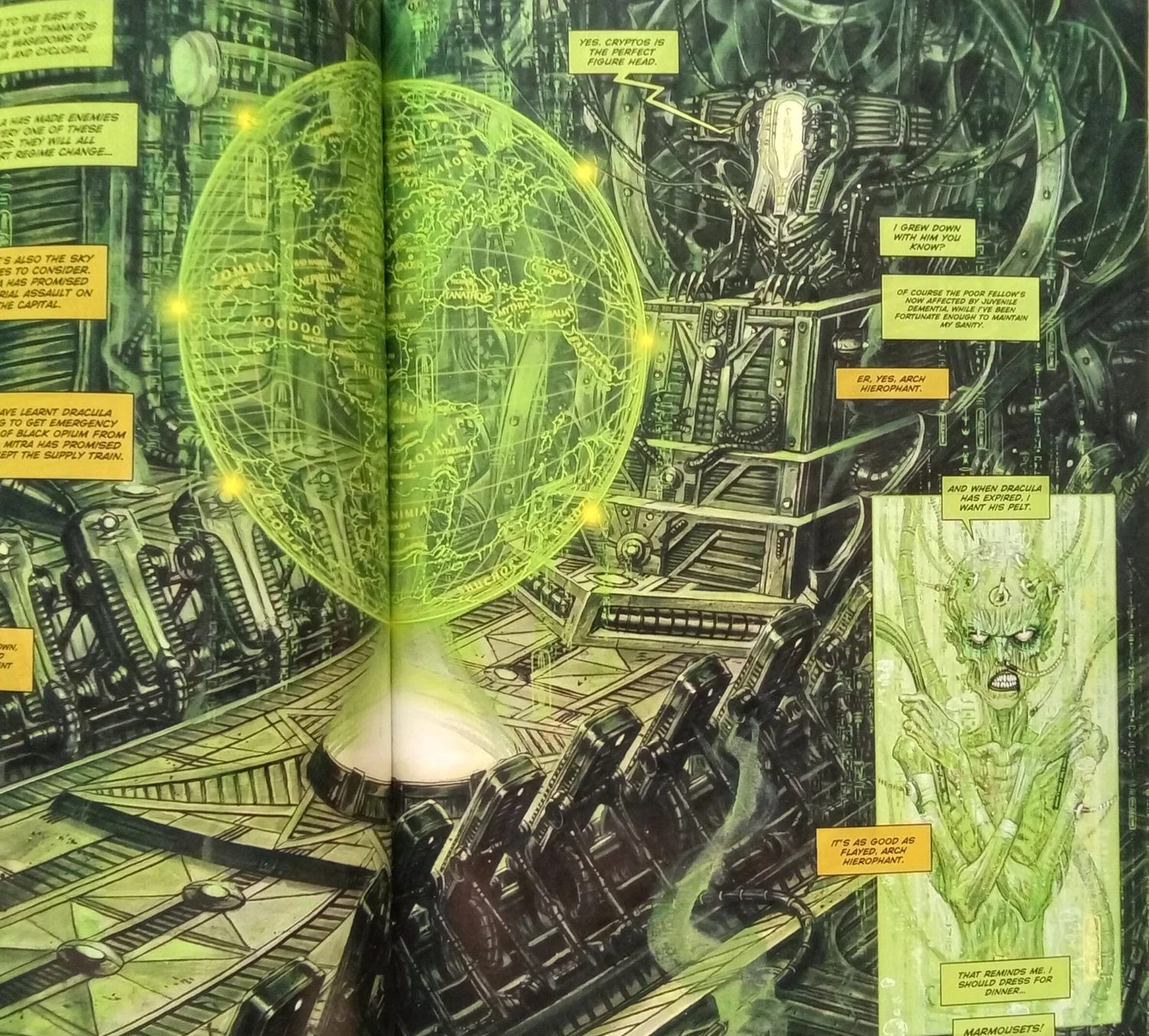
> Pat Mills
Pat Mills once criticised Alan Moore for not being original. Which is actually fair, Moore was highly modernist and almost all of his great works are re-interpretations, and usually darkenings, of things others invented first - he is original in storytelling but less so in concept.
Moore is intelligent though, which means he wins, because his comics are better.
Pat Mills, how can I put this? He has no taste. He actually canonically has really bad taste, and is the least literary of men. That has its own virtues though. Mills is more original than Moore, more Punk, more Pop, more Pulp. There is no noecortical hangover saying 'hold on now Pat Mills, don't you think that might be a little insensitive?'
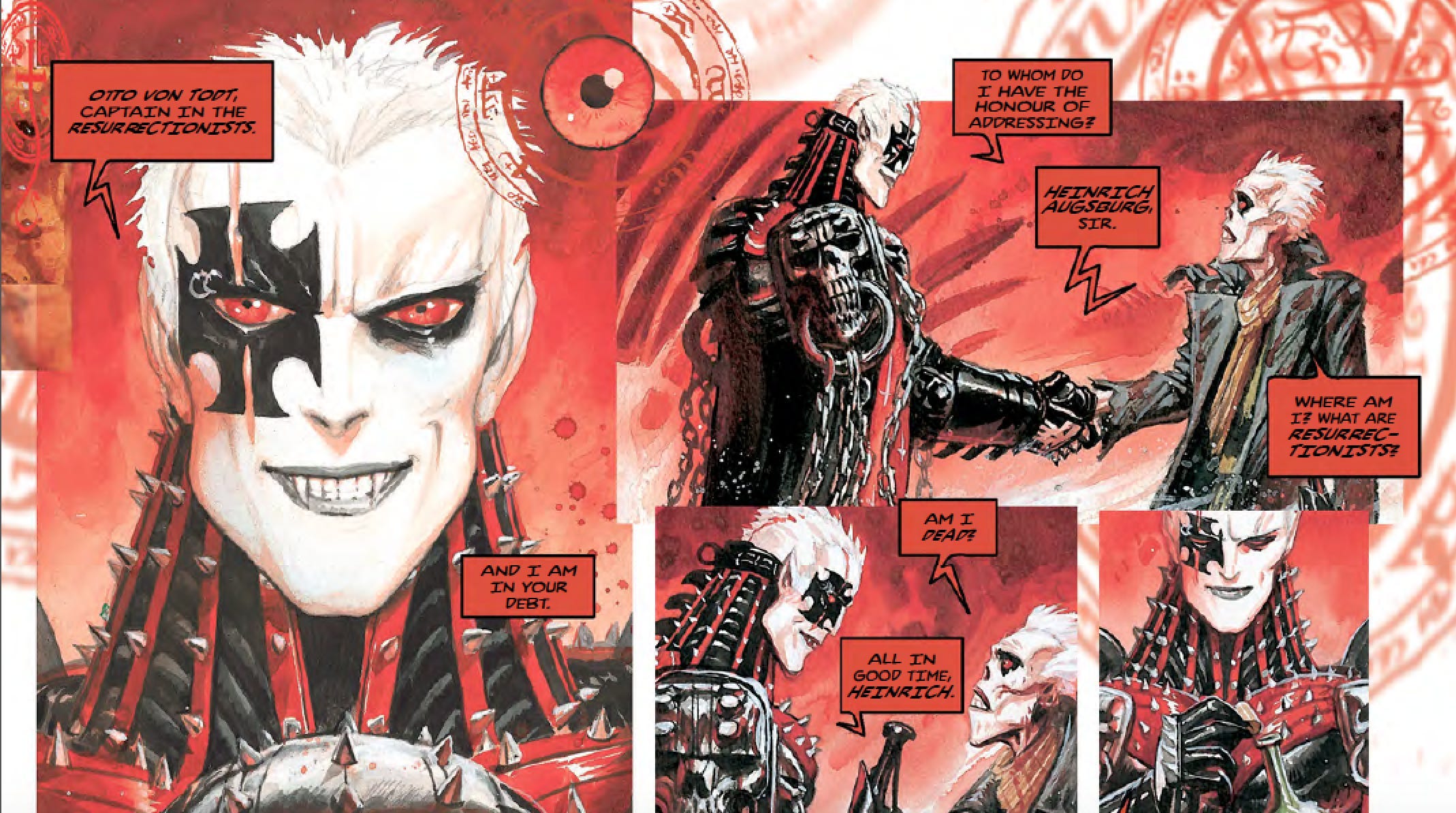
Such thoughts could not occur to one of true Vampiric Temperament.
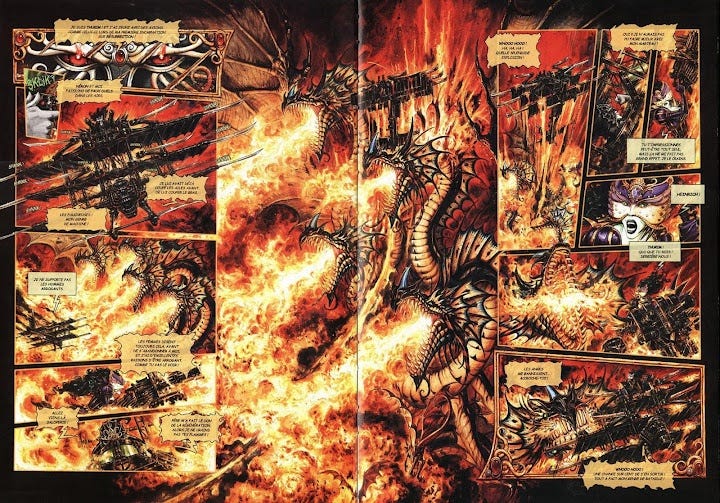
> Art
I would try to review the art but genuinely can't think of anything to say that can describe such bellowing and decadent gigantism. Play Wager at VOLUME.
I would call this Anglo-French Giallo, but even Giallo is usually a little more oblique and complex with it storytelling.
I don't know, a bajillion sexy bleeding stars of David out of five? The stars are also carved onto the face of a sexy vampire and the vampire is into it. This story is not yet complete, there may be a second collection at some point, but then, this is not really for the kinds of people who worry about completing things.
26th August - Weird Fiction, an Anthology
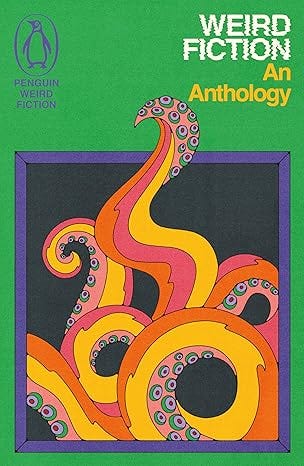
Pretty much the definition of a solid, dusty 'Three' pulled own from the shelf and hocked in the marketplace.
Is 'Weird Fiction' even a thing? According to this it could be 'Ghost Stories, but not quite', 'Science Fiction, but maybe not' or 'edgy Fantasy'.
The Masque of the Red Death by Edgar Allen Poe; Poe would have made a good interior designer. 4 decadence points.
The Monkeys Paw by W.W. Jacobs; A great story when it came out and still good even through 'The Simpsons' and 'The Body' Episode of Buffy the Vampire Slayer ate it up and shat it out. 3 out of ten for Mysterious Indian Influence (1 of 2 colonial majors in this collection).
'Oh whistle and I'll come to you my lad' by M.R. James; A good social capsule of its period. Has the second of two Colonial Service Majors (this one the actual hero of the story) "if you see it again just throw stones at it like a good Englishman'. Great setup. IT WAS CLOTHES.
'A Wicked Voice' by Vernon Lee; A fun time in sweaty Venice. Three points added for 'subversion of the true self & horror of living with that. Don't get malaria or trust Italian sounds.
'The Horror of the Heights' by Conan Doyle; a straight-up bonkers sci fi story about 'creatures of the upper air', add 10 points for being genuinely weird fiction, and ten more for the protagonist carefully writing everything down as it happens then throwing their record of events out of the plane.
'Kerfol' by Edith Wharton; ghost dogs. Excellent setup. Story was fine after that. A ghost story.
'Where Their Fire is not Quenched' by May Sinclair. Prize of the bunch. I knew nothing about this lady. Spiritual/psychological 'ghost' (sort of) story. Troubling. Genuinely 'weird' fiction.
'The Call of Chthulu' by H.P. Lovecraft. Systemisation of a great paracosm. plus 10 points for being genuinely 'weird' - (my semi-accidental researches uncovered a world-wide conspiracy which denatures all reality). Humanity wins in this one, great! Not that great a story otherwise. Plus five racism points for the mullatoes and half-breeds.
'Crouching at the Door' by D.K. Broster. Plus fifty decadence points for its abominable protagonist. A very, very very silly story. 'Weird' because it can hardly be anything else. Evil Caterpillar!
Verdict; read more May Sinclair.
27th August - Fantastic Four, the Night of Doom
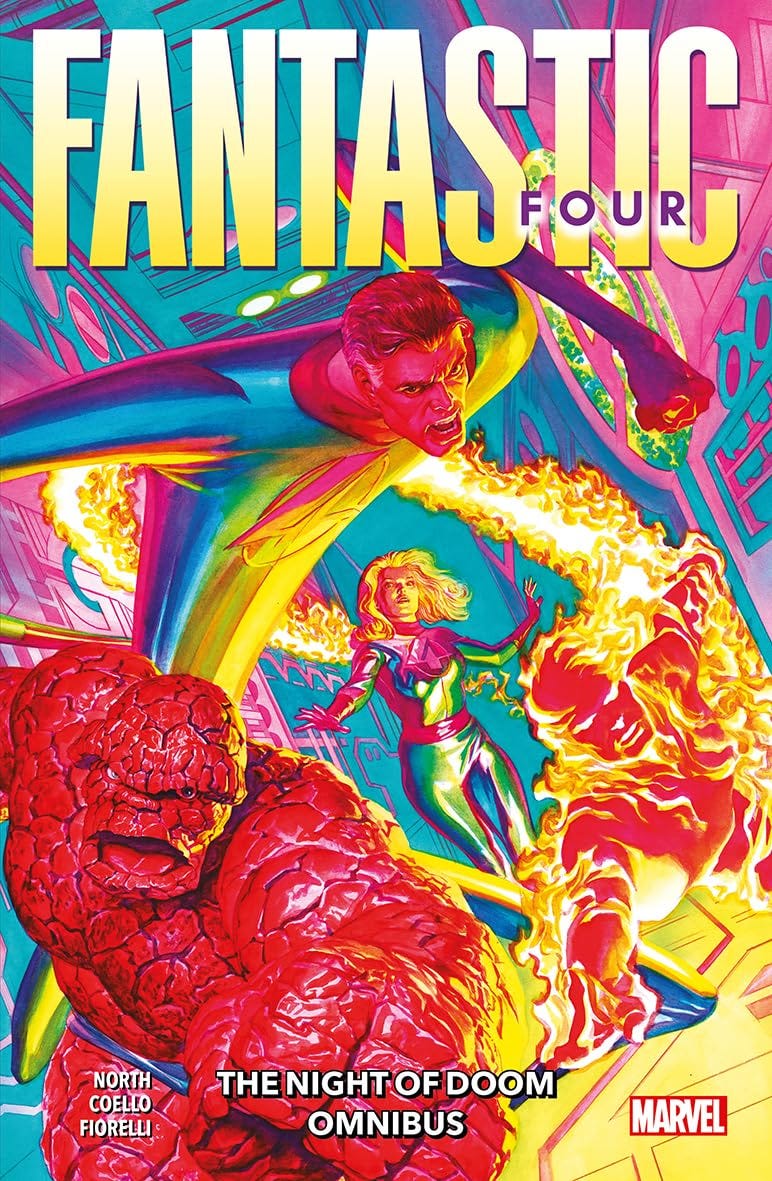
The art is ugly and that lets the book down.
Maybe I have been slightly spoiled recently by only reading quite-successful Manga series that have already been applauded, or poncy indy comics which might be horrifically flawed in many ways but which are often art-driven. I had forgotten just how unutterably mid much of Marvel/DC superhero art and visual storytelling is.
It’s not really bad, it’s just utterly and totally average in every way, which goes for the use of staging, storytelling flow, panel selection, panel placement, it’s all very standard 'Marvel Punch'.
Ryan Norths stories are quite a bit better than average and I think that’s part of the reason I am annoyed by the lack of control, innovation and perception in the visual storytelling. If this was better, we might be looking at something getting on the par with Moore's 'Swamp Thing'; a lovely little gallery of well-told episodic stories, and I think North is deliberately approaching the story-telling more in a 'Swamp Thing' style, with clear coherent issue-and-concept based stories which tessellate into something bigger, instead of shitty (for comics), U.S. Television-rhythm storytelling. But I think this will simply become an above-average normal comic and not a generational re-definition.
I was thinking these feel like little 'Twilight Zone' episodes and apparently that’s exactly what North was aiming for, so well done there. Time Loops, Robot Villages, Memory Prisons, altered Chirality, Cognitohazards, Time Travel, another Cognitohazard and Unionising shop workers.
These are Twilight-zone-esque in that they are neatly integrated with the small human stories and personal conflicts of the characters involved, and when this is not the case, the solutions and adventures which result are telling of character.
Judging from this North seems to vibe with Dr Doom almost as much as the FF. Two of the best stories in this collection are essentially about him, in one Reed and Sue encounter a town of Doombots who do not realise they are machines, all driven to continue a simulation based around the memory of one old woman who was once kind to Victor von Doom, in another Dooms command over time travel drives him into self-sabotage as, facing a problem he cannot solve, even with command over time, he is driven to become his own secret enemy; the only way he can psychologically accept abandoning an impossible challenge. The concept that this might happen to Dr Doom on a semi-regular basis and that his own refusal to accept the impossible, or his own limitations, has turned him into a kind of inadvertent causal hazard to himself, is left up in the air.
Fuck you SCP Foundation, the Marvel Universe did memory-altering cognitohazards first, and they were giant tree monsters from space! And you can win, (partially), by punching them! It was mildly amusing to see a very SCP-coded cognito-horror theme resolve into basically a tree monster, because Marvel actually introduced one with exactly this power back in the day.
This is a warm, nice comic, which is part of its virtue, especially when it comes to exploring the relationships between its main cast, but also means some of its concepts are carefully not explored, which is probably an acceptable 'failure' for a Marvel comic. (Though Witch Hat Atelier managed to continually be a 'nice' manga while also building its reality into a complex moral nightmare.)
If your calibration is standard marvel comics then this is probably exceptional, I would recommend. If you are calibrated to what I would consider an average level of 'good', then it’s quite good; consider getting it out of the Library when you can.
Four stars?
29th August - Eddington
Are there films where Joaquin Phoenix makes good decisions? I can't think of any.
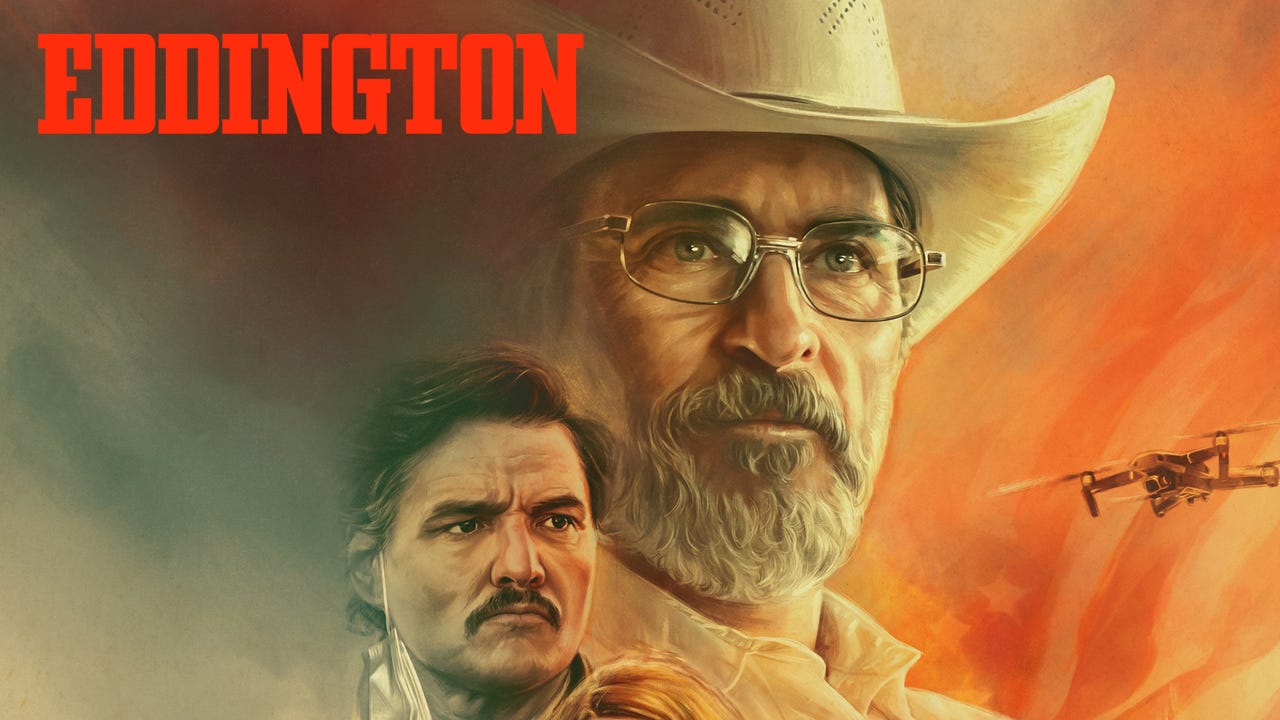
Mild spoilers.
This evolves into three different movies. The first is the best, the rest are ok.
We start off with a small town COVID-era social drama, then evolve into a dark slightly Cohen-brothers murder-mystery, then finally into a 70's style dreamscape implosion conspiracy movie.
Most of the emotional and moral weight to the movie comes from the first half, where we follow Phoenixes anti-mask Sherriff around the small town of Eddington and get involved in his conflict with Pedro Pascals mayor. Everyone in this part of the story feels much more human and sympathetic, the social and moral conflicts are so neatly observed and so integrated into a complex evolving social dynamic that at times I felt so awkward that I had to look away from the screen. Many of the scenes triggered memories from the start of COVID about mask-culture, public masking conflicts etc. This part actually does feel like a 'tragedy' as tangles of power, fear, resentment and (so-far mild), hypocrisy draw everyone into little whirlpools of personal horror.
Sometimes I have to look away from a scene because the 'film' is cringe, (Superman explaining what the film is about), but sometimes I have to look away because what’s being expressed through the story is agonising. This doesn't necessarily mean a film is good in all its parts but it did affect me.
First part with a lot of wounded, frightened, flawed, mildly shady but rarely evil characters grinding against each other like gryndlestones, is very good. Then Phoenix's character darkens and we get a creepy murder, then reality itself implodes.
BIG SPOILERS
All in all I am not sure this film has 'politics' oddly. It does make fun of some BLM 2020's lunacy, but for a film which (sometimes) foigns the addiction of white liberals to sacral black victims, AND the largely-white conspiracy-meta belief in crisis actors and staged disasters, its odd that this movie ends up with both a sacral black victim, AND real but *right wing* crisis actors. If this film had serious politics they would be pretty nutty but probably it doesn't, just treat it as a dark dream.
Jared Leto would have been great in this as the extremely-creepy cult leader, he is a pussy for not taking that role, I bet it was offered.
Best of the Month?

Probably watching the sun go down on Thurstaston beach. Great direction, nice use of complex tones and shifting light. Sound mixing on the waterfowl was rough though…