Get Moving
this mass of fears has dared to battle with a God

“Headstrong mortal, proud of that short dream which you call a lifetime, enamoured of your weaknesses and your miserable sins, and fascinated by death. Against such obstinacy even the gods have no power.”
…
Including reviews of;
The Wages of Fear, 1953, directed by Henri-Georges Clouzot.
Ulysses, 1954, directed by Mario Camerini.
Sorcerer, 1977, directed by William Friedkin.
Convoy, 1978, directed by Sam Peckinpah
The Flash, 2023, directed by Andy Muschietti, and,
The Running Man, 2025, directed by Edgar Wright
There is a man, and the man must move! Through time and space he thunders, by wheel, ship and racing feet. Where is he going?
“The purpose of the convoy is to keep on moving.”
The ‘Convoy’ and the ‘Running Man’, are defiant twins, both racing against ‘the power’. Ulysses has agonised a God, going home he loses men with every stop. He meets the shades of the dead, where he could easily have run into the characters of Friedkins ‘Sorcerer’ living through their own kind of Purgatory, I can see Roy Scheider stumbling from the mist to lick blood from the trough at Ulysses feet. Thus ‘Ulysses’ and ‘Sorcerer’ are also twins, or at least, connected through their world of visions and death, and a deep desire to go home.
‘The Wages of Fear’ and ‘Running Man’ are explicitly concerned with corporate governance (of course ‘Sorcerer’ is too, but the corporation of Sorcerer proceeds through visions and symbols while in both ‘Running Man’ and ‘Wages’, we get suits in offices talking, planning, desiring; they need the man to move and will pay to see it done. They may need the man to die, and they can pay for that too.)
Where is ‘The Flash’? Also a cursed myth, a tale concerned with inevitable death. The death of a mother, and a hero willing to shatter time and create Nemesis in a quest to free his father from durance vile, and return his mother from the world of shades.
The ‘Flash’ is probably the most insane film on this list, is mad, bad, and indifferent to observe except in a forensic way, in which case it is utterly fascinating, though its core story is truly Greek and, impressively, it is the only film which seems literally to have been cursed by its magical lead - the crazed spiral of Ezra Miller dragging both this, and the Snyderverse, closer to the cliff edge.
Wonderfully, Wages of Fear and Ulysses are nearly year-mates, - two wildly different dreams, while ‘Sorcerer’ is just the Bourgeois version of ‘Convoy’, again, separated by a single year.
Running Man was being written in the age of decadence that made the big truck movie craze, published in 1982, filmed first in 1987 and again in 2025, overleaping a whole age of Superhero movies which was falling slow, like Rome, with The Flash at its mad trailing edge.
Lets begin at the beginning, with the French…
Post-War Europe
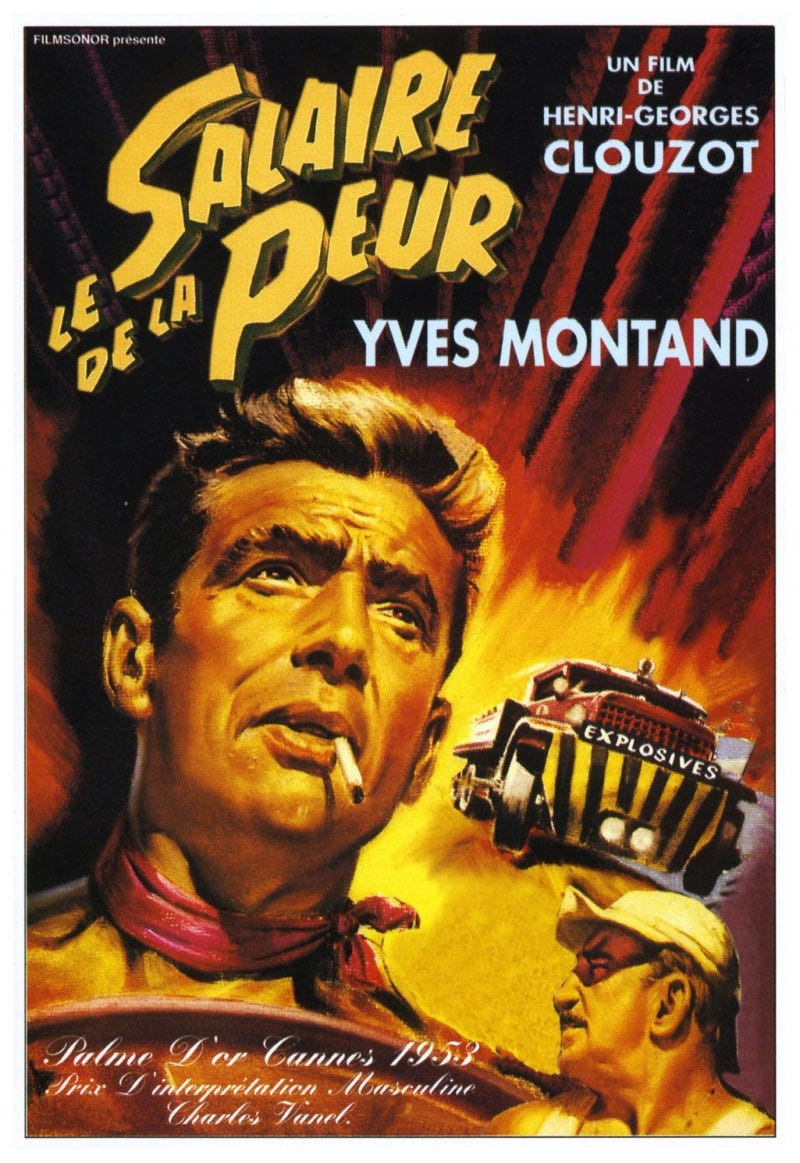
1953 The Wages of Fear
A deadbeat town somewhere in South America (South of France stands-in). An American oil company. Four disparate shoe-leather whites clinging to the wet dead end of the old colonial scheme. There is no way out of the town! No train and the plane ticket costs cash no-one can get. This is all carefully explained while they idle out the time.
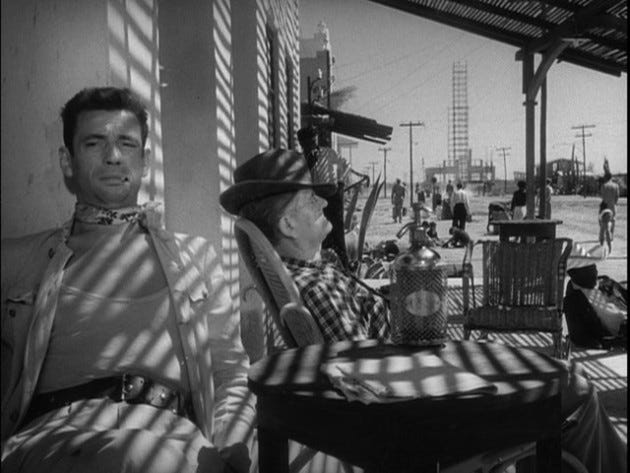
Much more than Friedkins ‘Sorcerer’, this is a social movie, a post-war Euro movie and its genuinely surprising how much of this film is concerned with male friendship and male sociality. Yves Montand plays the Corsican everyman ‘Mario’. Friends with perhaps the most Italian Italian man ever, Folo Lulli’s ‘Luigi’, Mario is seduced, not by sex, which he can get whenever (French), but by a man who knows the same streets of Paris, the shady flick-knife aging gangster ‘Jo’, played by Charles Vanel. Jo is a piece of shit yet Mario insists on hanging out with him. We’ve been this guy. (Its bizarre that this film has a Luigi who looks like Nintendo’s Mario AND a guy called Mario who looks a little like Luigi? Was Myamoto-san watching this as a kid?).
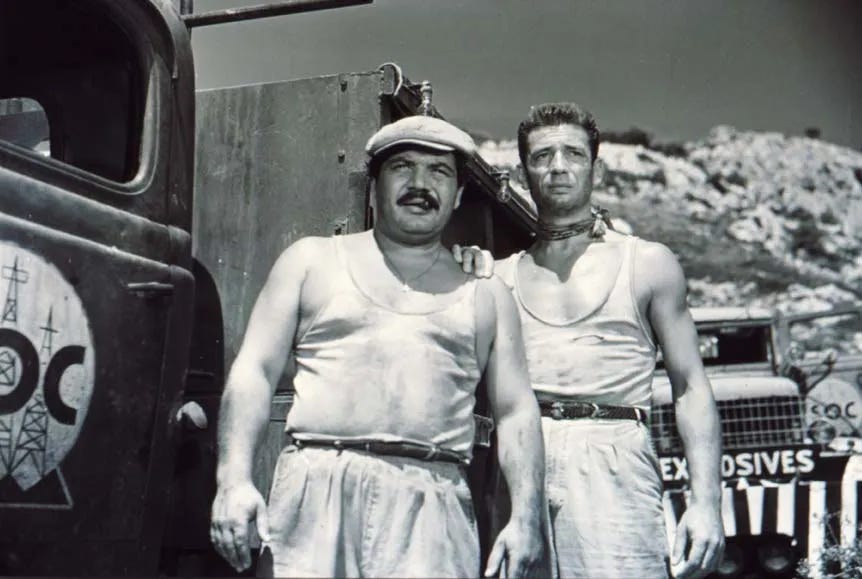
An oil fire. Utterly inflammable. A curse from Hades own hand! Except; the nitro-glycerine. Wrap it round the burning pillar like a wedding ring for god, and ‘poof’; out like a lamp.
The deadly Nitro is too far away. Long mad roads, and this stuff goes off if you breath on it. Someone needs to get it, and they have to be expendable, careful and fast. Luckily, there are the flotsam of the town; a testing sequence lets them prove their skills and its curious how nasty things get even then. The unwanted uncle-tickle of colonial race politics envelops like a smell. This film is either much more viscerally racist and/or just about more racist people, than Friedkins. There is lots of black people being artistically poor in ways I found broadly uncomfortable. Yes I do have ‘woke’ moments. The petty hierarchies of relative whiteness are unstated but observed, in a sense Mario (Corsican, so French, but not really), is ‘trading up’, by spending time with ‘Jo’ (French and Metropole, but not really).
Other drivers bullied, tricked and mocked away, two trucks remain; the shady duo Mario and Jo, and bold rotund Luigi, along with Bimba, cold mysterious nazi-loathing German with a nightmare past. Engines will be revved, cigarettes smoked and challenges encountered in this slow Odyssey
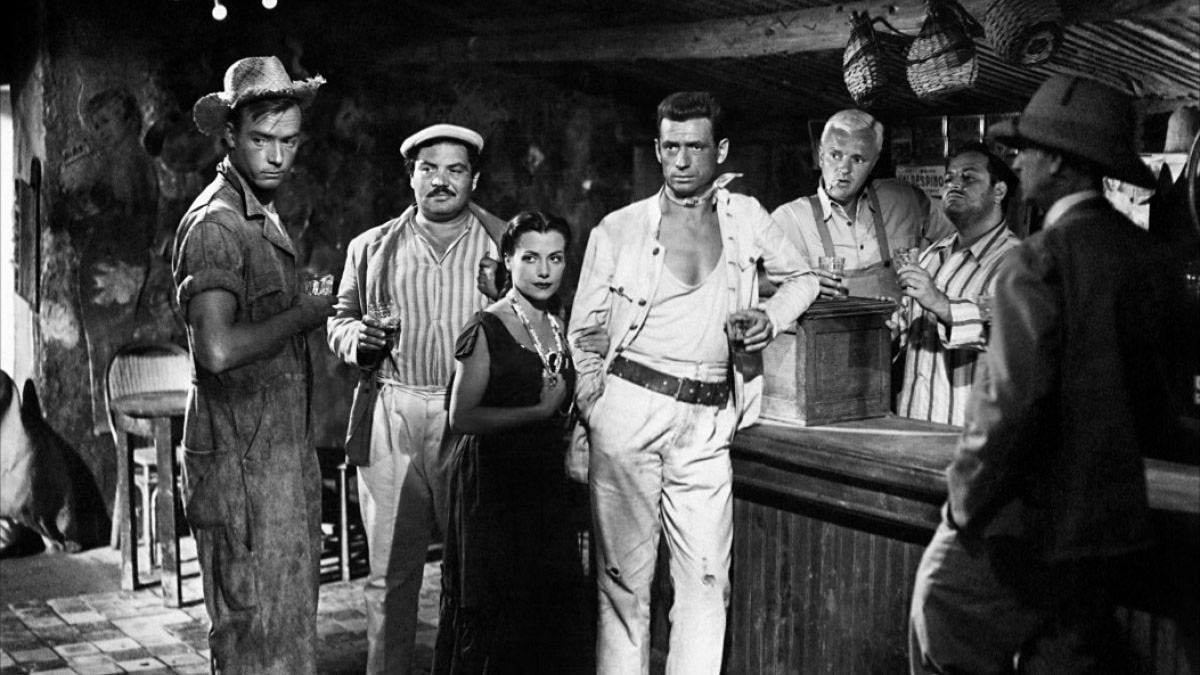
The conceit of ‘You have to do this quickly, but the package will explode if you do’, is so utterly perfect for drama I’m surprised they haven’t utilised it more. Yet, in both this and ‘Sorcerer’, we only get the death-drive half-way through. These are both films ‘about things’. In the case of ‘Wages’ its about a dissolute Corsican abandoning his Italian pal because a nasty piece of work from home showed up. Despite not visibly committing any crimes on-screen, like all of Friedkins main players, Jo is such a tangibly unpleasant piece of work that the only satisfaction I had in the last act was watching him fall apart, run away and get punched.
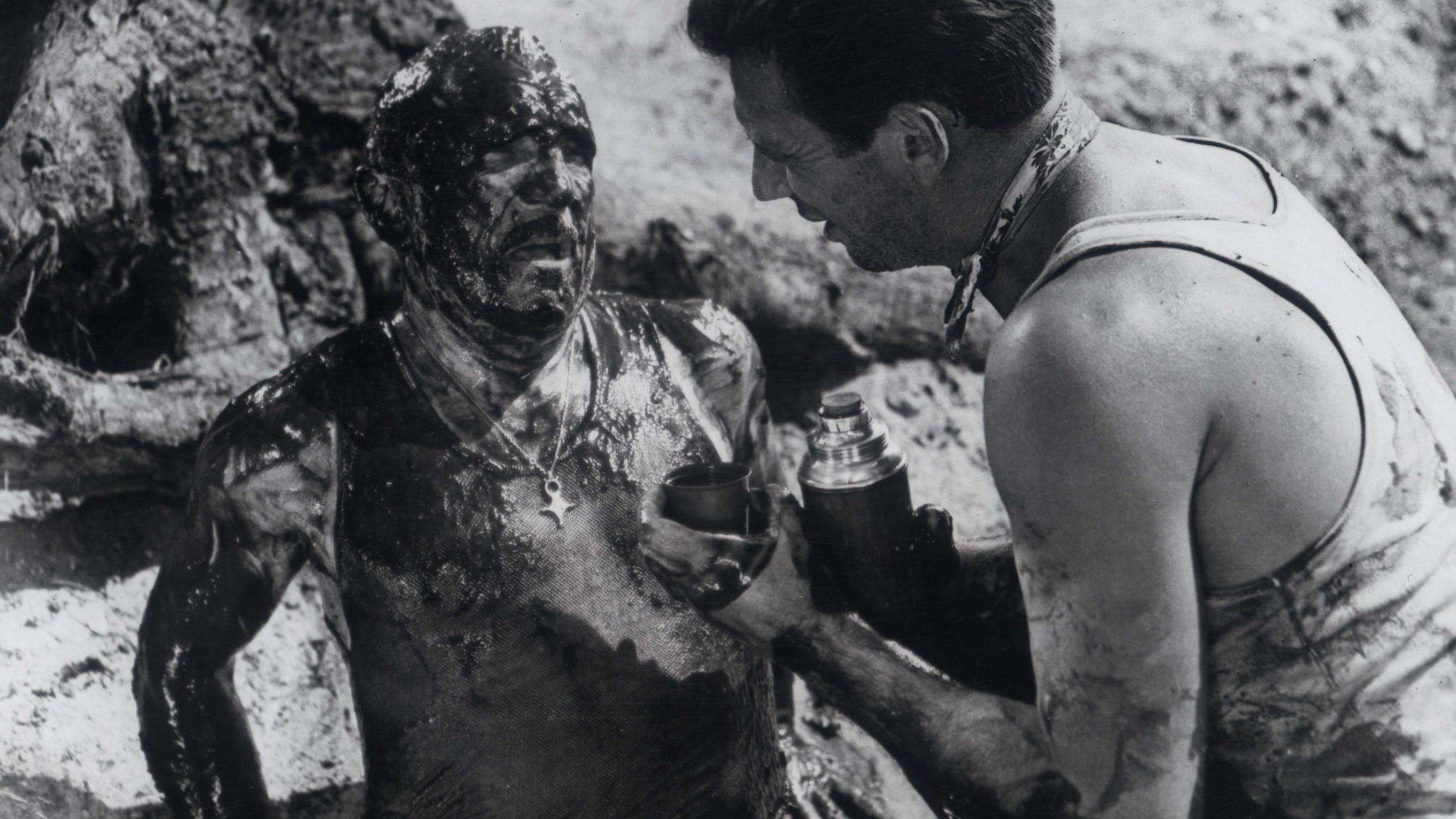
The ritual spell-summoning nitro scene is more beautifully terrifying in ‘Sorcerer’, but the moment when one truck explodes is stranger and more unnerving in ‘Wages’; a blinding, silent flash of light, the shockwave hits before the sound - tobacco leaves from an unfolded cigarette - then, nothing but a column of burning fire three miles ahead, and as remains, a hemispheric pit in sandy earth, the truck has been vapourised. Oil from a broken pipeline fills the earth, making a black pool of adhesive, clinging, flammable death through which the survivors must crawl.
The end is silly. Even a Corsican wouldn’t behave that foolishly. Yet, as Barry Allen and Ezra Miller will come to learn, Fate is Inexorable, this was never a story about surviving. No-one survives this Odessey, in every version every traveller dies, and yet they fight for life, and we see how they live. We never see what kills the jovial Italian, but ultimately he and the cold, mad German were more human, they never betray each other. Everything is mythic when you are driving a truck full of nitro-glycerine. Picking your nose is worth a chapter. We should add explosives to the Odessey. Hopefully Nolan is on this one, but trailers of his grim, over-clever, grey North Sea abomination impelled me to seek out almost any other Odessey;
1954 - Ulysses
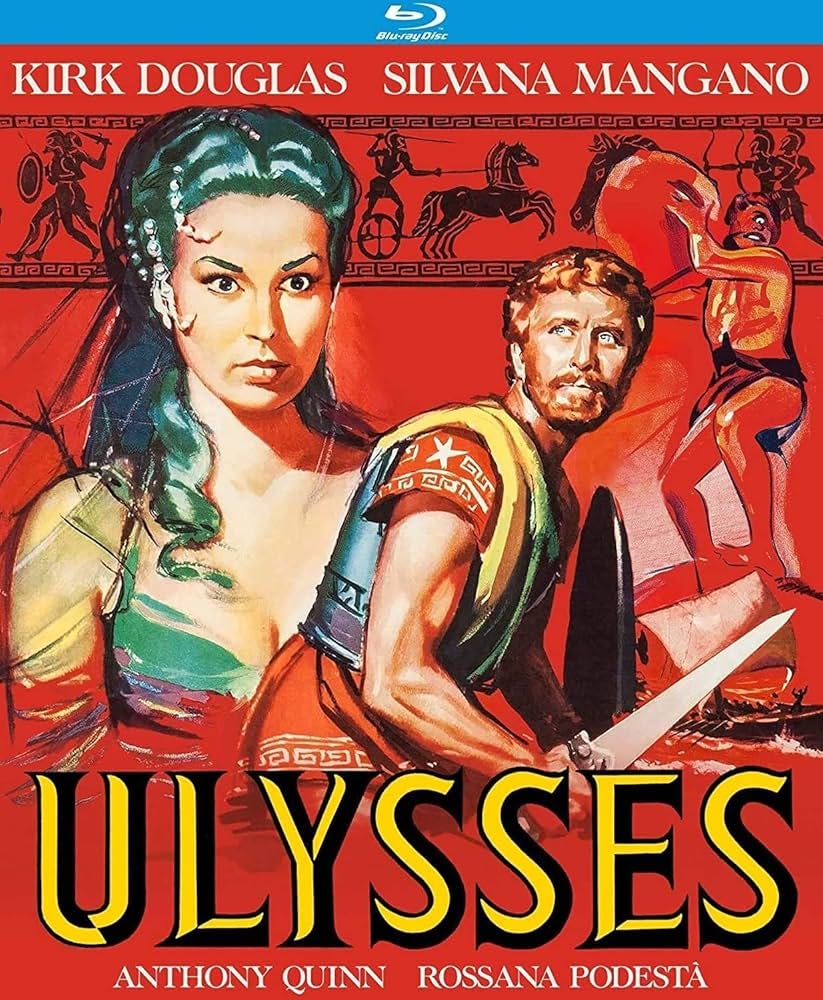
(I watched this possibly illegally via a very low-res Youtube video)
From a French film about a Corsican in South America to an Italian Film about a Greek, played by an American, in the Mediterranean. It’s a Dino De Laurentiis production and that means LIFE and COLOUR! Both of these we get! Kirk Douglas IS Ulysses! He spikes every scene with an electric jolt of heroic energy. He really does encompass all the positive and negative qualities of Ulysses, his cleverness, foolishness, arrogance, incredible charisma, charm and wild drive. This may be his best performance! He’s great. For a man with very high hips, he sure likes fighting in his pants. I have seen his bronze, oblong body tangle many times upon the sand.
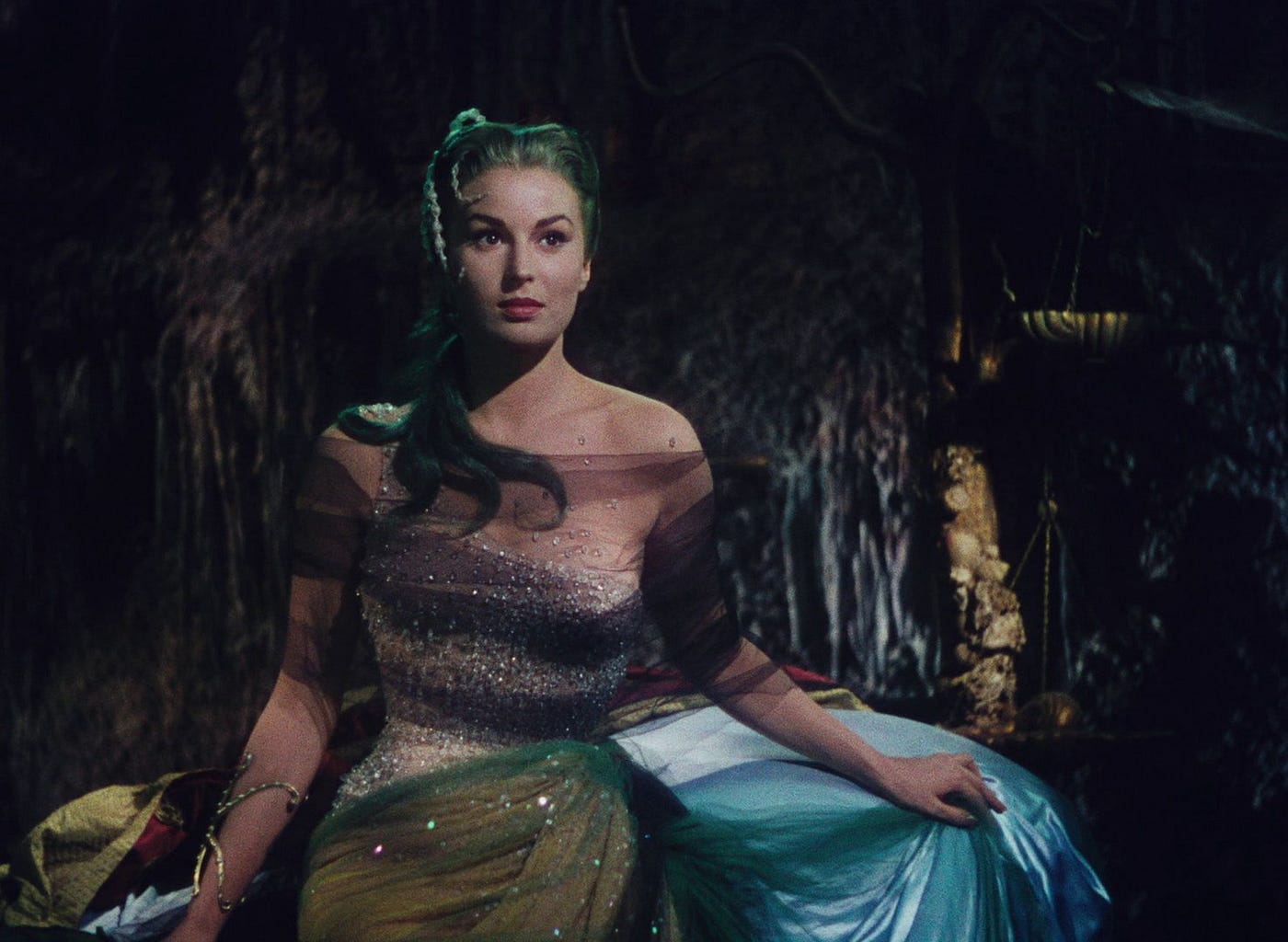
Silvana Mangano is magnetic in a dual role as Penelope and Circe. Utterly captivating. Of course the only thing stopping you going home to Silvana Mangano could be… sexy goth Silvana Mangano (plus the offer of immortality).
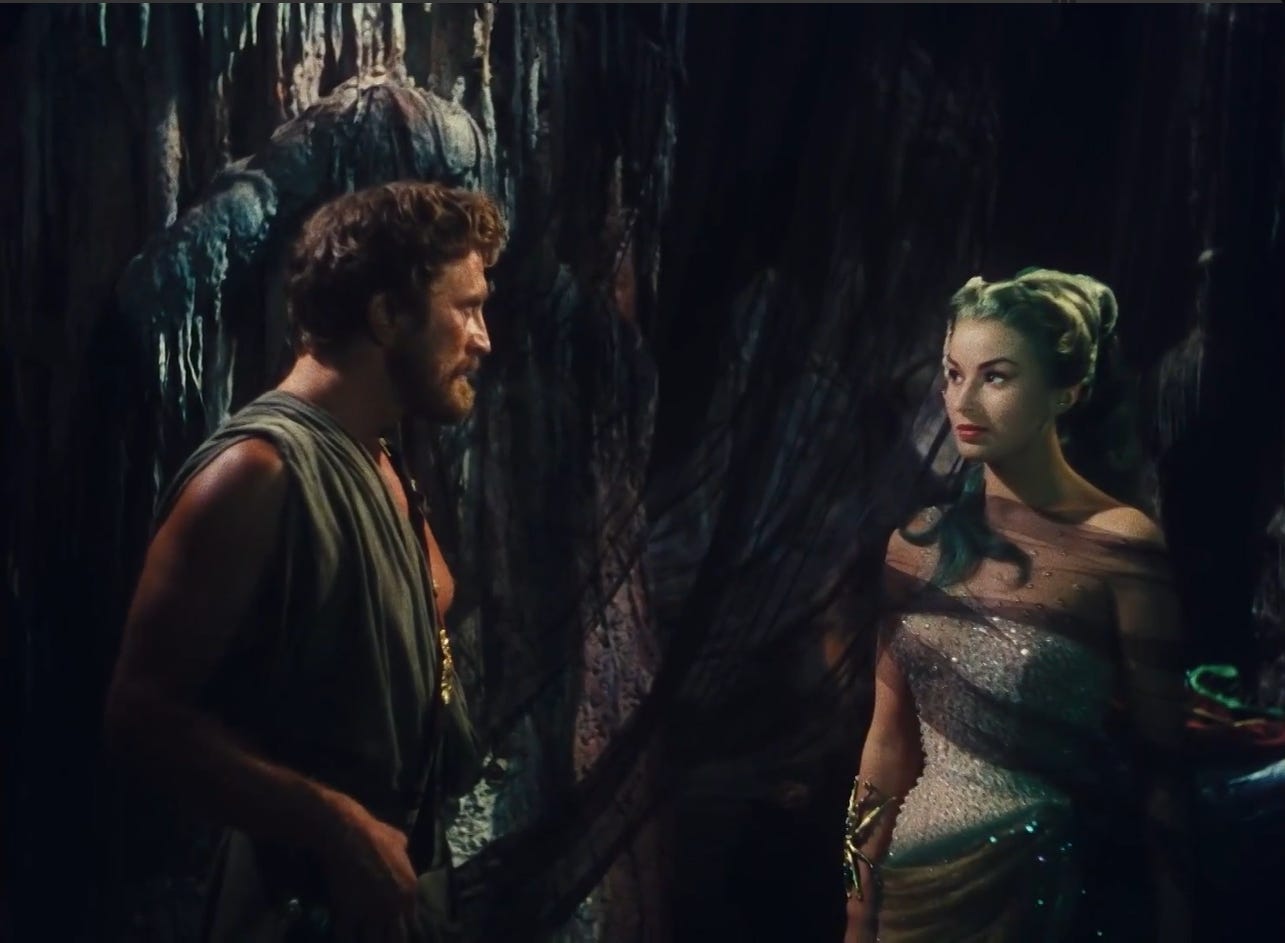
I would one day really love to see a cinematic projection of this movie because the scenes and sets in particular look absolutely gorgeous and the costuming is incredible; a wild combination of ancient Greek, bronze age Greek, ‘modern’ 1950’s and whatever they had in the cabinet. They even get Polyphemus’ eye to move! I wonder how they did that?
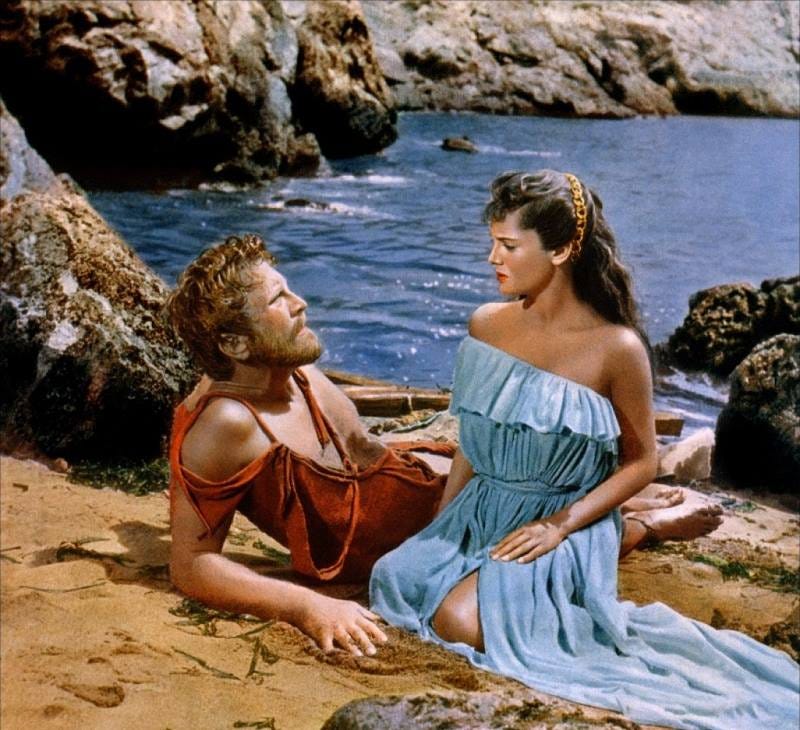
I want to see a real projection and, in an ideal fantasy world, I want to hear the original audio for the Italian actors because I don’t really care if the accents ‘spoil’ things - I feel like they were giving incredible performances (especially Silvana Mangano), but the dubbing chokes them off (this film also has some truly loony foley work) - maybe the Italian cut has the original voice lines by the Italian actors.
The scene in Circes cave where Circe tries to tempt Ulysses into accepting immortality, and the spirits of the dead come forth, some to aid her, some not, is one of the top ‘Odyssey’ scenes of all time (I mean in a meta sense). Here the basic conflict of every travelling man in every film in this post is laid out clear (writer Franco Brusati nails it);
Circe - This is my gift. The greatest gift that has ever been offered to a man.
Ulysses - No. There are greater gifts; to be born, and to die, and in-between to live like a man.
Circe - To live like a man? Filled with petty fears?
Ulysses - Only the fearful can know the value of courage.
Circe - And old age? That poor flesh will rot one day. And at the end, nothing but death. This is the terrible heritage of man.
Ulysses - I accept that inheritance. I no longer see myself falling in battle, or in the fury of a storm. It would take much less. A puff of cool air. A sudden chill one night. But even so, this vulnerable mass of fears has dared to battle with a god, and has not yet been defeated. If it should be that one day men should speak of me, I hope they say with pride that I was one of them.
Circe - Their pride will not serve to warm you in the kingdom of darkness. I offer you centuries of light.
Ulysses -I do not think that it will sadden me too much to close my eyes, when the time comes.
Of all these men racing against death, only Kirk Douglas’ Ulysses really rises to the challenge, and he is mythic. True, if we go by plot, Barry Allen also does, but that film is a godamn insane mess.
Crisis of the West
1973 - The Running Man (book)
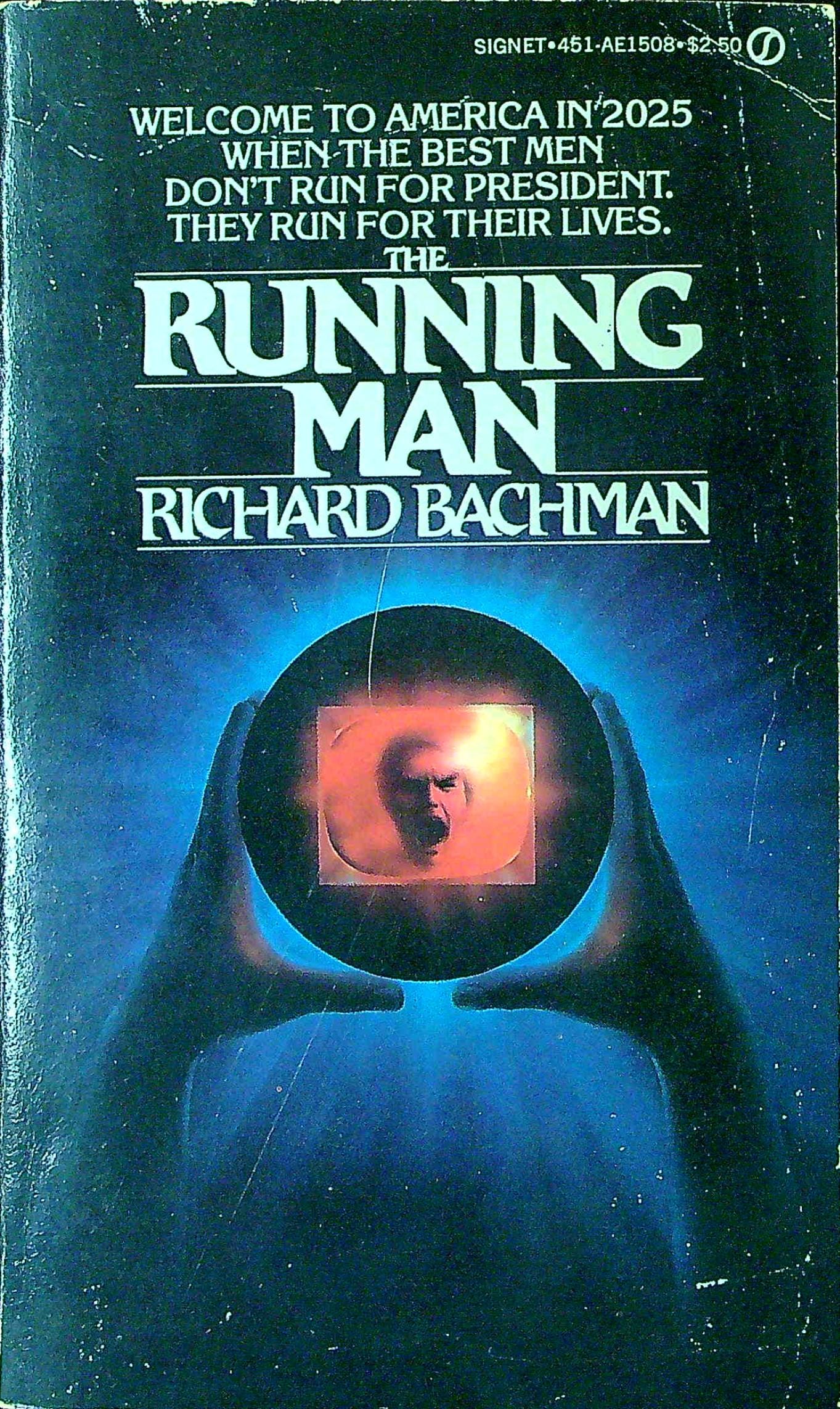
Yes, published in 82 but the original draft was written in February 1973, under a dirty pseudonym in a single week of god knows how much cocaine. Running Man makes much more sense as a birth caul of the dirty murky 70s; poor, armed and amphetamine-slender. The culture that produced it feels a like the desert town at the beginning of Cluzot’s ‘Wages’; a desperate sick and lonely place where everyone believes they have been tricked. We are not meant to be here.
But this is not the 50’s and Stephen King middle America is not Oil Company South America. You can just get on a bus out of town. There are a lot of things you can do. Materially, its fine. The cage is spiritual instead, which makes for different tales.
I talk about Edgar Wrights ‘Running Man’ below, when we get to the 2020’s, fifty years in the future, but it seemed important for you to know and understand that its genesis comes from the 70’s, from the same oil-pond as our next two films; ‘Sorcerer’ and ‘Convoy’
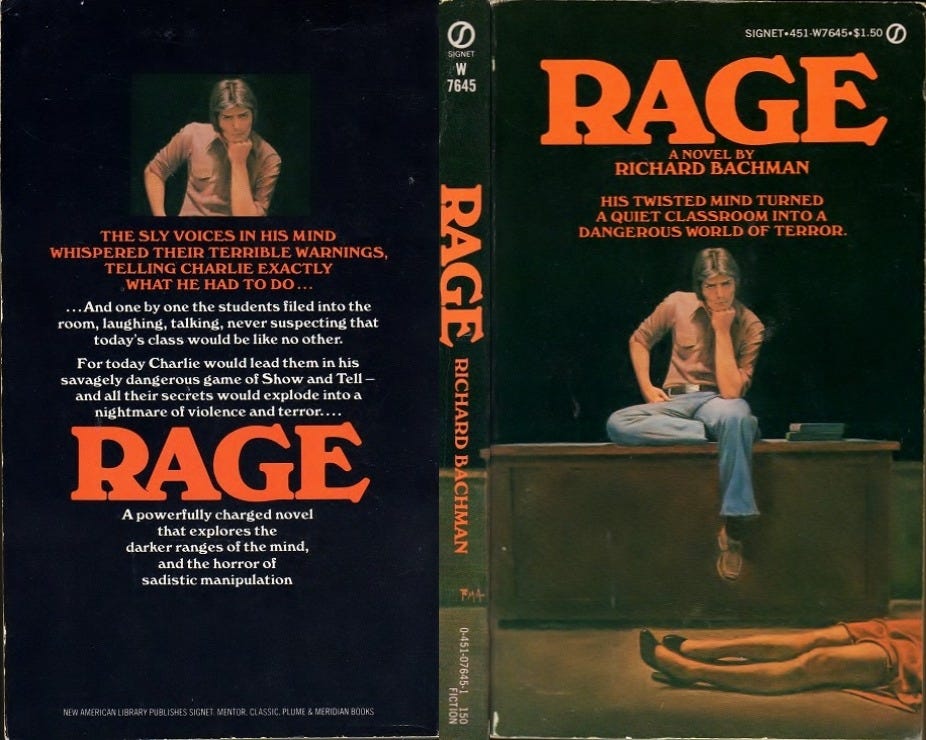
(The Stephen King in Yellow - under his pen name ‘Richard Bachman, King wrote a clutch of scurrilous tomes, one of which; ‘Rage’, describes an armed student taking a schoolroom hostage, and between 88 and 97 was associated with five school shootings. Like Circe, Bachman was a spellcaster, and like Prospero, he abjured his book, for fear of its terrible power.)
1977 – Sorcerer
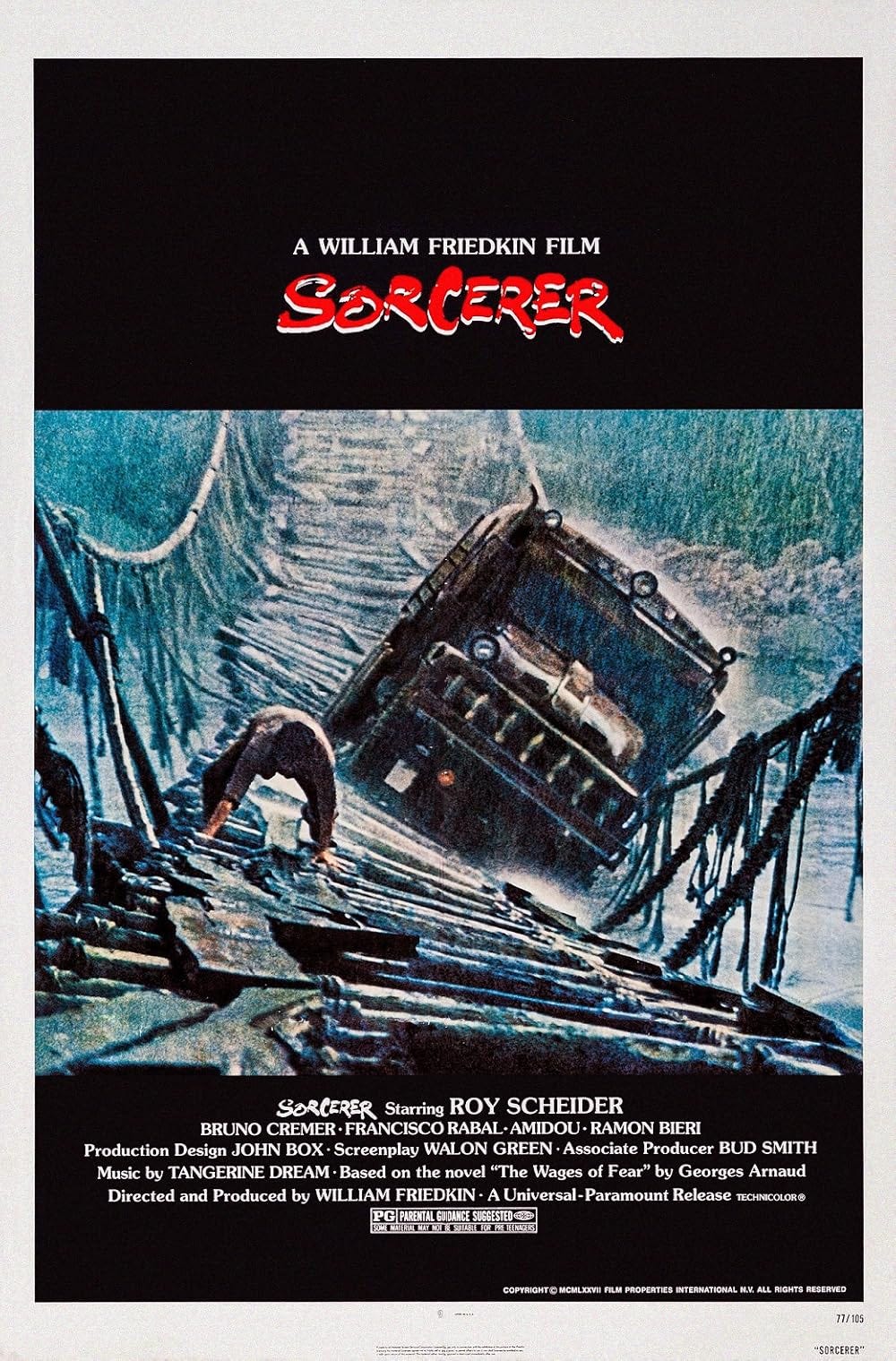
No one ever asks William Friedkin if he was trying to cash in on the ‘Truck Flick Bonanza of the 70s’, (maybe the whitest film craze of all time) but if you look at the box office and release dates, ‘Sorcerer’, the extremely arty, dreamy, psychological and catholic Truck film, is just part of a craze that includes ‘Duel’, Smokey and the Bandit’ and ‘Any Which Way but Loose’ they belong on the same shelf.
Regardless, we are back! The oil again. The greedy Shah won’t cough up the black stuff, trucks detour through our minds instead; fuelled by dreams. Back to fight oil fires and Star Wars, which will come out the same week as William Friedkins remake (or re-imagining) of ‘Wages of Fear’. Star Wars wins, conquering the world on a budget of 11 million dollars, while Sorcerer cost 22 million and made shit all. (Star Wars comes closer to being a cheap Indy movie, with Sorcerer the decadent Corpo flick….. )
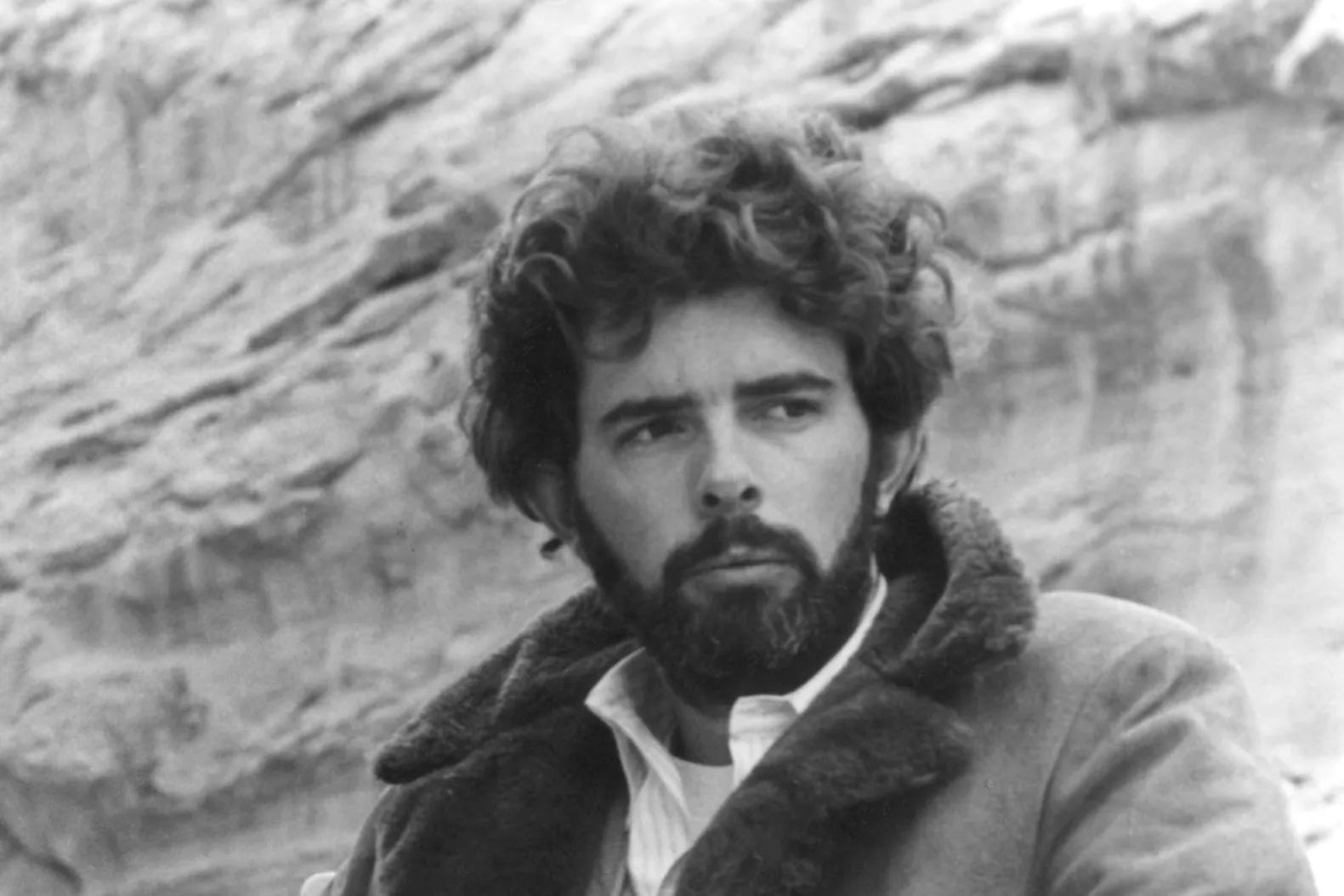
We are doing Wages of Fear, but we are doing it pretty, and fancy, and psychological, with less explaining and more Catholicism, implication, and mud. And slightly less racism, arguably.
Trucks like monsters. Moody modernism - Friedkin makes a lot of ‘hip’ cuts that slice us through the story like a chopping knife. Incredible filmic moments, and specifically film and specifically film and physical events where the laborious physical creation and certain risk of the creation of this theatre looms behind each scene, adding to the dense gravity. Maybe the most gravatic movie of all time, maybe the most textured movie of all time.
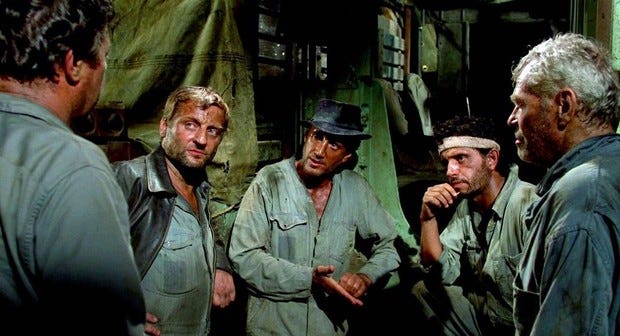
While ‘Wages’ took its long sweet time being social realist, centring itself on the day to day lives of its cast of castoffs, scenes where they live, brawl, eat and explain their plans and backgrounds, all leading up to the TRUCKS, Sorcerer begins with four little groovy movies, showing the sins of its cursed quartet.
Somewhere in one of the anonymous rooms of Europe, one man kills another, Nilo, the Assassin (Franciso Rabal) exits to nowhere. Here is a man as a cipher. Manipulative, clever, dark. He goes to hell.
In Tel Aviv Palestinian explosives enthusiast Kassem blows some people up. In a series of scenes torn from ‘The Battle for Algiers’ he flees, last survivor of his group.
In exquisitely decadent Paris, the banker Victor Manzon admires his beautiful and literate wife (this is one of the last times a woman will talk in the film), she is reading the biography of a soldier in the Algerian war;
Blanche (reading) - “’The cannons were trained on the village..’”
Manzon - “Another Soldier poet?”
Blanche - “More philosopher than soldier. ‘Soon I would lower my hand and the firing would begin. Through my field glasses, I could see a woman with a jug of water on her head, walking slowly toward her home as she had always done. In a second, my simple gesture would remove her from the face of the earth. Whose gesture would remove me? When and how would it come?’”
Manzon – “And did he lower it?”
Blanche – “Yes.”
Manzon – “Then he was just a soldier.”
Blanche – “No one is ‘just’ anything.”
I do like it when a film tells you it is deep! That is how you know you are dealing with proper Art; when it tells you itself, (and makes no money). Manzon’s bank is shady, (or perhaps betrayed?). The cash is gone and this exquisite life has hours to run before he goes to jail. After a desperate last persuasion leads to his colleague blowing his own brains out in the car park to a lovely restaurant, Manzon pegs is, I mean he physically runs, in nothing but his fancy clothes, he disappears.
Finally, in gritfest NYC, Jackie Scanlon, Irish getaway driver (he begins the film trying to get away,) is trying to get away after his, (he’s more of a secondary member), gang robs a corrupt Italian priest of stacks of cash he shouldn’t have. Unfortunately for Roy Schieder, his car is full of IRISH MEN and in a scene from ‘Father Ted’, they start arguing over nothing and accidentally shoot each other. Crash. Leg wrecked and plastered with bloody money, Jackie limps away from the gathering cops and, much more dangerous, the Italian gangster brother of the church his gang just robbed.
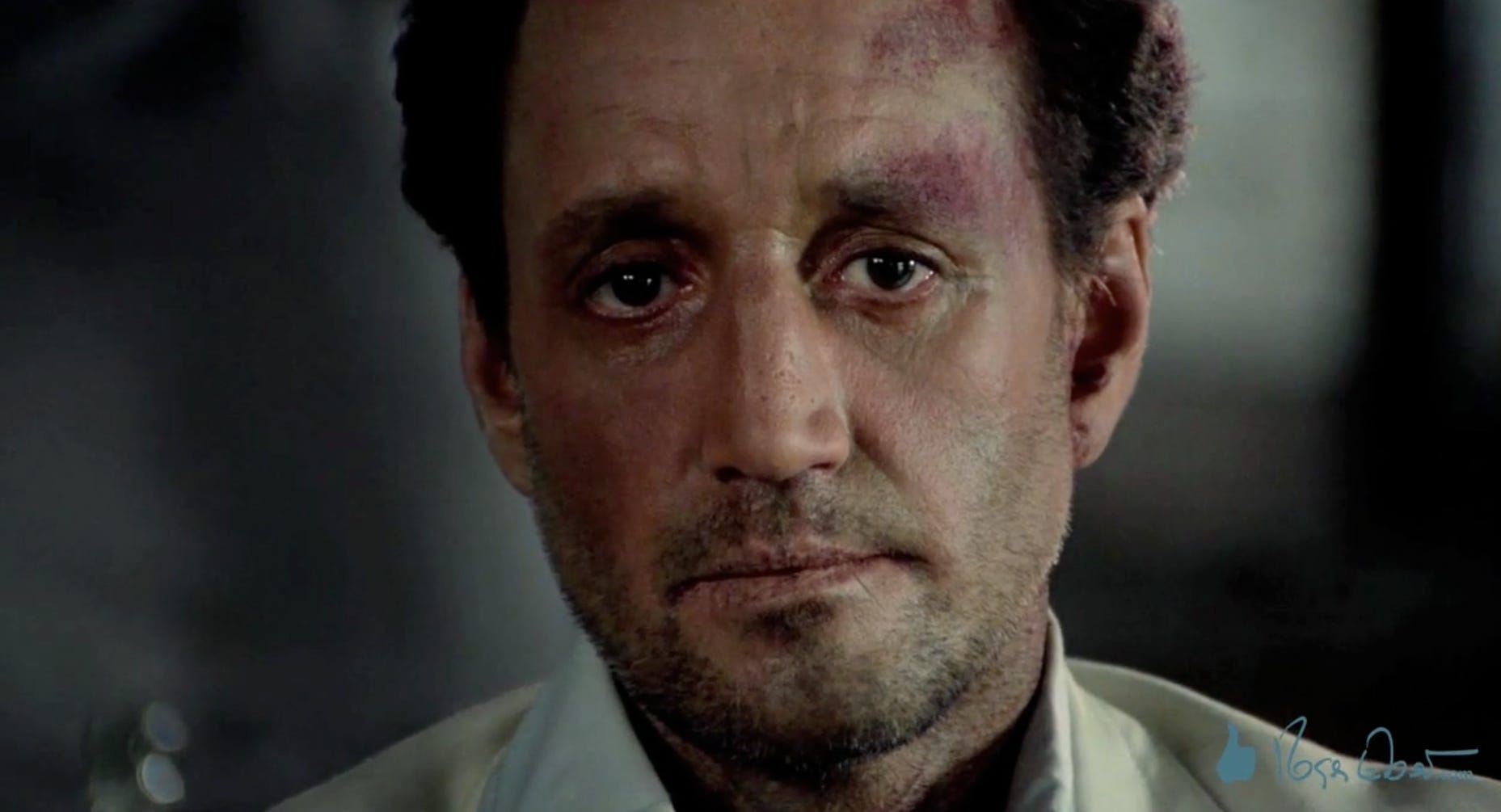
They end up in The Town.
This is not southern France standing in for South America. This is proper, dirty, muddy, textured, beautiful tropical horrible sweaty poor corrupt actual South America. We have the budget for it. This being an ooogly boogly dreamtextured literary movie, it’s also clearly purgatory. In ‘Wages’ Mario was making it with a sharp-tongued barefoot coquette, in ‘Sorcerer’ Mazon bangs a borderline crone who silently arrives before the doom-drive starts, her face cauled with death, to return the golden pocket watch he used to pay her for a night, his wife’s sweet words still scribed into the shine.
Thence, the plot proceeds. The blaze (ignited here by radicals, rather than mistakes), the company, the Nitro – this truly Sorcerous scene is unquestionably better than the first, these Edgar Allen Poe explosives sweat, they nearly reek, they emanate doom. The trucks, pairs, the road, the doom. All similar, all different.
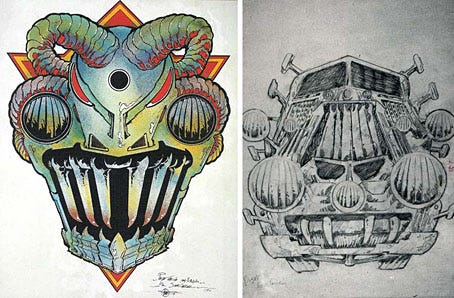
This is a very cool movie with some very cool trucks. The first films were good but these are literally part-designed by Phillipe Druillet, and which the original maximalist designs are subdued, made concrete by hot metal and decay, they still look cool as shit. I am surprised no lone Japanese man has produced scale model kits of them yet. They are works of art.

And everything about the film is very political and cool. And kind of slightly gauche, but looks amazing and hits hard, it flows into a double-bill with ‘There Will Be Blood’ on one end, or could form the middle of a trilogy with ‘Aguirre, Wrath of God’ on the other. The clawed oil company logo floats across the screen like the shadow of Cortez. In ‘Wages’ the gang blow open a great stone, here it is a tree; Friedkin says he called in an insurance scam gangster to show them how to set up the Dungeons & Dragons improvised timer.
Beautiful, less human. The protagonist dies. In ‘53 Luigi survives the death ride and gets himself killed in a car crash caused by a Mediterranean temperament. In ‘Sorcerer’ Roy Scheider makes it through the long, dark night alone, with only the corpse of what was probably a man sent to kill him. Picking up his money he stays in the bar a little too long, literally dancing with death, while outside a taxicab pulls up, containing the gangster brother of the priest Scheiders gang shot in the start. He’s not getting out alive. I was always the afterlife. What did it mean? Looks like Circe got one traveller at least.
The title is terrible, should have been “Super Murder Truck Adventure” or “2 X Wages, 2 X Fear” or THE “CASH OF DISASTER”.
1978 - Convoy
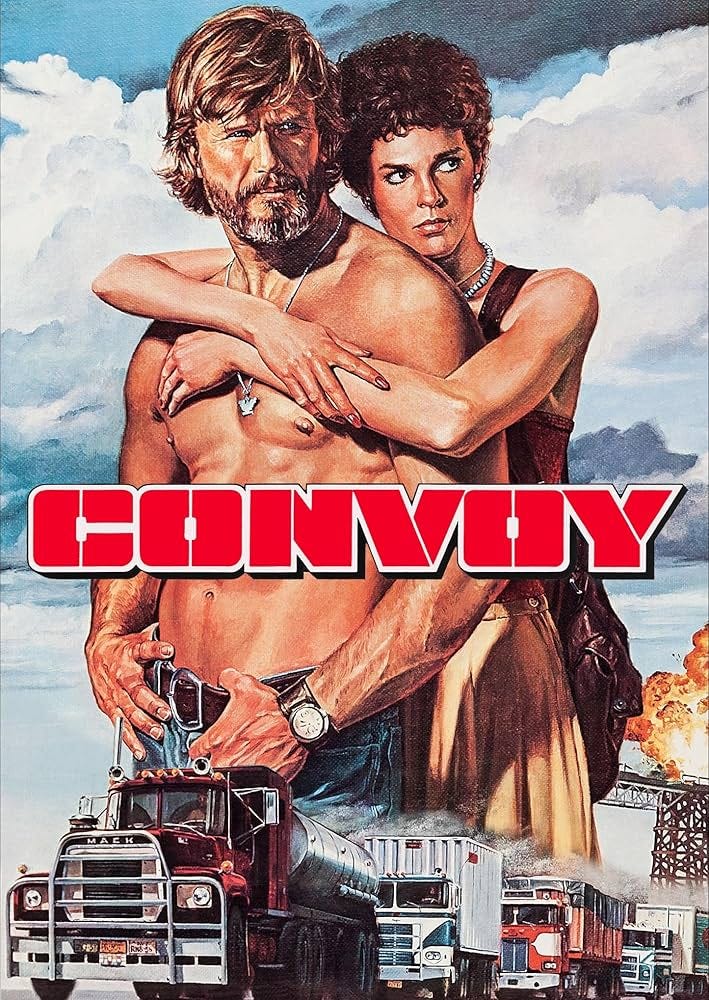
‘Convoy’ came out a year after ‘Sorcerer’, we watched it hoping for some comedic relief after the relentless tension of ‘Sorcerer’ followed by ‘Wages of Fear’.
This did not entirely work because SPOILERS, ‘Rubber Duck’ gets blown up at the end. The truck EXPLODES. God damn they got us again, except.. wait.. DOUBLE SPOILERS… it was a sneaky Odysseus Trick! Chris Christofferson faked his death and escapes disguised as a Dionysian priest, it was a Life movie all along!
I need to be clear, because I am going to be talking about a bunch of things that absolutely fascinated me about ‘Convoy’, that I do not actually think it was a great film and broadly did not enjoy watching it that much. The humour is gross and awkward, Chris Christofferson is an attractive cipher, Ali MacGraw is not much better. If there is a centre to the film it’s probably Ernest Borgnine’s corrupt Sherriff who effortlessly holds the screen whatever else is going on.
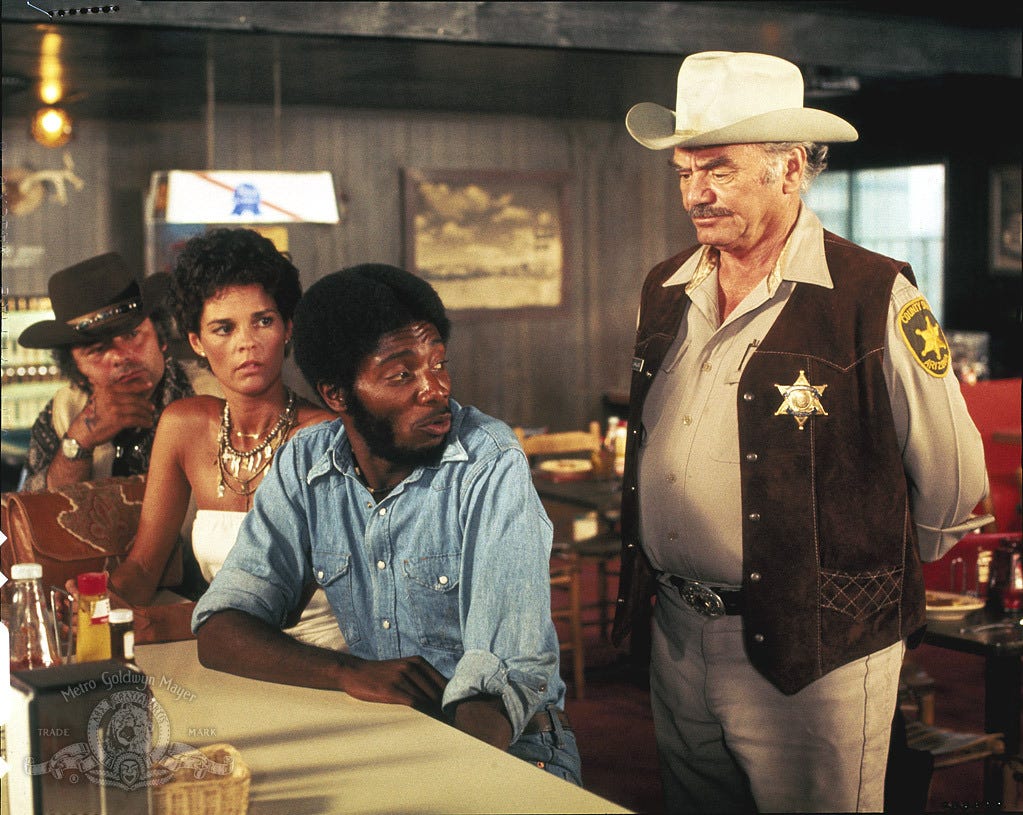
There in a huge and I mean gargantuan difference between what was happening in ‘Convoy’, in terms of pure cinema; image, light, movement and arrangement, vs the actual story being told.
The visuals, the editing and the strange tapestry of sound that underpins, and in a Nolan style, unwittingly alienates from the story, nearly make ‘Convoy’ an art film. The cuts of movement, cause and consequence, of sound and action, are wild. And dumb, with cutaways to ‘wacky’ comic goons. I genuinely can’t tell if this is Peak Artistry or Crude Comedy; it’s often both, and this is another thing that makes it feel like a very ‘white’ working class movie, because it has these wild swings of invention and touches of genius but it’s got no fucking class. Its dumb. Its anti-cool, a true flyover state truckers protest movie.
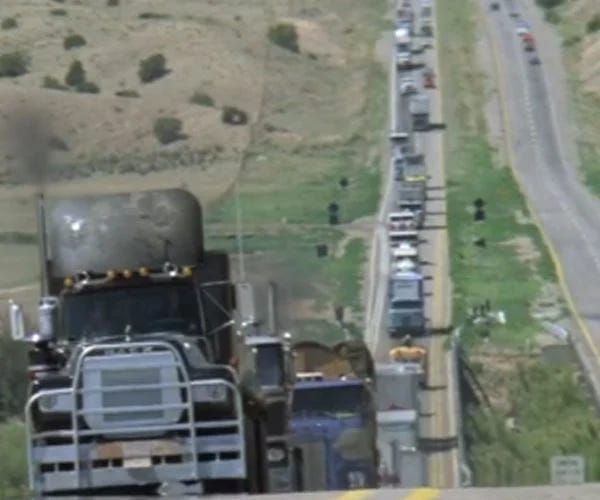
The story being told is kind of an archetypal working class rebellion tale and the script and voices and dialogue are crude, or off kilter, or dull, at least in the central performances, which just happen to be there, (apart from Ernest Borgnine). This might be one of those films that works better dubbed or in a foreign language, as there would already be a kind of dislocation there between the voices and performances and so people would more just be looking at the pictures.
What are they protesting? Even they don’t know. After a minor altercation with Borgnine’s shady Sherrif spirals out of control, ‘Rubber Duck’ and his gang just start driving. There is a vague suggestion they are going to Mexico, but they don’t seem have a location in mind.
The fact that the Convoy is protean, its meaning to be decided, almost pure, is one of the better through-lines of the film. (Ultimately the Convoy does gain a purpose; freeing a captured black trucker from the clutches of evil Sherrif’s. Unlike Ulysses, Rubber Duck does go back for his men, and unlike the shoe-leather Euro-migrants of ‘Wages of Fear’, he is a racial egalitarian.)
The Convoy metastases. CB radio brings in Truckers from wherever, adding more and more and more trucks to this infinite line of machines that sweep through the night like leviathans. The police watch; HELPLESS. Some towns put on parades. It’s All Fools Day, it’s a protest against the Power. It’s about freedom or something. Truckers Together. One of the best scenes in the film is Brian Davies’ senatorial apparatchik standing on the back of a moving flatbed, pointing a camera through the truck window at Rubber Duck, asking about his intentions, his political affiliation;
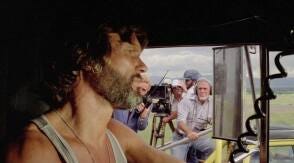
“What is the purpose of this convoy?”
“The purpose of the convoy is to keep on moving.”
Perhaps the purest and most emblematic dedication to the great cause of motion - the movement itself is the purpose. Perhaps the only protagonist truly unafraid of death. Self-fulfilling.
This is one of very few films based on a Country Song. It also uses that song as its theme, which is handy as the song directly describes what is happening on screen. A brief resurgence of the ancient balladic form that gave us the Odessey to begin with; “sing, O Muse, of Rubber Duck, the Southward-turning man, who drove his black-hulled craft across the Western Lands. Yet he mocked the Priest of the Five Pointed Star, who called down the wrathful God of State on his path.”
Our own path lies far distant, fifty years into the future and twenty three into a new, strange century, already tangled with cultural ruins.
The Waning of an Age
2023 - The Flash
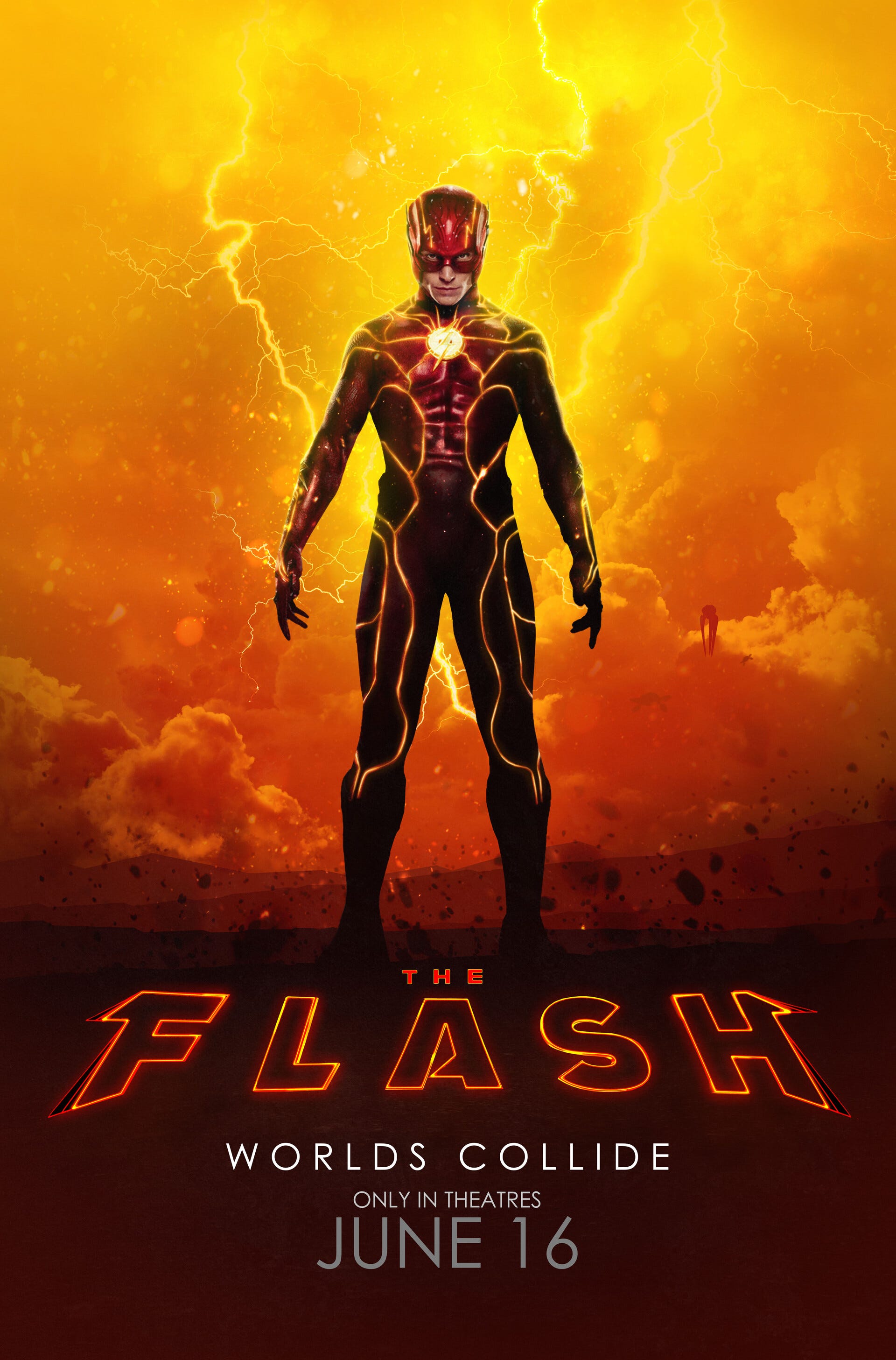
leap into the distant future, of a cinematic world shaped by Star Wars rather than ‘Sorcerer’, and into the doom of a once-great, wait, no, it was never great, it was utterly mid always and at best. Let’s say instead, we journey to the doom of an absolutely garbage empire as it flames out, for the first time at least (the wheel will keep on turning); the DCU!
This film was brain melting. Truly, absolutely, one of the films of all time. A bonkers Aleph, a coagulation and concentration of a particular moment in time, impossible, inexpressible.
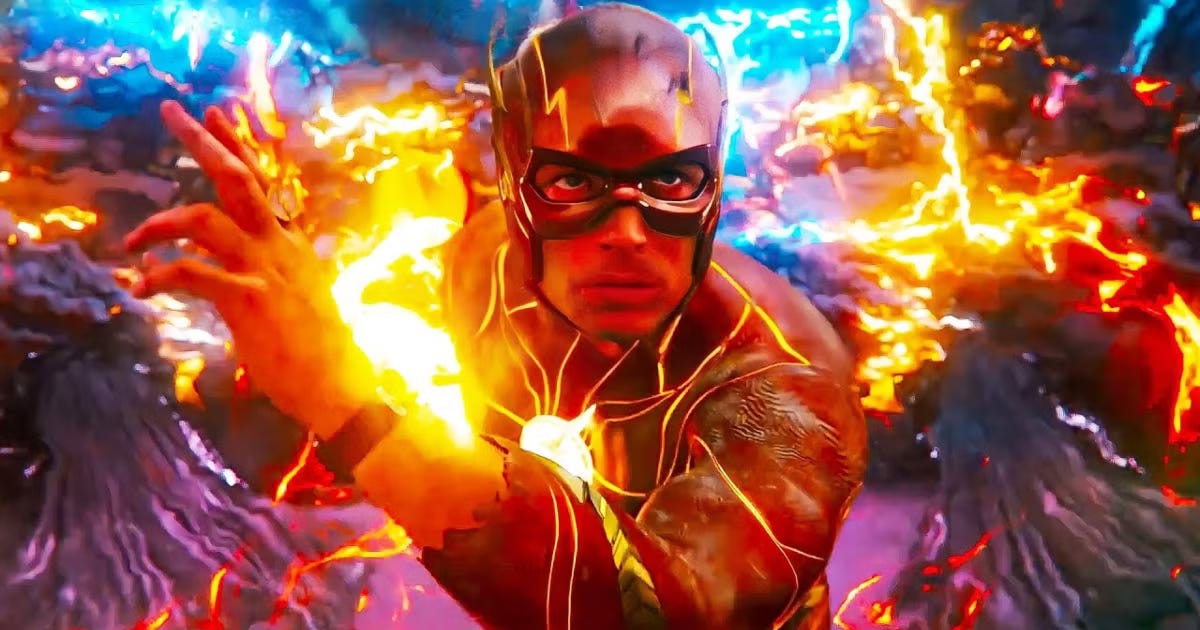
Remember the Walter Hamada style DC Universe before James Gunn came in to make it competent colourful and mild? My god what a strange wild run. R.I.P. THE SONYVERSE 2013 to 2023 (2024 if you count ‘Kraven the Hunter’). We had ten years in power CRYING FACE EMOJI. Rest In Plower, King. (& release ‘Batgirl’!) (Not to mention the Venomverse, Scraped together from Spider Man characters who weren’t Spider Man, that Sony still sort of had the rights to.)
The Sonyverse; a polished coal, into which we scry, like Doctor Dee, witnessing strange angels who will tell our fate & suggest we swap wives. It’s like a tarot deck, the entrails of a bird, of which The Flash must range above as some kind of Big Bird if you will.
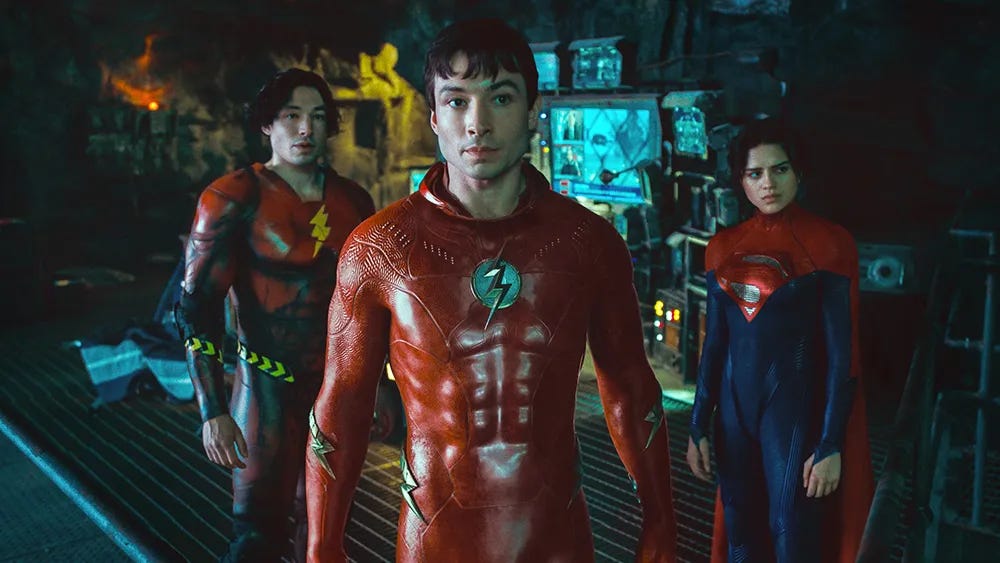
Wait, there is a plot, its actually not bad. Barry Allen, already a Superhero and ‘The Flash’, discovers how to run through Time. He immediately uses this power to prevent his mothers death and save his father from being falsely accused of the crime. By altering causality, this Demigod crosses into the powers of an Abrahamic God, utterly fucks things up and creates, or gains access to, the, or a, Multiverse. (Also RIP Multiverse movies, we were… I guess about eight years in Power? Roughly 2018 to 2024?) This creates a world unable to defend itself from Michael Shannon’s ZOD, so Barry Allen teams up with Barry Allen, Sasha Calle and Michael Keaton to defeat Michael Shannon and Barry Allen (who was the real threat). The timeline is restored and Barry Allen accept his mothers death (but does manage to free his dad).
Not since Ulysses have we come so close to Myth; mothers, fathers, brothers, sin, fate, mortality
Batman comes back to life and dies, an Apollonian Sasha Cralle is released from Tartarus, and uh, aliens invade in the conveniently empty desert. Ezra Miller plays two roles (zhe probably wanted more).
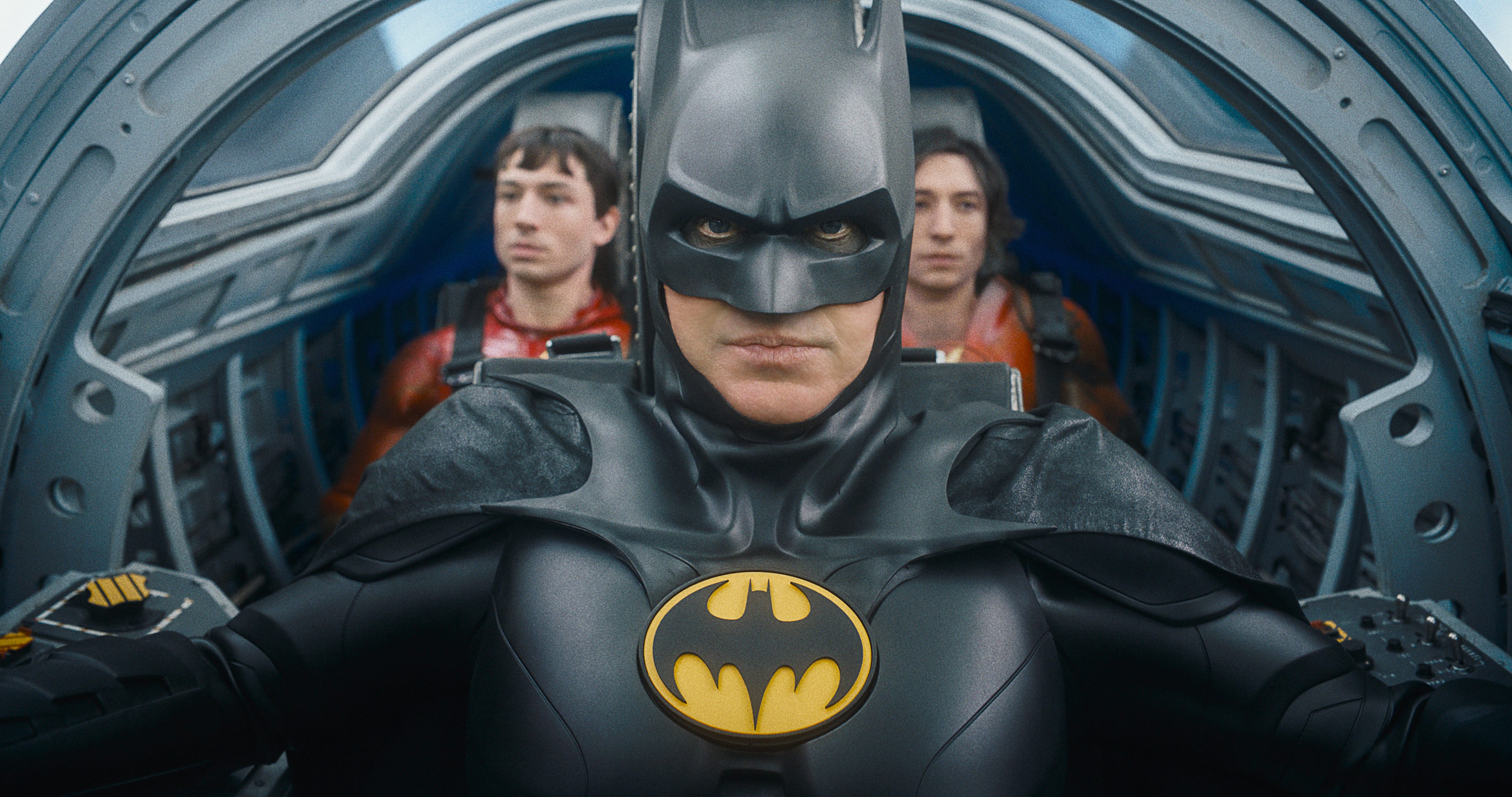
I absolutely cannot look at Ezra Millers performance and see anything but Ezra Miller, and there are TWO EZRA MILLERS on screen most of the time! If life truly is a performance then what a performance zheres was, glorious ascension, diving straight into the Sonyverse and then the most magnificent and impressive systemic crashouts of all time. Truly living the mould of an Achaean Hero, touched by the Gods and sacrificing all for imperishable Fame. They do not make stars like this any more.

There is so much playdough CGI. It’s weird. An inadvertently Claymation journey into the past, and many alternate presents; Christoper Reeve, Nicholas Cage, BUSTER CRABBE! Wait, as proof that The Flash may be an Aleph of its age; I’m sure we all remember the Great Device of Giordano Bruno, renaissance theoretician and plump lion avoider, where he tried to scam a Prince with the idea of building an engine of thoughts, which would be like a huge radial room set with these semi-mechanical images like tarot card with each image having various complex layers of symbolism, and the images having attachments and relationships between them, moving, rising up or folding down, obscuring or revolving, all according to the schema of some vast meta-philosophy which this machine would both embody and, with human integration, understand. We all remember this.
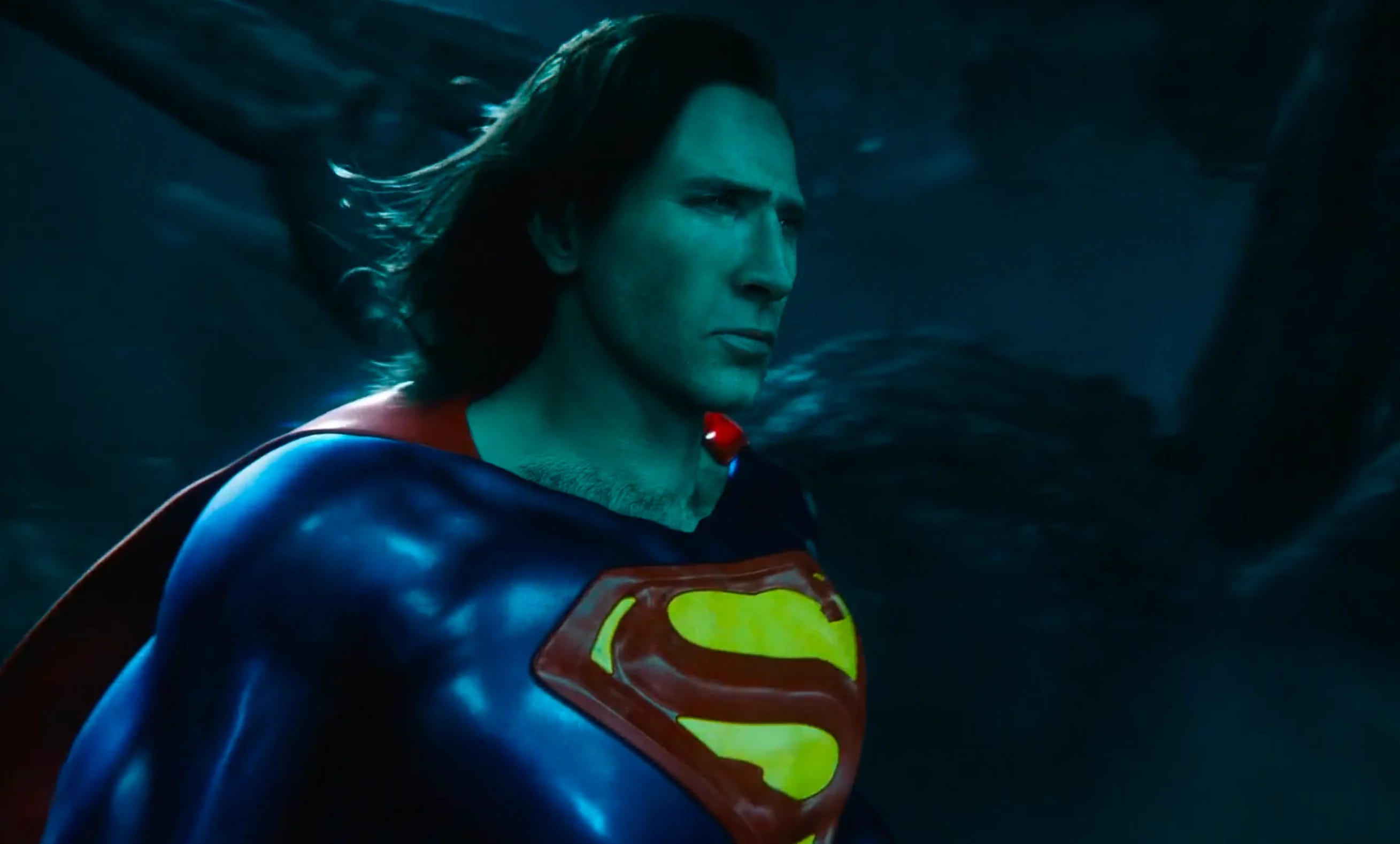
Well! The big radial wheel of CGI shifting realities that the Flash enters into when he gets super upset and exceeds the Speed Force, does look an awful lot like Bruno’s Great Machine. Obviously Deep Cut about the paradoxical urge to systematise conflicting realities and the semi-corrosive touch of human memory which warps what it reconstructs even as it seeks to preserve what is most special to it.
And speaking of warping and reconstructing Memory..
2025 - The Running Man (Edgar Wright)
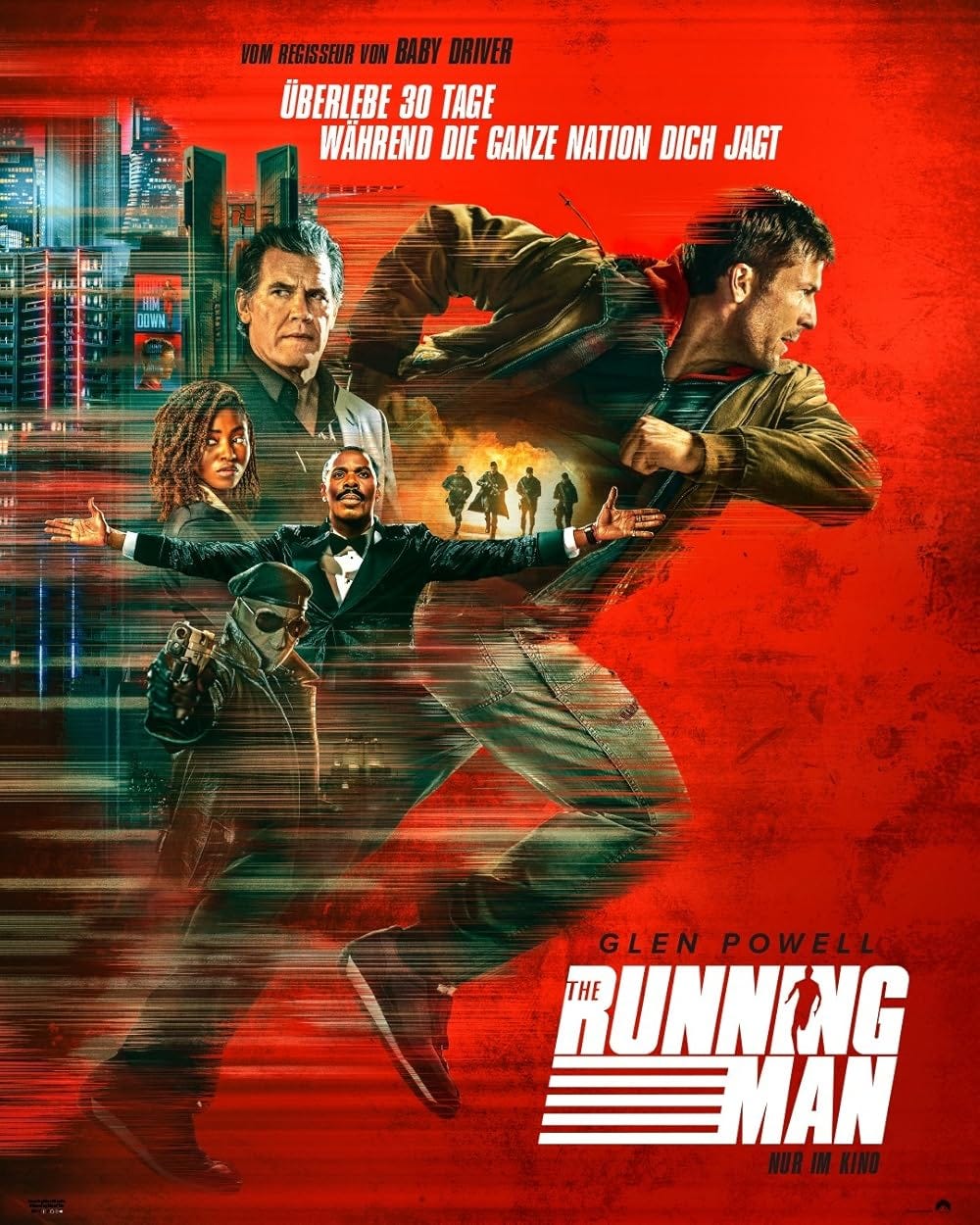
Fifty years since Bachman wrote ‘The Running Man’, the same time spent the other way takes you to 1923 - the end of the Ottoman Empire and the Munich Putsch. The 20th century casts a long shadow
But we are back....back and back again, to run. (This film was bad.)
You all must know the basics; dark future, class divide, gameshow culture, lethal show. Play and be hunted by the world. Survive and all your dreams come true, but no-one survives; the Running Man! We loved the crazy 80’s flick, we have not read the book.
There may be reasons for that. The book is dirty, grimy, nasty, weird. It ends with the protagonist suiciding a plane into the network tower. Do people want to see that? They will not get the chance. Despite its reason for existence being closer to the text, Wrights ‘Running Man’ flubs the finish, spazzing into a knotwork of crowd-test re-writes, and giving Glen Powells Ben Richards a happy ending that he may deserve but his world does not. This vague sense of pussiying out may be why the film is not good. It’s a nasty nihilistic story and Edgar Wright is not nasty or nihilistic and has nowhere to go with those emotions. It’s a fake homecoming and the emotional and moral dissonance embodied by this change weaves its way through the whole of the film, making everything shallow, silly, weak and small. Blessed soul-pure cringe millennials cannot comprehend Peak Bachman Cocaine nihilism. Are we kinder than the hero/demons of the past, or narrower, our virtues those of Bonsai Trees?
Team Bad Guy plays it well. Josh Brolin is wonderful as Killian and his screen conversations with Powells Richards have more drama in them than the rest of the film. The weaponisation of fame and the way public perception and private drama interact with each other, forming positive and negative feedback loops, and creating complex opportunities for whoever can navigate between the two systems best, is the most interesting part of the story, but ‘To Be Hero X’ already did that much better. Colman Domingo is piping hot as the Running Mans presenter. Lee Pace stands well and obscurely seems more comfortable in his mask than when it is removed. A commedia dell’arte actor born in a leading man’s body.

The remainder saddens me. The tech is imagined for a 70’s scene and the transmutation of mailed video tapes into rocket powered flying post-boxes, does not work. Digital technology is a leash around our necks and no Running Man could run for long if hunted by our world. Perhaps this could have been feathered differently or otherwise conceived, but the conception fails.
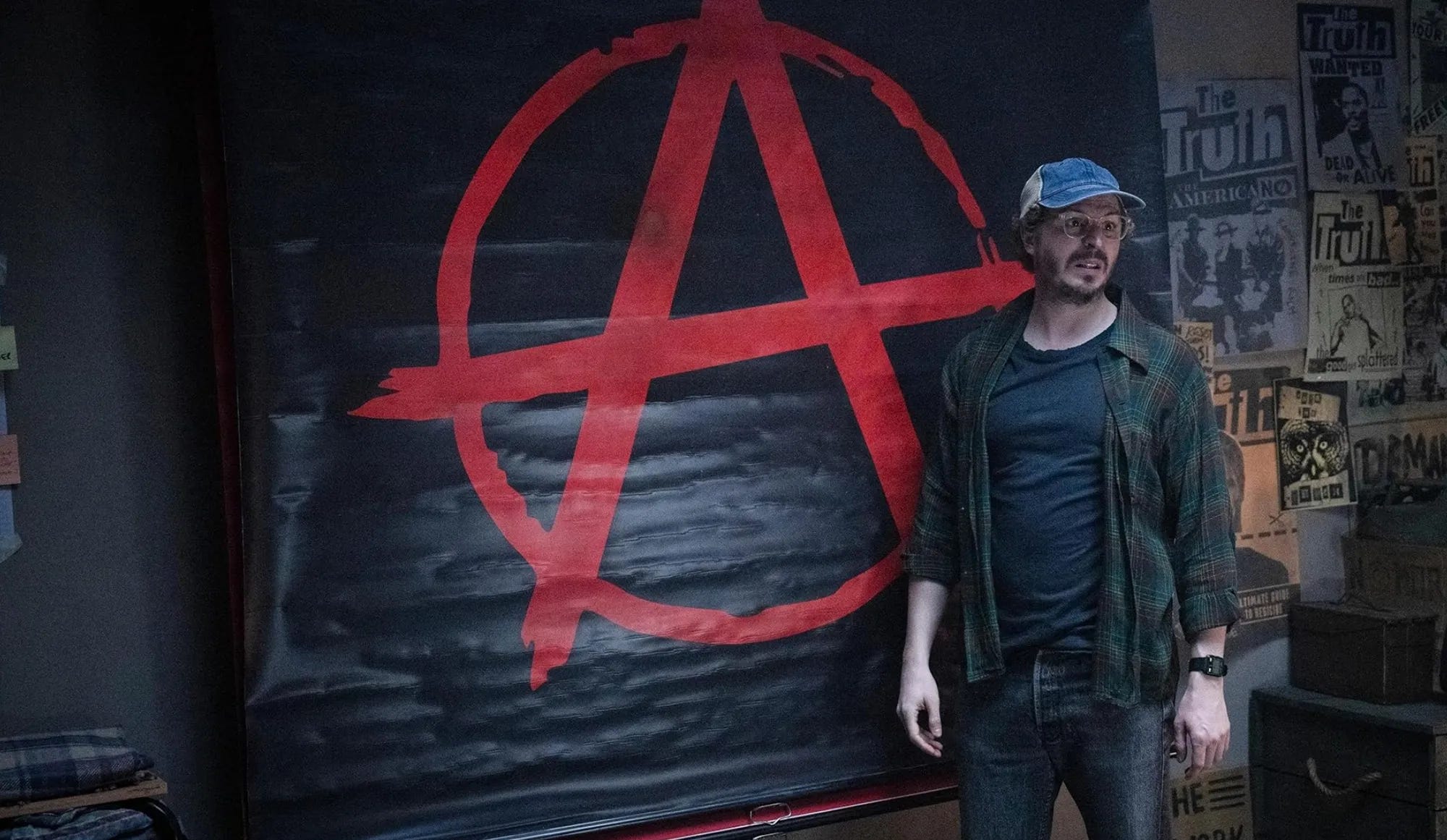
There is a scene where Powell disguises himself as an Irish Priest, another scene about ‘Zine Culture’, videotapes. DNA sniffers and drones. A 70’s TV show set. Its awkward. A mish-mash. Michael Cera turns up and is relentlessly Micheal Cera - the only point in the film where I laughed was during a the Monster Energy Drink product placement - and I can’t tell if that was a gag or not. Maybe the film did not know itself. Tonally all over the place. Cartoon people in a dark pseudo-reality or real people in a cartoon world.
…
So much, so early 21stC. We have escaped the Multiverse of Memory, but are still enraptured by the Sirens of Boomerism, all while Pluto rages at our theft and the black curse of Oil pursues our boat. We must load it with explosives once again.
Also;
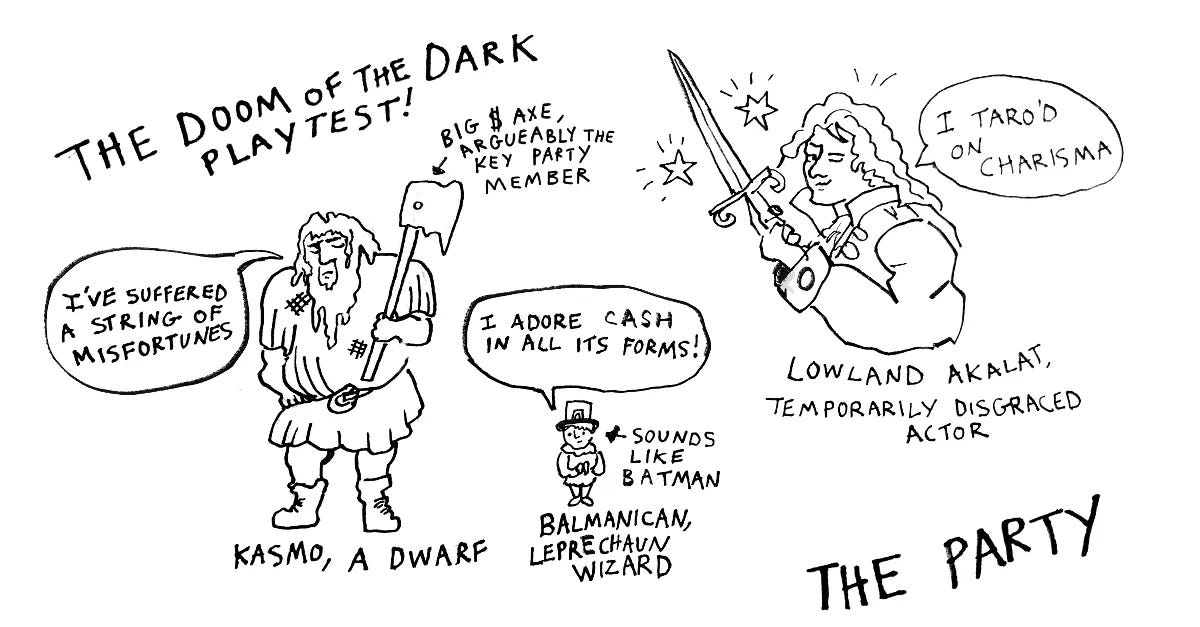
The DOOM of the DARK Kickstarter is still running!
You only have TEN DAYS left to back it!
Who knows how many we will print? I certainly don’t.
An improved PDF if we hit £7000!

Do you know that we intend to print in the US AND the UK?