

I Read Generators of Underground Worlds
my brain is cooked

Previously I asked my audience for examples of large-scale cave generation and, essentially, no-one had what I was looking for; I meant Nation Sized, underground wilderness.
In fact only Douglas Niles in ‘The Dungeoneers Survival Guide’ and maybe Zedeck Siew in Reach of the Roach God came anywhere near to producing systems at this very grand scale, and only Niles addressed the problem of three-dimensionality, and he only partially, and via a complex but elegant method of isometric mapping.
Nevertheless, I feel like I did learn quite a lot from dragging myself through all these varied systems and the process did affect my plans and ideas for VotE;ReDux so I will go through my general sense of each method here, in alphabetical order, at least until I come up with a better method.
Carapace - by Goblins Henchman
https://www.drivethrurpg.com/en/product/261079/carapace-basic-version
An odd, complex little pamphlet I got, maybe directly from Goblins Henchman? Who knows how long ago? I found it in my box of Zines! This is an adventure built around some generation systems for having trouble in a giant ants nest (the nest is giant, and is the nest of giant ants, so I suppose for them it’s just a proportionate nest).
Three methods are proposed for the creation of the Nest; a Point Crawl, Labyrinth Move and an ‘Hex Flower’.
[I have photos but it feels wierd reproducing them here.]
Its interesting to me that two of these; the point crawl and the ‘Labyrinth Move’ both live neatly within broader methods of conceptualising and using underground spaces that we will run into later several times.
The Point-Crawl in this case is not a die-drop system and is based on a layered diagram, printed in the pamphlet, with semi-random ‘rooms’ and interactions.
The ‘Labyrinth Move’ uses a table and a progressive encounter roll, in concept, not that dissimilar to ‘Flux Space’, though I think this is more a case of convergent evolution than direct descent. (The text says this is an adaptation of Jason Cordova’s ‘Labyrinth Move’ for Dungeon World - something I know nothing about. I wonder what the background of intellectual connections is here? It also seems similar to Emmy Allens Gardens of Ynn and Stygian Library methods, though its been a while since I read those.)
The ‘Hex Flower’ seems to use a similar interior logic to the ‘Labyrinth Move’ but has it built into a little printed Hex-Map with the decision logic based on spatial arrangement. So far as I know, only Goblins Henchman has ever used this. This one also has a Hunter/Prey mechanic built into it, which should liven things up. Perhaps this is something to think about when considering other underground mapping techniques at any scale.
Corpathium
https://lastgaspgrimoire.com/in-corpathium/
(Ten years have passed and it’s all still there. The page even has a G+ link (;_;) )
So far as I know, the grand city-building project of Corpathium, which seems notable and unique, only exist via (very pretty and well-designed) web-page. What, not even a PDF? Surely this should have been a book at some point?
Anyway, the only part I am interested in is the city-generation system which could be easily subverted into a cave generation system
Its DICE DROP, which, honestly, is not that bad an idea for intermediate spaces.
Is non-representational, more diagrammatical, so that’s good.
Uses a 7-dice set, so I assume d4, d6, d8, 2d10, d12, d20
Uses the points (i.e. the corners) of the dice! Have not seen that before. If dice point to another they are accessible to each other.
So then we compare the numbers against a list of potential city-quarters with their own sub-rules about what is going on.
Then you have some interesting rules related to the concept of Corpathium as a place
Dice drop honestly seems like a really solid method for ‘intermediate’ zones between the ‘world map’ and outright cave crawling wilderness. It’s immediate, fast, coherent. Probably better and simpler than the method I used in VotE for generating intermediate cave systems. Reading Corpathium persuaded me to the use of a system of this kind and played a meaningful part in causing me to re-order my whole hierarchy of systems.
Deep Rock Galactic
https://steamcommunity.com/games/DeepRockGalactic/announcements/detail/4593196713081471259
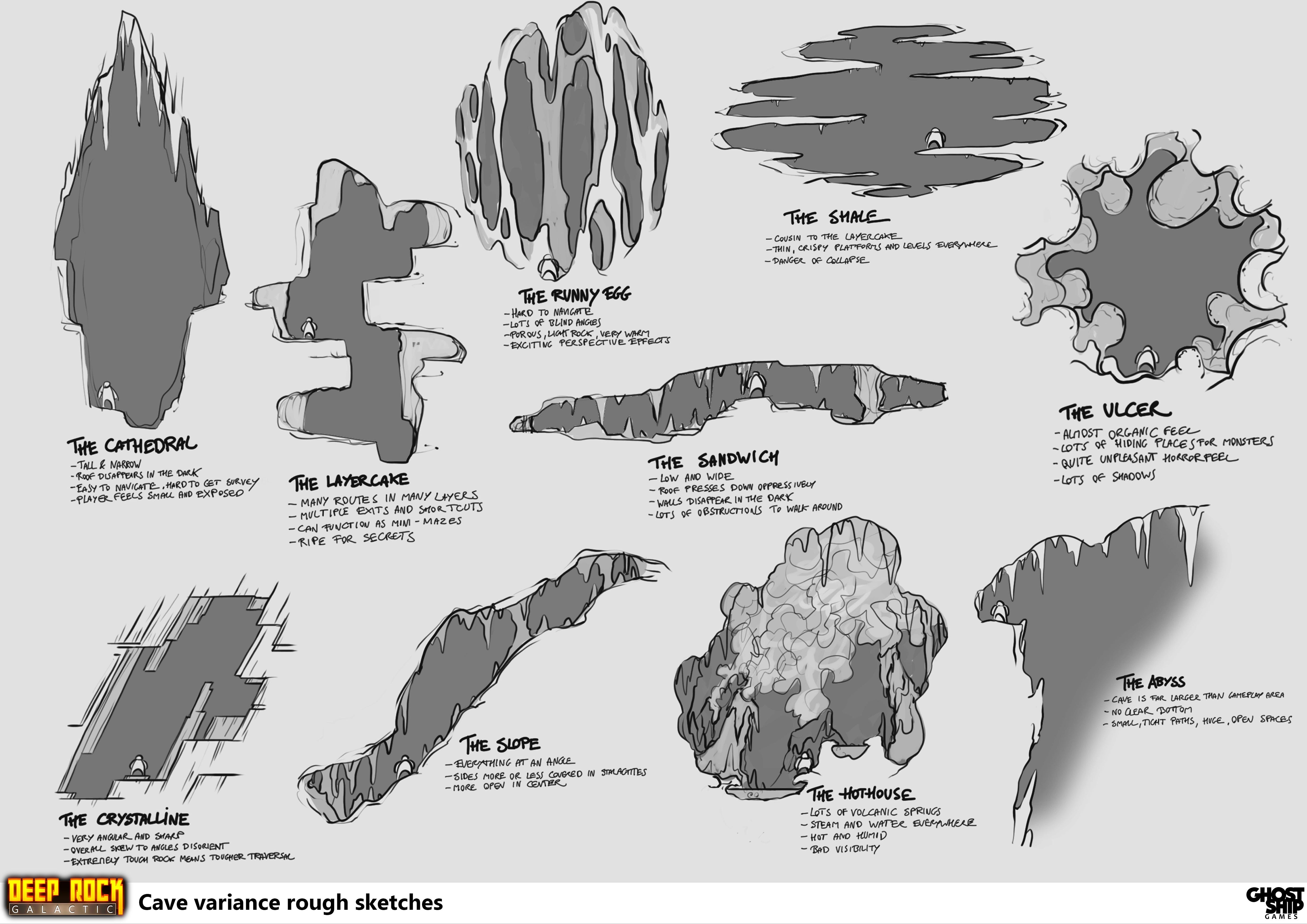
Someone recommended I take a look at this web-page where the designers of this Space Dwarf mining game, (which I have never played), talk about their process
Even though this uses systems and crunch impossible for a human, some of the logic of cave-creation, at least the sequencing, is broadly similar; a range of templates with some ‘randomizer’ elements, combined in new, strange ways.
As the designer here sees it, there are a few key considerations in making a good cave: traversal, natural wayfinding, and dramatic experience.
One way this did affect me was that it made me re-conceptualise the ordering, arrangement and importance of the different methods I intended to use, in particular the primary methods. It was partly here that I started to crystalise the idea of there being three ‘layers’ of resolution, with lots of optional little sub-systems which could be added on according to taste and usage, but essentially a sandwich with three layers; Wilderness Scale, built on an interlacing paths pointcrawl, a medium scale, built on a die-drop method, and the idea of the ‘Adventure Cave; a cave made specifically to have adventures in, with maybe a ‘close cluster’ of nearby caves to add options.
I will look into this, in particular; combining the encounter-design ideas from Silent Titans with the 100 caves from VotE (though all this will be much later, need to work on ‘large scale’ now).
The Dungeoneers Survival Guide by Douglas Niles
The most beautiful and interesting book of all I considered, mine has been rabbit-damaged for a long time (something I will never forgive)
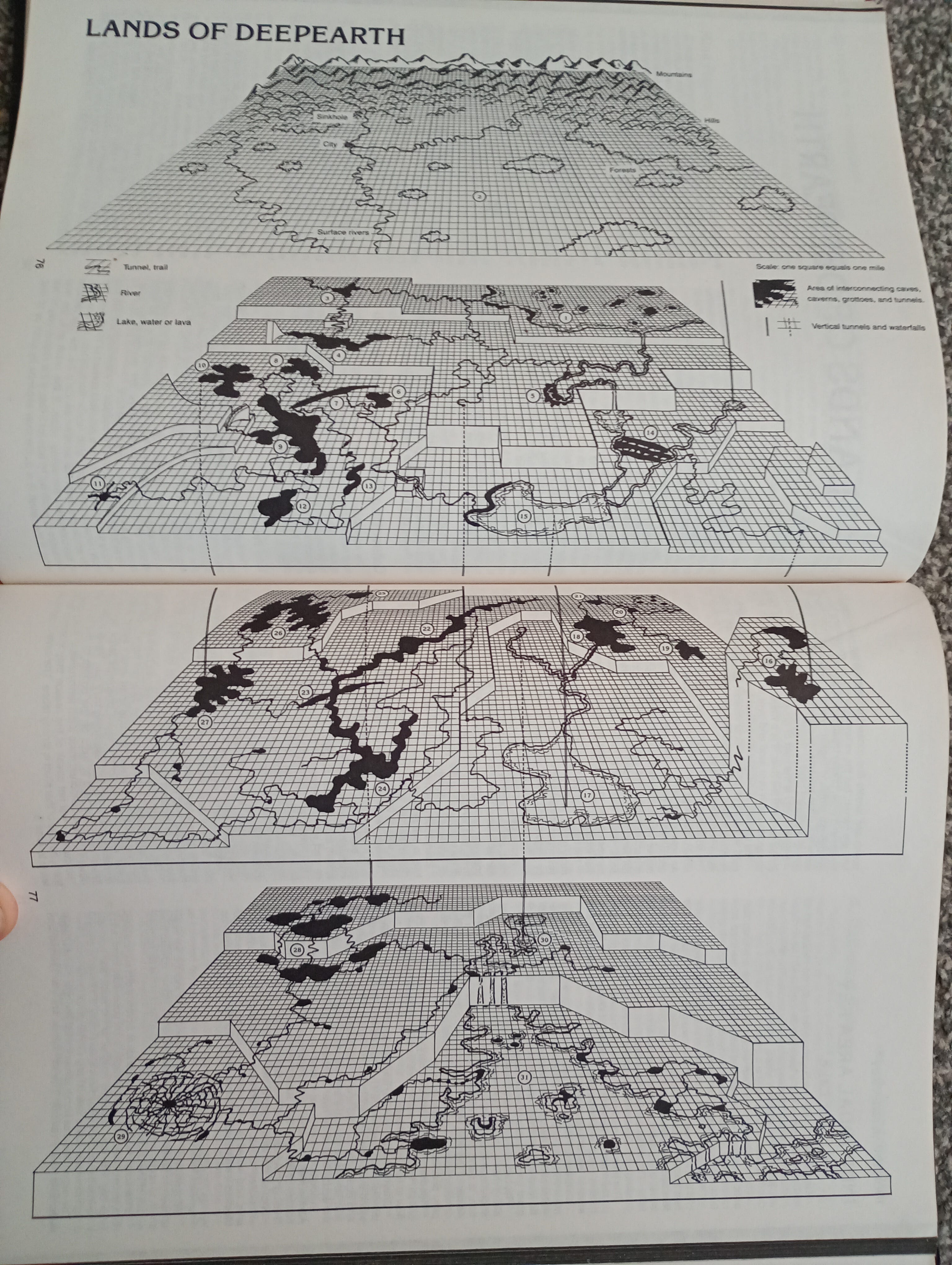
Douglas Niles is one of the only creators to directly address exactly what I was looking for; not a big dungeon, or a large cave system but an underground world - something at least the size of a small nation.
He even provides one in this book! Sketching out, through a series of lovely, layered, isometric maps, the ‘Lands of Deepearth’, made up of complex riverine systems and caverns, filled with all the wonderful creatures of AD&D.
However, almost to my relief, as I have read way too many of these already, he never actually deals with how to generate such a territory. He spent a huge amount of energy communicating his wonderful and only somewhat complex maybe even ritualistic isometric mapping system, that I think once you get that system, you can just vibe on it? Honestly a very reasonable concept in that, through achieving a sufficiently complex and expressive physical skill, by the time you have it, you will either intuitively know what to do with it, or experimenting with it is so simple and joyous an experience that the matter simply no longer presents a meaningful problem and you can’ in the words of the winged goddess of victory ‘just do it’.
But, for reasons given in my comments to the last post about this, I am not going to adopt this beautiful and coherent isometric late-analogue culture mapping system. Still an inspiring book though.
Flux Space
https://www.paperspencils.com/flux-space/
“This simple conversational back-and-forth is a good engine for producing fun, but it falters when the characters are exploring spaces which are Large, Samey, and Confusing. ... Other examples of large, samey, and confusing environments would be a winding network of caves,”
This is something I had considered when thinking about cave systems but reading Flux Space convinced me that I had not been thinking about it deeply enough. There really is a fundamental tension between the concepts of natural or pseudo-natural caves, which are, as stated above, often ‘Large, Samey and Confusing’, and the forms, shapes, paths and locations necessary for adventure, which are (while seeming not to be so), actually the compete opposite of the above; Small, Distinct and Clearly Organised.
“Traversing through Flux Space can be regarded as a type of Point Crawl, with the distinction that moving between each point is especially arduous. Once a Flux is solved it can be peregrinated through more swiftly, but solving it will be taxing.”
What ‘Flux Space’ is, is a relatively solid and only slightly over-complicated and over-specific method of abstracting the exploration of spaces that are ‘large, samey and confusing’ without specific, local mapping in real life. Instead the simulation is of the company slowly crawling their way about, spending time and resources, gradually encountering important elements of the ‘Flux’.
The basic time signature is ‘Turns’, there are 6 turns per day, so a 4 hour turn. Every Turn of Charting depletes resources, hits some kind of encounter/event, (Flux Space uses the classic overloaded Encounter Die) and crucially, grabs you a Point of Interest. There are a limited number of points of interest per ‘Flux’
There are ‘Shallow’ and ‘Deep’ rooms. At first you randomly encounter ‘Shallow’ rooms, and as you do, cross them out, Then, if you roll a shallow room encounter after its crossed you, you get a ‘deep’ room, and the deep rooms go only in sequence, one after another, and after the last deep room you are done and ‘know’ the maze’. You can move in and out of it however you like.
Some points of interest;
· It assumes you are burning resources, which is standard already for VotE.
· You would need the time and stability to note or record things, though, VotE wise you could use knots or muttered chants
· The Event/Overloaded Encounter Die has some cute elements and some meta-currencies.
Altogether a very useful and excellent tool which I wish I had invented
NOT a good tool for VERY large wilderness/nation-sized spaces, but very good for cave systems and mazes built around central concepts, inhabitants, purposes etc, between small dungeons and wilderness, an excellent intermediate tool. NOT a rapid, easy immediate generator, you will need to think & plan ahead of time.
Though ‘Flux Space’ would not be one of my ‘Big Three’ core generation techniques, (Large Scale ‘Lands of Deepearth’, medium scale Dice Drop and small-scale ‘Adventure Cave’), I am committed to using it or something like it as an ancillary cave complex generation method. It fits too perfectly into something like a Deep Janeens maze or an Alkalions Salt Maze. Though these would be things you need to think ahead to plan.
There is some excellent advice on filling out this simple and useful concept at the web address, describing more would be excessive. (Someone please write an extensive blog post about how Flux Space related to Gardens of Ynn and that to Dungeons Worlds Labyrinth Roll or whatever it was.)
How to Host a Dungeon
This is an entire sub-game and I am sorry I did not get round to reading or reviewing it. Just too big too complex. I will try to read it at some point.
In the Shadow of Mount Rotten
A 2012 PDF from Joel Sparks.
https://www.drivethrurpg.com/en/product/100100/in-the-shadow-of-mount-rotten
This has a small, competent, naturalistic cave/lair generator.
It is fine and there seems to be nothing wrong with it but it has little utility for me as, first, we are talking about large scale generation, second, these are very much lairs, or naturalistic dungeon-like environments whose relation is primarily to an ‘outer world’, and last, their entirely reasonable naturalism, means they are largely wet, or drowned and either too small, too long and thin or too blocked off to be interesting.
A fine system. Not for me.
Inkvein by Murkdice
https://murkdice.substack.com/archive (There seems to be no single central site for this.)
This is an actual Megadungeon for Mork Borg by Murkdice.
Basic notation system looks broadly similar to VotE (addressing identical problems).
No 3d notation in the caves that I can see.
Has a nice Caving diagram.
Is already a megadungeon so has no generation systems at any scale. (These may show up in the final product, I only got a look at the Quickstart rules). Also this is so similar in broad concept to VotE that I am leery of dealing directly with it.
Lowlife by Sam Sorenson
https://lfosr.com/product/lowlife/
This little pamphlet has a LOT of stuff in it, very little directly related to the precise needs of my enquiry.
We got the basics of this are a die-drop method; where Corpathium used different kinds of dice and the angles of the ‘points’ on the dice to trace a network which produced, in abstract, the accessible paths of a cities layout, Low Life is explicitly aiming to create a tunnel network, uses D6’s and then uses the combinations of numbers to decide partially the connections between things but also the nature of the connections, it also engages the idea of just repeating the dice-drop method to produce a system of greater complexity and interconnection.
Low-Life also has a method for introducing three-dimensionality (!) though it conceptualises this as ‘dungeon layers’ rather than using the diagrammatic nature of the tunnel system to create ‘uppy downy’ not related to the concept of ‘dungeon layers’.
I will almost certainly be returning to ‘Low Life’ later on throughout the project as it covers a lot of very similar ground. A very solid product!
Reach of the Roach God by Zedeck and Mun Kao
(rest in power kings)
Most of Reach of the Roach god is about the Roach God and his reach, but at the end we get a little cavern-generation system based on TOYS. This is very millennial as it assumes that people buying this arty D&D book will have toys to throw around and yes I have them, shut up.
This is meant to be simulating the hollowed out bodies of dead gods so the humanoid shapes coming through the process are deliberate. It breaks down the toys into three sizes, two big, four or more medium and some small, and a bunch of ribbon to connect them.
How do you turn this into a map? In the style of The Dungeoneers Survival Guide; just be a good artist, or maybe actually trace around them? That would work if you had a big enough paper.
This method is different to most of the methods so far which tend to work on a principal of “room & route” – this matters as one thing you will notice about natural caves is they don’t have neat divisions between ‘rooms’ and ‘routes’, though, to some extent, this is how humans have to think about them; here is the bit you move through, here is the more round bit where you can rest.
The RotRG method produces large irregular, but linked caverns, which is something you might need, it uses the typology of the toys used to decide the location of world-relevant locations, the god type also represents special rules affecting that space, there are rules for using the ribbon as a river and instantiating that in the cavern system.
A much less technical system than most others, this still does something notably different, and it uses the layered information of its figure types in a range of interesting ways - I am sure a use can be found for this!
My Grand Result
My final analysis is, as stated above, to work on three ‘layers’ of map and location creation; the Large Scale Underground World, the Die-Drop cave system, and the ‘Adventure Cave’; the kind of place where its good/interesting to have an encounter.
The brutal truth of the modern reader is that, as well as being borderline illiterate (new), they sadly have very little interest in mapping or simulating complex three-dimensional spaces, especially using arguably counter-intuitive methods of paper-folding and cave diagram.
You have collectively, as a culture, let me down in this. You should have been more interested in three-dimensional space. Feel bad about this.
The ‘new’ version of ‘Underground World Generation’ will probably end up being broadly similar to the original VotE version, but without the paper-folding, and with relatively little three-dimensionality, (it’s hard and people do not understand it). It will be integrated much more with generators for Cities, Settlements, Rivers and Environments, but in core concept, still a bunch of scrawls on a page, just now with more interesting dots and names to the ‘wilderness’ reaches of hidden-swiss-cheese stone between routes.
It will be one of three main systems and all should be initiative, quick and not especially clever; the Underground World, the Dice-Drop System and the Adventure Cave.
As well as, and included around those concepts, will be some other optional systems, or at least references to them, in particular, something like Flux Space/Gardens of Ynn, and other perhaps more complex, or longer seeming methods for when you need variety and/or something special or specific. This might just end up with me saying ‘use Flux Space if you want to do this kind of thing’.
This was a useful experience, though perhaps the most useful thing about it, more than any particular method, was the global, or deep, view of how people arrange their generation and mapping methods for actual games, and the intuitions this feeds about what is most necessary and immediate.
I think for the most and maybe the intermediately abstract layer physical distance doesn't really matter. The time taken to traverse a cave system depends on a lot of factors totally unrelated to distance. I would just draw the world map like a weighted graph, with the weights being Lumes/time:
1. Slap down some points of interest with no concern for their physical relationship to each other on the page
2. For each connection between two points, roll a die (the size of which simultaneously determines the scale of the world you're simulating) which will equal the lumes to traverse that path.
3. Each Lume you spend in traversal (maybe lumes should be converted to a watch instead of an hour to connect them to this system), roll to see if you come across any particularly intimidating geometry like a sump, and if so, have a hidden roll for an encounter (so the players don't know if the sump will be full of pubescent neurovores or whatever.) The Encounter roll could be combined with the dice drop rules for determining the rest of the geometry of the room.
Maybe the lume count of the path could also plug into the encounter roll so that the short paths are actually more dangerous per lume? (lume count of path gets added to roll. lower results = more dangerous,.) Otherwise players could mathematically determine the safest paths.
There's something quite enchanting about the idea of rabbit-damaged RPG books, particularly given the lack of further explanation.