

The Frozen River
“The past does not cease because you ignore it.”

This is a combined review of two ‘Romeaboo’ books I read recently; Gore Vidal’s ‘Julian’ and Wallace Breem’s ‘Eagle in the Snow’, both about the passing of the old gods, the rise of Christianity, Mithraism and trying to keep the gods-damned Germans on their side of the Rhine.
Julian
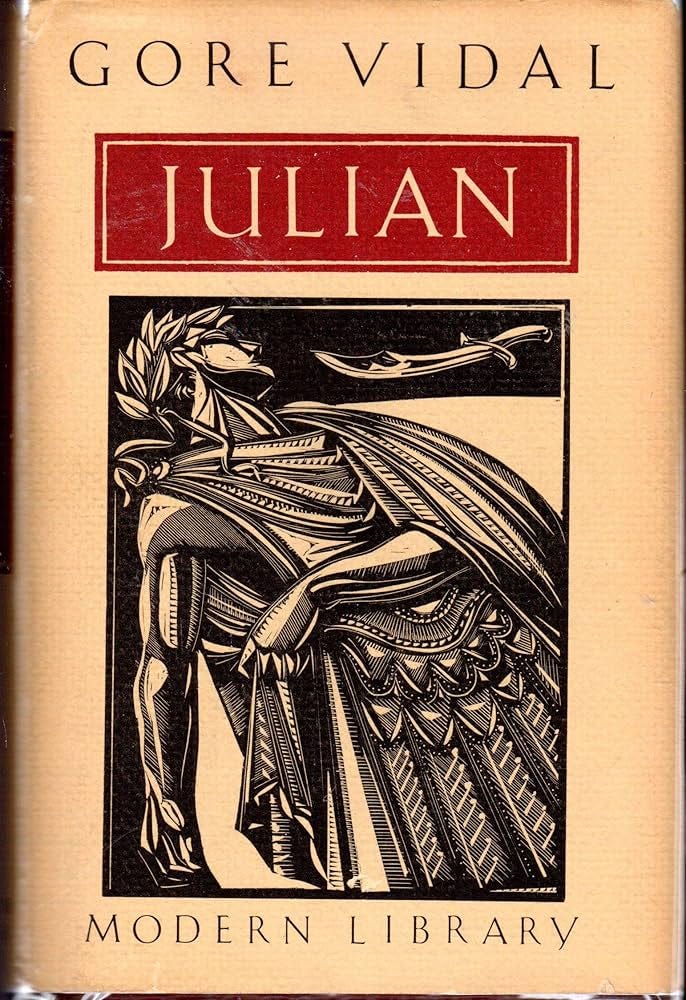
‘Julian’ is Gore Vidal’s fictional, epistolary autobiography of Julian the Apostate, last Pagan Emperor of Rome.
It’s an intelligent, well-researched, highly readable story which is still fundamentally less perfect than ‘Eagle in the Snow’, which follows a generation on from this, or ‘Memoir of Hadrian’, which remains the gold standard for ‘emperors telling their story’ stories.
At War With Christ
Julian is at war with Christianity, and so is Gore Vidal. From every source I could find he was utterly serious about his hatred for ‘Abrahamism’ and sincerely believes that something went massively wrong when the ‘death-cult of the Nazarene’ took over the West.
“I see nothing good ever coming of this religious system no matter how much it absorbs our ancient customs and puts to use for its own ends Hellenic wit and logic. Yet I have no doubt now that the Christians will prevail. Julian was our last hope, and he went too soon. Something large and harmful has now come into the life of this old world. One recalls, stoically, the injunction of Sophocles: “And ever shall this law hold good, nothing that is vast enters into the life of mortals without a curse.”
It is also significant that the death cult should take hold just as the barbarians are gathering on our borders. It is fitting that if our world is to fall – and I am certain that it will – the heirs of those who had originally created this beautiful civilisation and made great art should at the end be artless and worship a dead man and distain this life for an unknown eternity behind the dark door.”
The reign of Julian is perhaps the last moment in history when the rising tide of Christianity might have been reversed. We know this didn’t happen, and in the story of ‘Julian’, the gods themselves are as open as they can be about the fact their age is ending. The only people not listening are Julian, and perhaps Gore Vidal, who knows the inevitable truth but who is choosing to live through the dying moments of a millennia-long culture he grieves for, as.. not penance, perhaps in search of wisdom? I imagine him like a science-fiction time traveller traumatising himself by living though the final moments of a disaster he cannot change in the hopes that he can glean some slender fragment of wisdom from the conflagration.
What Does Gore Vidal Believe In? It’s not really clear and this is a flaw in the book. (I suppose in ‘being civilised’.)
Gay Gore
‘Hadrian’ and ‘Julian’ are both Gay Books. Margurite Yourcenar was gay and obsessed with Hadrian from early youth. (Hadrian was very gay.) Gore Vidal was largely-gay, wrote a very-open book about his Gay Love and, at least by his description, had his novels blacklisted by the New York Times for a decade, being forced to involve himself in Hollywood, until he wrote ‘Julian’, his best-selling return to being reviewed in the NYT. Vidal seems to have been very absolutely serious about thinking the Abrahamic religions were rubbish and wanting Hellenism instead, (though ‘Julian’ is popular with both factions), and his honestly very brave out-and-out true-love homosexuality, probably played a major part in alienating him from America, a country he seems to have instinctively considered ‘his’, and which he both desired and loathed like you would a charismatic ex.
“For the first time in history, a Roman emperor was mocked and thought ridiculous. From every corner of the earth derisive laughter sounded. yet except for this one lapse, I find Hadrian a sympathetic figure. He was much gifted, particularly in music. He was an adept at mysteries. He used to spend many hours at night studying the stars, searching for omens and portents, as I do. He also wore a beard. I like him best for that.”
(This paragraph would be perfect if it ended there but as with everything, Vidal, and Julian, talk too much, explain too much and leave little for the reader to do.)
These are songs of alienation. Vidal died in a culture where his homosexuality was pretty-much accepted, at least to an extent he would have never believed, but the high-WASP culture he loved was pretty much dead. Would an Hellenic world have been better?
Irreligious Gore
The man had, I think, not a sacred bone in his body. This limits the text. A book built around the conflict between two great faiths, two mysteries and two fundamentally different ways of seeing the numinous and the real, and the writer understands both, intellectually. Never did I feel that strange secret sympathy and vague numinosity I did with General Maximus in ‘Eagle in the Snow’.
Something BIG changed, and with it, reality changed. There was still corruption, bigotry, cruelty and sadism, but it was different, and even those arguing against it, or simply making characters who are against it, believe it; that something shifted in the soul of the (Mediterranean and European) world. They accept that it happened simply by arguing against it.
This might be why Jesuits apparently LOVED ‘Julian’, a novel about a main character who’s main deal is HATING FUCKING CHRISTIANTIY GET THESE GALLILIEANS AWAY FROM ME. Vidal is writing about that great change, the Jesuits are on one side of it and Vidal is on the other but they are both looking at this shadow tide of the soul. You can’t really look directly at it; too big, vast, vague and strange; the substance that thoughts float on, not what they are made of, but you can ‘see’ it by stringing together the substance of history and watching it quiver like a fat spiders web.
Vidal has his fingers on the web but he is absent at the sacrifice. He does not really believe and he is not very good at trying to.
“No matter what impels a man to pray to a god, the fact that he performs the ritual act is itself an act of worship and a beginning, even though his heart is false.”
Satire is an empty form. Vidal, or his characters at least, can war and flail against Christianity, dropping bomb after bomb, but they know they are not going to win, and Vidal knows he is not going to win.
“”Here are your latest crimes. Murders requested, and property requested ... oh, how you love the riches of this world! Yet your religion preaches that you should not resist injury or go to law or even hold property, much less steal it! You have been taught to consider nothing your own, except your place in the other and better world. yet you wear jewels, rich robes, build huge basilicas, all in _this_ world, not the next. You were taught to despise money, yet you amass it. When done an injury, real or imagined, you were told not to retaliate, that it was wrong to return evil for evil. Yet you battle with one another in lawless mobs, torturing and killing those you disapprove of. You have endangered not only the true religion but the security of the state whose chief magistrate I am, by heaven’s will. You are not worthy even of the Nazarene. If you cannot live by those precepts which you are willing to defend with the knife and with poison” (a reference to the poisoning of Arius by Athanasius), “what are you then but hypocrites?”
(Of course he know that hard-core Christians love this kind of thing. It is hardly going to put them off.)
But the ‘Hellenism’ Vidal and Julian discover/concoct to oppose and hopefully replace Christianity, feels in this book, very awkward and patched together, a ‘modern’ confabulation;
“Julian decided to make the ceremonial public. Everyone was shocked at the ritual scourging of an hundred youths by the priestesses. To make matters worse, the youths had agreed to take part in the ceremony not out of faith but simply to curry favour with the Emperor, while the priestesses were almost all of them recent initiates. The result was unhappy. Several young men were seriously hurt and a number of priestesses fainted at the sight of so much blood. The ultimate rites were a confused obscenity."
Both in the text and outside it, the answer isn’t very good. Vidal is yearning for something but he can’t quite commit to the bit. He is not engaging in the rituals with either Confucian sincerity or Wiccan bipolarity. We can see Julian experiencing his mysteries but we are never with him in those mysteries because that is somewhere Gore Vidal psychologically cannot follow.
"Yet from the beginning, there were always those who mocked. A senator of the old Republic once asked an auger how he was able to get through a ceremony of divination without laughing. I am not so light-minded, though I concede that many of those temples at Rome where certain verses learned by rote are chanted year in and year out, yet no-one, including the priests, knows what they mean, for they are in the early language of the Etruscans, long since forgotten."
Humanist Gore
An epistolary novel, ‘Julian’ is set with the accompanying text of two Philosophers; Libanius and Priscus, who both knew Julian before his death and are reviewing his autobiography, whilst arguing with each other about translation costs, passing acid remarks about this person or that or just complaining about age.
Priscus: “As to the famous Battle of Strasbourg, I can add very little to what Julian himself wrote.
Libanius: Then why do you? Priscus keeps protesting he can add little and then adds too much. He has aged. He always used to be brief, to the point of being laconic, but now...!
Priscus: my own memories of that day in August are quite vivid and surprisingly full, considering the fact that I have no memory of what happened last year, or even this morning.”
These catty, clever sections are the most Vidal-esque parts of the book, the most comfortable and also the source of some of its real virtues. Gore Vidal has never been a man to lust after the eternal or unseen, but he does quite like this life, and often has a fair amount of sympathy and interest for the people in it.
‘She rose heavily, with some difficulty. She steadied herself against the white marble wall of the tower. “Yes, I should have likes to have been Empress of Rome.”
“I doubt it. If you had been Empress, you would be dead by now. The Christians would have killed you.”
“Do you think I would have minded that?” She turned full on me and the large black eyes blazed like obsidian in the sun. “Don’t you realise - can’t you tell just be looking at me, my dear wise old Priscus - that not a day has passed in twenty years I haven’t wished I were dead!”
The speaker above is Macrina, mild autist girl philosopher and probably the closest thing Julian has in his life to an equal, happy partner and true love. He leaves and she never tells him she was pregnant with his child, which is politically and socially wise, but also destroys her, inwardly at least. In a tribute to Vidal’s humanism and curiosity, we meet her soon in pages but later in time, long after Julian is dead. This is one of the few occasions where Vidal rises above Yourcenar; he has an interest in the little people, and dropping into all the stories of all the little people left in Julian’s wake brings out much that is good and human in him.
Blindingly Obvious Gore
For the most part, having a prolix, relentlessly self-analytical protagonist, and two academic interlocutors going over every statement and event means that nothing is left to inference, making this actually a very un-literary book.
Julian’s parents are killed by his uncle and he and his charismatic, beautiful, confident, brutal, mad brother are raised by ever-watchful agents of that same uncle, in a state of simultaneous privilege and horror. A dark fairytale. This probably helped to crack open his brothers nascent madness and sadism, but we really don’t have a good psychological theory for what it means to be a king, or to be raised in murderous dynastic politics, in which the closest relationships are the most lethal. It’s a strange quirk of history that great polities become dark machines of death at their bases, where steel grind flesh, at their peripheries, where the Other is encountered, and at their very tips, where they consume even those who would rule them.
“You can never trust anyone, not even your on flesh and blood.”
I tried to protest loyalty at this point. But Gallus ignored me. “All men are evil. I found that out early. They are born in sin, live in sin, die in sin. only God can save us. I pray that he will save me.” Gallus made the sign of the cross on his bare chest.
“But it is a fine thing in an evil world to be Ceasar. From here,” he indicated a height, “you can see them all. You can see them at their games. But they can’t see you. Sometimes at night, I walk the streets in disguise. I listen to them. I watch them, knowing I can do anything to them I want and no-one can touch me. If I want to rape a woman or kill a man in an alley, I can. Sometimes I do.” He frowned. “But it is evil. I know it. I try not to. yet I feel that when I do these things there is something higher which acts through me. I am a child of God. Unworthy as I am, he created me and to him I shall return. What I am, he wanted me to be. That is why I am good.”
Probably there is some nascent or actual sexual element to Julian’s fearful, desiring love-hate relationship with his mad brother, but we don’t need to speculate, as Priscus and Libanius will directly point it out, in case we missed it.
The same thing happens when Julian, already semi-alienated from his families Christianity by the fact that they murdered each other whilst bleating about mercy, visits a range of prophets and magicians and, after witnessing some mysteries and getting some prophecies, becomes convinced that he may have a destiny to restore the old gods.
Or.. has this young and vulnerable prince, instead of randomly encountering mysteries and portents, actually been drawn into a well constructed conspiracy to manipulate him and convince him he is Alexander come again? Could it be possible?
Well again we don’t need to worry as Priscus and Libanius will tell us directly. No need to infer.
(An actually-good minor sub-theme of the book is that the sincere Hellenes, the true worshipers of the Old Gods who really believe, and their prophets, all constantly warn Julian that he is doomed, that their age is ending, that their voices are falling silent and that there is nothing he can do to prevent it, and he can perhaps only moderate the loss by civilising the Christians. It’s the goons, magicians and flim-flam men in the sparkling robes who keep telling Julian he is Alexander Reborn and is going to re-wind time.
‘”The bull moved unsteadily. One leg was weak. He stumbled. A bad omen. I took the ritual knife. I said what must be said. Then I cut the bulls throat in a single clean gesture. At least that went well. The blood gushed. I was covered with it, and that was also good.
... The mob was now quiet, interested I suppose, in and ancient ceremony which many of them had never seen before.
When it came to the augury, my hand hesitated. Some demon tried to prevent me from seizing the bulls liver. I prayed to Helios. Just as I did, the sun rose behind Mount Silpius. Light streamed on either side of the mountain, though its shadow still fell across the morning city. I plunged my hand into the entrails and withdrew the liver.
The omen was appalling. Parts of the liver were dry with disease. I examined it carefully. In the “house of war” and in the “house of love” death was the omen.”
Honestly, all the omens are accurate, and all of them are bad. Listen to your gods Julian!)
This anti-literary tendency to blinding obviousness and self-cleverness does get better as we go on. It feels like Vidal improves at writing his own book, in particular, the final act, in which Julian is stabbed in battle (by a Roman spear!) and dies at the hands of some kind of conspiracy. In a lesser book this mysterious conspiracy would be left wide open, but instead Priscus identifies one of the main conspirators, writes to him and is invited to his house where the man confesses to doing the deed for Jesus and, revealing himself as a petty mediocrity, is deeply desirous that Priscus publicise the act so he can go down in history, something Priscus refuses to do.
Vidal perhaps intended to valorise Julian but his deeper sympathies are with Priscus and Libanius, the tired, aging, upset philosophers who also hate Christianity and yearn for something else, but who, if they believe in anything, really probably believe in books and philosophy. (Though this is Julian himself);
“I seem to have missed the fault of avarice. I have no desire to own anything. No. On second thought, I am greedy about books. I do want to own them. I think I might commit a crime to possess a book.”
Hubris and Julian
The modern process of history was born complaining about Christianity; scholars complaining about stupid and bigoted priests. Probably Gibbon would appreciate Vidals ‘Julian’.
Largely they talk past the priests though. The scholars have no real answer for the strange, silent question of the Roman World; why did people stop believing? Why did the Old Gods fall silent? Why were they no longer enough? Why did people turn, and in such numbers, to such a strange, almost life-denying, cult?
Why could Zeus not survive the end of Rome? Its not like he even made Rome, Zeus was Greek first. Civilisations have fallen before. Why could not even Mithras survive? Perhaps the Empire, in its own long time, made a shadow to long, to deep and too invisible to its makers, for the Gods of the Empire to live on in its invisible dark.
‘Julian’ is not great literature but it is a good story, and as someone living through our own ‘slow fall’, and what feels like an axial point in history, a dying-away of what was, with everyone still in denial, it is a very prescient book.
But Rome is always falling in the Western mind.
‘There was a silence. Then John said, “Do you see no significance in our victory? For we have won. You must admit that.”
I shrugged. “The golden age ended. So will the age of iron, so will all things, including man. But with your new god, the hope of human happiness has ended.”
“Forever?” He taunted me gently.
“Nothing man invents can last forever, including Christ, his most mischievous invention.”
Eagle in the Snow
“Behind me I left my youth, my middle age, my wife and my happiness. I was a general now and had only defeat or victory to look forward to. There was no middle way any longer, and I did not care.”
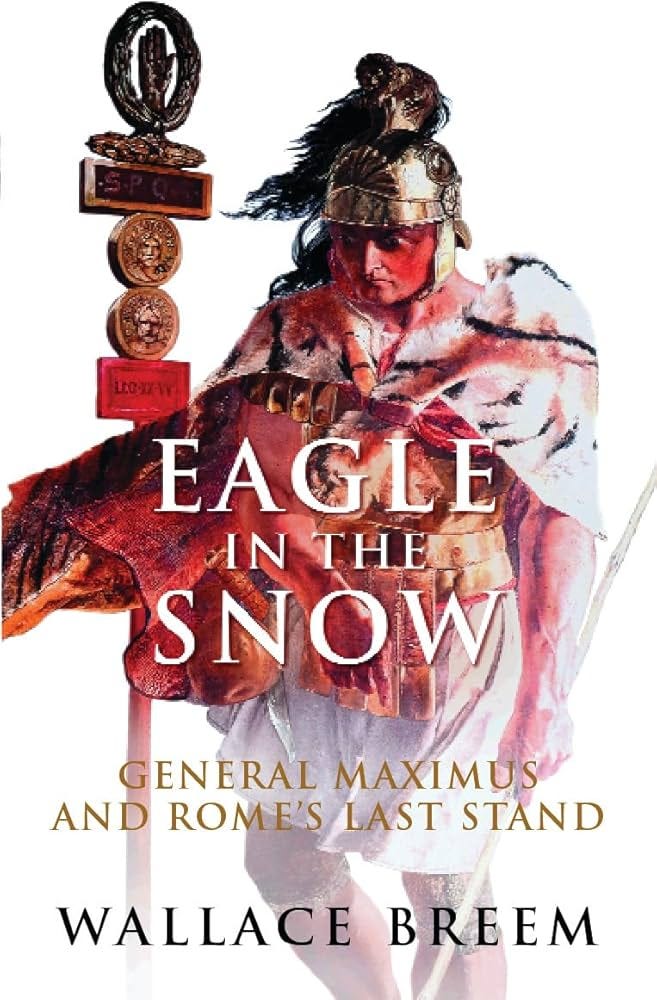
This is a very doomed book. Childhood passes in a page. Thirty years of service on the frontier in a chapter or two, five years fighting in Italy are skipped. What remains is snow, blood and the frozen Rhine. Wagner would approve.
More than any of the other Romaboo books I read recently (’Memoir of Hadrian’, ‘Count Bellusarius’ and ‘Julian’), ‘Eagle in the Snow’ is a book explicitly about war. Perhaps it shouldn’t surprise me that the law-librarian Wallace Breem seems to take a deeper interest in the details of tactics and defence than the WWI Captain in the Welsh Fusiliers Robert Graves.
It is surprising that this is an existential novel of late middle age, as well as, and on top of, being a dark adventure story, a leap at historical transport and an excellent guidebook on how to defend the Rhine against a mixed confederation of Germanic tribes while being dangerously outnumbered and under-resourced, should you ever need to do that.
Breem may not have been a Captain in the Welsh Fusiliers but he was a military scout on the Indian North West frontier in the years just before that stopped meaning anything and, unlike Rupert Graves, he fucking loved it. His careful descriptions of the intermeshing powers and personalities of inter, and intra-tribal politics; the pride, charisma, Heroism (in the Greek sense), and deep instability of the tribal world, and the mixture of cunning, theatre, threat, deception, bribery and slim honour used by the Imperial Legate to hold this strip of order, depicted in ‘Eagle in the Snow’ may have its roots in the tribes of the North West Frontier.
“and worst of all, you have sacrificed yourself for everything”
The original is “Your worst sin is that you have destroyed and betrayed yourself for nothing.” But what happens if you take the opposite path, and relentlessly, adamandly and heroically refuse to ever betray yourself for anything, ever, yet still come to nothing in the end?
Ridley Scott stole a kind of image of Maximus for ‘Gladiator’, but it was only a superficial sheen; the Apollyonic, heroic aspects. What makes ‘Eagle in the Snow’ not just a good adventure story, but good literature, is all the other parts you wouldn’t put in a Hollywood film because they are a bummer.
The Maximus of ‘Eagle in the Snow’ is probably the Coolest Guy Ever (tm), which makes him incredibly fun to read;
...
“He bared his teeth. “For that some men would call you - butcher.” He smiled with an effort. “But I come in peace. May I see my sister?”
“No.’ but you have my assurance that she is alive and well.”
He said passionately, “You are a man who cares nothing for the feelings of others.”
I said, “So men have told me. I care. But my people are not your people.”
He hesitated. “Will you tell my sister I came?” Will you give her this?” He held out a small silver brooch, such as girls like to wear. Judging from the workmanship it had come originally from the east. “I will do that,” I said.
He nodded. “Thank you. “He turned to go back to the boat. I took a step forward, unthinking. He swing round towards me: his hand flashed into his belt with the speed of a striking cat. With the knife upheld to throw he stopped and stood motionless as I pricked him beneath the chin with the point of my sword.
I said, “I wondered why you came. A man who loves his sister would have come weeks ago. I wondered too, why you gave the brooch into my sword hand. Did you think to catch me with such an old trick? I learned that one from the Picts on the Northern Wall when you were - nothing.” I pricked him and his back arched and his chin went up as he tried to avoid the point. Blood showed on the blade.
He licked his dry lips . He did not speak.
I said, “I could kill you for that. It would be my right. But - butcher as I am - I will not. Your father would not have been so foolish. Go back to your people, boy, and take your shame and your treachery with you. So long as you remain king I have no need to fear. Who would worry about such a people, led by such a king?” I pushed with the blade and he overbalanced and fell back into the water. I bent down and picked up the brooch, lying between my feet. He swam, splashing frantically, towards the boat, and the men hauled him in, all dripping. They were trying hard not to laugh.
“Aquila said, “You should have killed him.”
“Perhaps. This tale will be all round their camp by nightfall. They may do it for me. It will save a lot of trouble.”
....
The absolutely based power fantasy of supreme male competence. The kind of man we would all like secretly to be, or at least to be recognised by. Even better; he is ignored till middle age, simply ‘doing his duty’, until doom and disaster thrust him into the axis of history where he can reveal that yes, he was actually very cool all along.
He is also a man in the long, slow process or losing everything. Born into an abandoned faith, like Vidal’s ‘Julian’ he is a sincere Mithraic, and one of the last. He marches into the future knowing that in his camp of thousands only fifteen or so will follow him into the mysteries, and soon not even that.
Heir to a dying Empire; like Belisarius, one of the Last True Romans. This man who has never even seen Rome, has sacrificed his life to the idea of it. Multiple times he refuses to betray the trust of his superiors, less out of his love for them, but his love for Rome. Several people try talking geopolitical sense to him; why not take his fresh-trained Legion and just settle in, and protect, Britain? He would be self-sufficient, isolated, and its damn certain that no help will be coming from Rome to Britain - the resources will be drained from the province to help sustain some Dynastic drama or repulse some tribal invasion. Well he won’t do that either; Rome is all of Rome and we are Romans and we are not giving any of it up. The slow economic and demographic collapse of the West is in full view; everywhere towns are shrinking, walls crumbling, civilisation slowly falling back. It has been invaded and restored before, but how many times can you keep rebuilding while the foundation crumbles? Worst of all, the aristocrats are cutting their thumbs off to avoid military service. They are doomed if the tribes invade, but still won’t fight. What happens if the ruling caste of a society won’t risk themselves to defend it?
...
“I left the room with their cries of sacrilege echoing about me. I had not expected their co-operation, but their bitter, blind stubbornness and obstinacy in the face of danger made me feel sick. Their indifference and their fatalism had about it a hint of madness. I had met it in Britannia and in Italia - this blind refusal to face facts and to accept the need for change in a time of change. It was not new to me. If the empire were to die it would be because the people in it who held posts of responsibility no longer cared. They could not govern themselves and they had lost the confidence to govern others.”
Same bro, same.
Maximus knows, he must know, that the culture that defines him, is passing away. Other members of the elite respond to this like British voters, he simply compresses himself deeper and deeper into an absolute plutonic core of nuclear Roman virtue. But the end is the same in either case.
Wife dead; one of the few sources of softness in Maximus’ life; “Three months later I was sent on leave and went to Corinium, which I did not know. I went to the officers’ club and I drank, and I hunted a little, for they were much troubled by wolves that Autumn. Then I met a girl with dark hair whose name was Aelia, and I married her. For a wedding gift I gave her some gold ear-drops that had belonged to my mother, and she gave me a signet ring with the likeness of Mercury stamped on it. She was a Christian, though more tolerant than most.”
The poor woman ends up being posted, with Maximus, to the end of the world, (Hadrian’s Wall), an utterly lonely spot. Their relationship must have lasted at least ten years but it passes in pages. She is lonely. The tribes revolt and they are separated. After the tribes are suppressed he finds her again, clearly having suffered sexual assault. She gets better, gets sick and dies. Her ghosts haunts the rest of the story.
First friendship ruined; Maximus has a brother, in spirit if not in flesh. Almost the first action of the book is his arrest and exile of this brother.
...
“One day Fullofades sent for me. He was the new Dux Britanniarum; an Aleman from the banks of the Rhenus.
“A part of the Legion at Deva has tried to mutiny,” he said. You will go to Deva at once with reinforcements and take charge until I have appointed a new commander.”
I looked at him in astonishment.
“The Legate” (Maximus’ Father) “is dead,” he said harshly. “I am sorry.”
...
‘Taking charge’ means selling the mutineers into slavery, apart from the ringleaders, who are made Gladiators, and forced to kill each other in the arena, one by one, until only one remains. This one, who revolted, failed, survived, killed and remained at the end with a wooden sword to mark his freedom, is Julian, Maximus’ friend from youth. He also returns throughout the book as a shadow of the past.
Second friendship mortally wounded; Maximus does develop another best friend, the cavalry commander Quintus, a devotee of the Mithraic mysteries who stays with him throughout Britain and Italy, and faces the snow and doom alongside him.
The bad news is, as revealed by Julian in the last act; Quintus was having an affair with Maximus’ beloved wife.
‘”One half of my life has destroyed the other half.” I said aloud, and Quintus flushed and bit his lip. He was too proud to make excuses, too honest to apologise for the things he had done, about which he could not be sorry.”
...
The depth and extent of the loss, the dark strange echoing sense around Maximus, redoubles and increases his enormous, even staggering, Roman Virtue. He is a man fuelled by duty above all, even when all the referents and living expressions of that duty are dying, falling, fading, gone.
The very extremity of his character makes him something nearly less than human. We find this out gradually throughout the book, and we do have to actively find it out, (this is part of what raises ‘Eagle’ above ‘Julian’). Its easy to see why so many people admire and respect Maximus; his troops try multiple times to raise him to the Purple and he has to trick them and fight them off to stop it happening. Its easy to see why his enemies loathe but also admire him, towards the end of the book, even they, the German tribes he has been fighting, offer to join with him and make him Emperor.
Its also possible to see he might be awful, even despicable. He ‘loses’ his wife during the tribal invasion of Britain. Only much later do we discover that he retreated from a besieged town, leaving her behind. No doubt it was the most militarily effective thing to do, but still, would Quintus have just left her behind, if she had been his?
Maximus is not sadistic, but neither is he merciful. Again, this is politic for the leader of a Legion, but leaves a vague sense of emptiness. He endures the execution of a traitor amongst his own men, not really believing in it, in fact despising the process, but ensuring that it happens, for the good of the Legion. He watches gladiators ‘very properly’ fight to the death, only being horrified when he has to hand the wooden sword to the single survivor and look him in the eye. After a captured Gothic princess tries to assassinate him, he promises the tribes he will crucify her above the Rhine the moment they try to cross. Its impossible for us to decide if he really intends to actually do this; he ends up buying perfume for her and treating her as a kind of non-consensual grand-daughter. In the end he does send her to safety before the invasion begins, but he refuses to tell even his closest officers and friends, right up until the last moment, whether he really will murder this woman in full public view, keeping them, and the girl herself, in an agony of expectation which nearly sends her mad. As the hero of our story, we feel nothing but relief when he finally sets her free, and once he does so, it seems impossible that he would have done anything else.
But he might have. A more sinister, and more accurate picture of Maximus is that he probably would have crucified this woman in full view if it had been useful to him. If it would get him an hour, a day, a minute longer before the inevitable tribal invasion, he might be willing to do anything at all. The implication that ‘Grandfather’ Maximus and ‘Ruthless murderer’ Maximus are actually the same man, and share the same body, is more interesting. Not an ‘evil’ man, in fact extremely honourable, more than most, honest, brave, clever, loyal, even imaginative, perceptive and subtle, not to mention strong-willed. But cold. Colder than he seems, colder than perhaps even he knows, though he starts to realise on the Rhine.
It is the coldness of Rome, and this sad, echoing, existential mercilessness, mixed with high virtue and great culture, makes this more a pair, in spirit, with ‘Memoirs of Hadrian’, a book about a great and virtuous man in the grip of a slow spiritual crisis he cannot fully see or understand. Something of Flauberts ‘immutable ebony’ - the spiritual crisis that leads to Christianity.
Conversely, ‘Duke Bellusarius’ is another militarily expert and virtuous general who is continually betrayed and dropped into problems, but, despite all his incredible events, he is a less interesting character than either Hadrian or Maximus, perhaps because he is spiritually certain of what he is doing and never changes in that. The material, and Mithraic, pairing, is with Vidal’s ‘Julian’. Both Maximus and Julian are sincere Mithraics in a time of Christian domination, both are, oddly engaged in fighting Germanic tribes on the Rhine, sometimes in exactly the same positions, (Maximus visits and defends several places noted by Julian in his own book nearly 50 years earlier in described time.) In a way they are doing almost exactly the same thing, and facing nearly the same challenges, material and spiritual, separated by fifty years. The two books couldn’t be more different in spirit and character and, at least so far, the hidden cleverness, cool inference, focus on a single individual and general taciturn subtlety of ‘Eagle in the Snow’ makes it a better, and deeper book, which actually makes you feel the moral coldness of the ancient world, this deep incohate worry which is really what ‘Hadrian’, ‘Eagle’ and ‘Julian’ are all about; ‘our gods have abandoned us’. Things no longer work as they did, or as they should, yet to submit to ignorant, superstitious and bigoted Christianity is either inconceivable, or impossible.
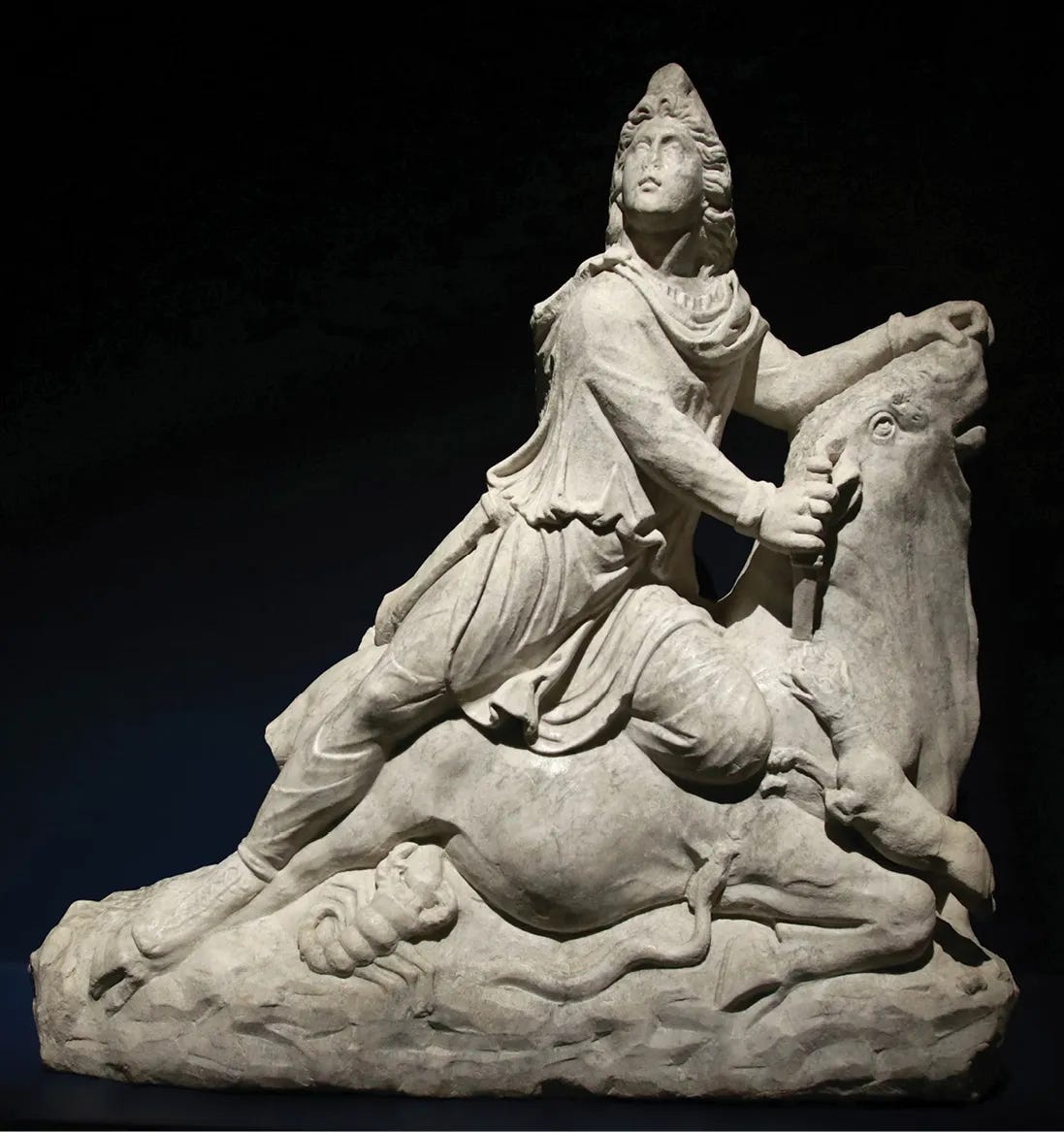
We built it, we cherished it and we renewed ourselves before the god in whom we believed. I stood there beneath the blue vaulted ceiling, while the light slanted like a lance through the open windows onto the upturned eyes, and the knife moved, and the Bull died. In that perfect moment when everything was clear I could see the way and the pattern and the world of no shadows; and I knew what it was like to be a child in the womb as I knew what it would be like at the moment when I died. I could feel the very skin that covered me age and wrinkle and see the nails grow upon my fingers. I knew then, without doubt or hesitation, that the things that mattered would come right for those of us who had the courage to burn ourselves in the sun.
Have you've read Vidal's Blondel?
I was thinking about "Julian" just the other day, so your post is a welcome one. Good insights, as ever.