
The Ink-Scribed Sea
You are a Franconian Pear Tree.

You grow with an unerring regularity, year upon year, in an orchard in sight of Nuremberg's walls. You have no idea, currently, how many Popes there are; could be up to three. As a tree you don’t keep up with the news. You know your job; survive, deliver regular pears, and stay out of religious matters. You will achieve oneof these things.
You will have a hard time doing so. Hussite Wars, Margrave wars, (armed men steal your pears but never get round to cutting you down, though they do with several of your kin) droughts, (you put a lot of effort into maintaining that extremely-even growth pattern), and plagues (lol, die monkeys), but you pull it off. At some point, an armed procession marches past carrying the Imperial Regalia, and ultimately, this is what dooms you.
The Nuernberger’s put these Relics in a box, (Oak, no relation), hanging, held by chains, above the congregation in the cities Cathedral. Every Nuernberger, almost every day, can see the relic box up there, but they can never see the relics. Only once a year can they be shown and the chaos this produces is deranged. Even out here in your orchard there are crowds, sheltering under your branches, eating your pears, going on and on about ‘did you see the relics’ and ‘I thought someone died in the crowd’ (they did, people get crushed every year), handing each other gingerbread and thimbles and boasting of the mirrors on their caps which, they say, have seen the relics, even the lance with a nail of the True Cross, the image passes on but the sacred power is held within the glass. Which they then wear on their silly hats.
This urge to freeze a moment still in time… They have pictures too, age, you are getting old, it’s true. How long can a Pear Tree live? You wither. Can’t get them up. Some years they don’t come at all. But the pictures, pictures on paper, they have these too now, more each year. These are not like the frozen moments they imagine trapped within their mirrors, nor have they drawn them for each other, they are some third thing, the mark of human hands is on them, but there are dozens, nearly identical, on fine white paper made from rags. Even the pear thieves can afford them!
But its late now, far too late. You can feel the end coming. Soon you will be bowls. Or possibly a flute, that would be nice. They chop you down and saw you up, and make you wait, for years again, hanging around dripping sap.
“This one.”
The voice is not a pear thief, not a priest, a knight, not a peasant either. It’s one of those other people, the Goldsmiths son. A ridiculous figure.
Sawn, set sanded. Smaller and smaller, flatter and rectangular. Barely even a plank. What use could you possibly serve? The pompous, flighty, silly youth, chatting to his mother, complaining about light, about lamp-black and curtains.
What is he doing? He is drawing on you. What is he drawing? Are you a painting now? What ferocious concentration. He seems satisfied at least.
More movement now, more men. Old men with knotted hands, old heads hanging over you, and beyond them, like the sun, bobs the Goldsmiths boy, he is talking talking talking, and they don’t like what he says. Here is the clicking of tongues and down-cast eyes you remember from Farmers saying something “can’t be done”. But the boy is capering now and still talking, gesturing, describing, describing motions with his hands, HE’S GOT A KNIFE! The boy cuts air as if he could kill it, hands twisting, turning, moving, layering, the old men are watching, uncertain, but thinking. The boy has coin. This seems to settle it. O shit, here come the blades.
As strange and horrid as this is, the common afterlife of wood is not so bad. The men are abominably careful, the lines they carve so light, so precise you can barely sense them, but you can hold them, of course, as a Franconian Pear, all that neat and regular Germanic growth, those tightly nested rings, you make a fine surface it’s true. Exact.
Now back to the boy, he is smearing you with ink. Well, again, you are pretty tough. You can carry that. Fitted into some kind of giant screw? What. A plain white, clear white, unmarked field, as white as snow-bright sky. But it grows darker as the screw grinds down, blackening, blackening, carefully. MASHED. HE IS MASHING YOU.
And then released. That screw is squeaking more as you are raised. What has he done to you? You see it now, resolving into lines. Made of lines, as nothing in nature is, for things are things, not marks, have their fullness, and this image is composed only of cuts, of cuts in you, you know this for you felt each one, and the only way to mark you is to cut you, for you are tough, even, clear and strong. But these cuts forge a simulacrum of nature.
This nest, this web of lines is growing now as you are carried far above it. Though lines, they make a World. A Saint. The illusion of a Saint, made only out of lines, composed of cuts in Pear Wood. So that’s how they do it!
“Good for fifty this year, and good for ten years more.”
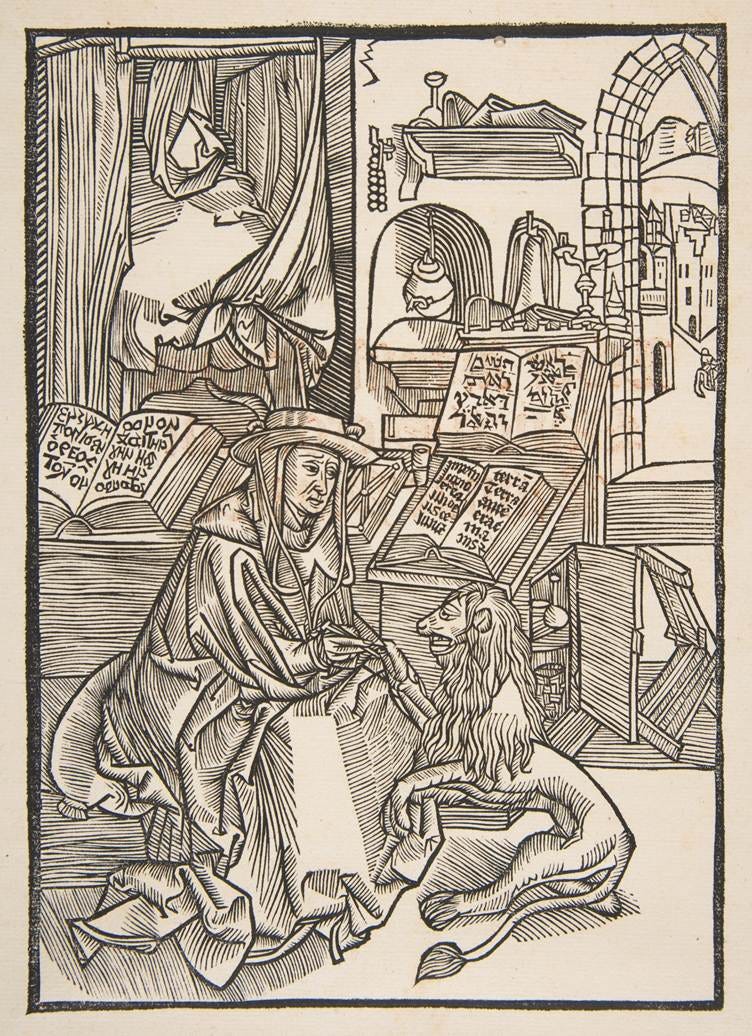
For scenes of sacred truth and images of God, go to the church, and, in this be little different to ten thousand years of human beings, for the Images, of Gods, Monsters, Heroes, Kings and (symbolic) semi-naked women with amazing boobs, are placed somewhere sacred, they cannot easily be moved, and you must take your body to them, not the other way around. Anyone may see, but all must enter in.
But here in white-hot techno-city Nuremberg, the world is bound in shadows, stamped, replicated, set in pages, and exiled out, back into itself, a world within the world, gathering gold along the way, all for the carver of the sign.
As techne binds the seen world in replicated form, it looses hordes of greedy and inquisitive Europeans out across the wine-dark sea. The little bastards can get anywhere now! Pease Allah, find me a navigable river-mouth that doesn’t have a European living on it, sweating, sweating and surrounded by prints.
Now the world will be re-made in monochrome, in graven lines, and sent to noble minds, and low. The price of books is falling. Paper tech’s improving. They hang these things in taverns now; Eastern Seas, Tiger Hunts, the Bible, forms foreign and impossible, all neat in black and white, and for anyone, for everyone to look upon. Newspapers?
A new Mass Culture of the Seen worms its way out of the womb; radio-for-eyeballs. Prints.
The Complete Engravings, Etchings & Drypoints of Albrech Dürer, edited by Walter L. Strauss
He is such a weird guy. It can’t just be that he’s German and five hundred years in the past, the man is genuinely odd, all by himself.
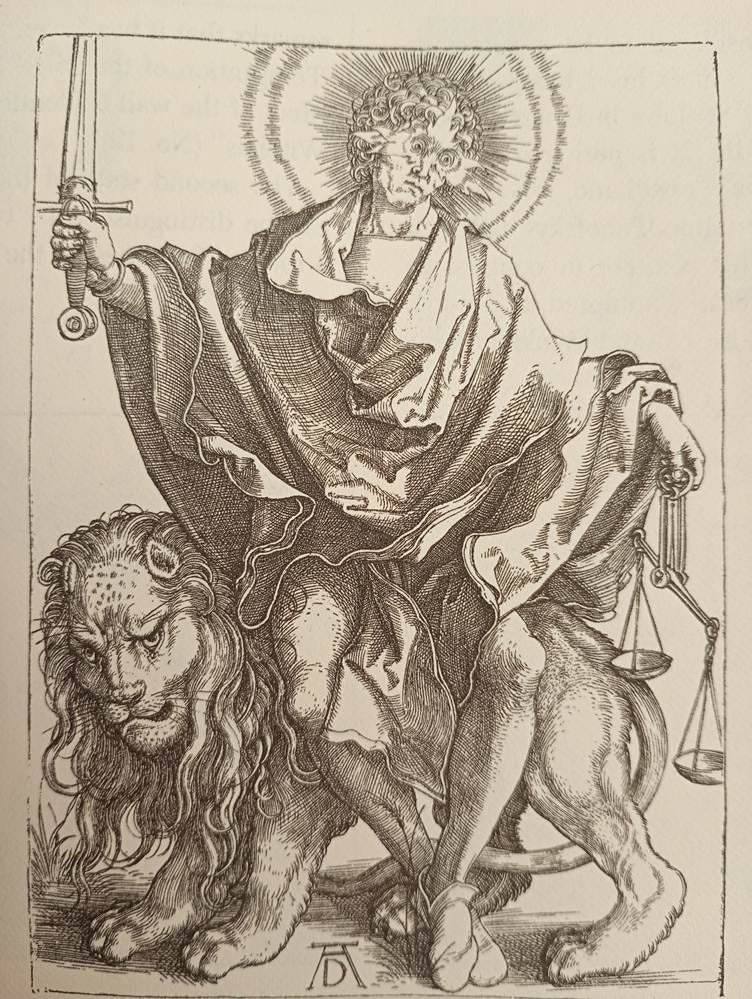
This was the last of these books I bought but the first chronologically. I wanted to see more of the history of Engraving, of the pressed black lines, and Dürer strides the spring.
He’s so fucking odd. Grotesque. The engravings at least. There are no woodcuts in this book but I think I actually like the woodcuts more. The Old Pear Plank forces the armies of autistic detail back upon themselves, and forces Dürer to actually-design a page. The grain simply won’t let him chimp out like he wants to.
If the Italian Renaissance was; “The Bible, but sexy.” A world where everyone is slightly maybe gay and possibly bangable, then Dürers world is “what if I am surrounded by strange-fleshed Goblin People? What if even the hot people aren’t actual hot? I feel meat crawling on my bones.”
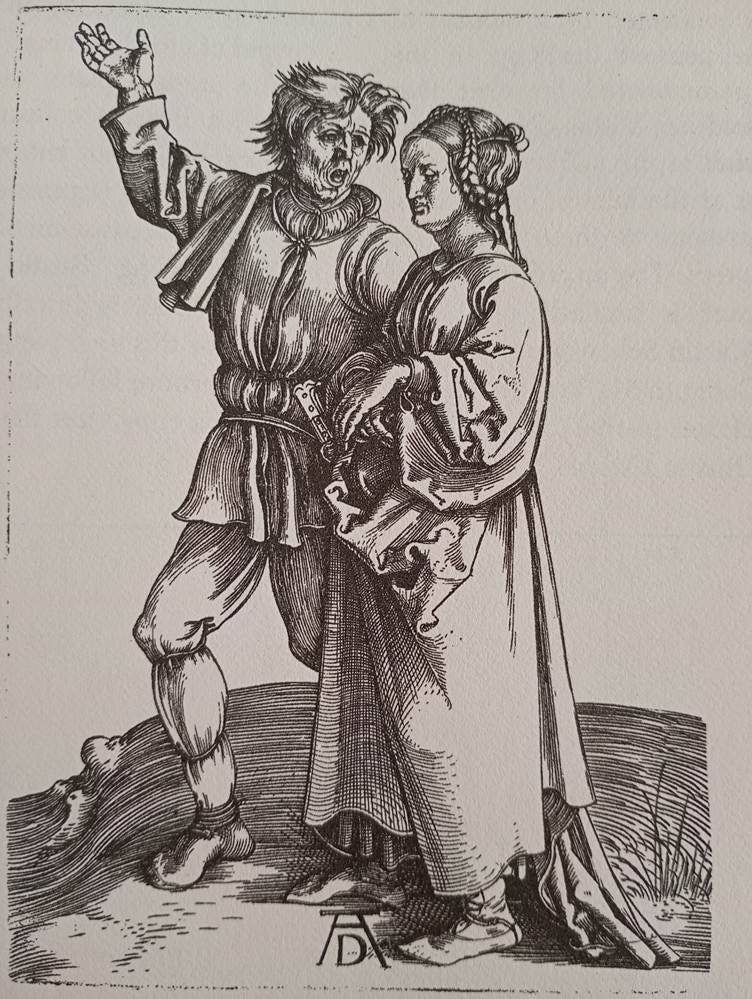
When he has access to Engraving, in particular, I found Dürers oddness, love of grotesquery, apparent hatred of human beauty, and frothing mania for detail, to be a kind of nightmare. Etching frees him from this a little and Drypoint frets him gently into a pleasing cloud of form, but the full-on burin-cutting, where he presses down into the copper, carving off these looping snail-spirals of metal with his Goldsmiths hands...
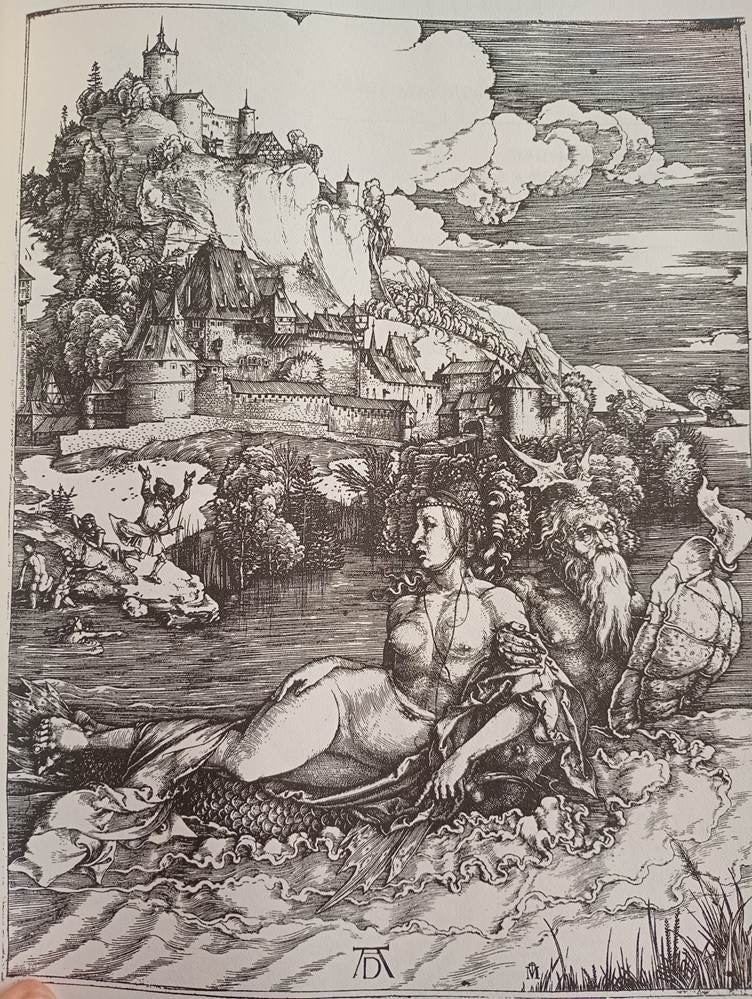
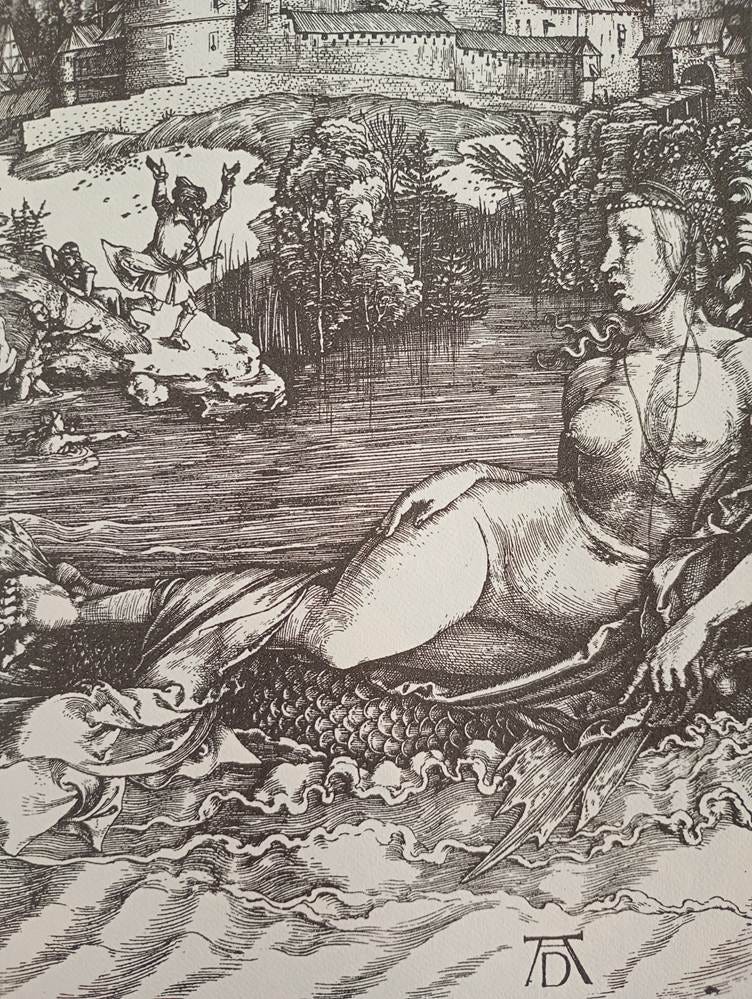
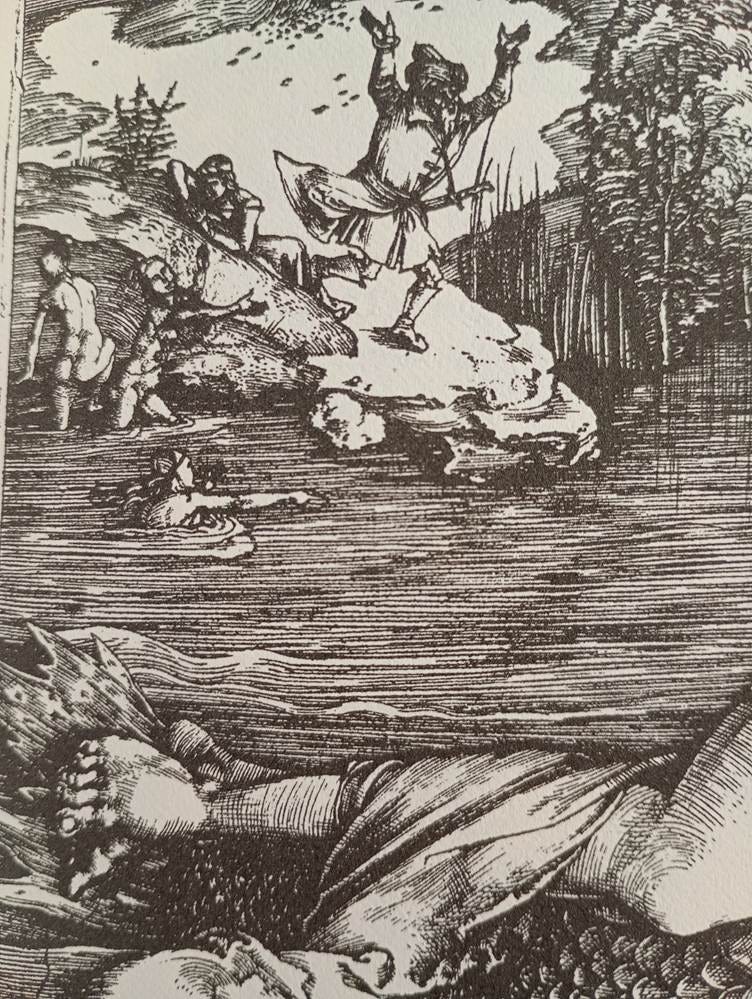
What about ‘Melencolia’ what about ‘The Knight, the Devil and Death’? Just Play the Hits Already! Yes. Dürer is a genius without compare, and his pop hits amaze the eye, but, you have never had to read through a whole book of ALL the engravings where you get the Hits but also, say, a very long sequence on the Resurrection? Have you?
Cyberpunk Nuremberg; perspective has been invented in Italy, but its secrets are well-kept. Someone pirates an Italian book and artists creep through the city at night, to secret meetings where the book, and its knowledge will be shown. Conceptual Horse Theft; Dürer makes extensive notes on the ‘Proportions of the Horse’ - oddly obsessed with horses, he will write the Core Text on his equine friends, but, someone steals the horse notes and makes off with them! They are never seen again.
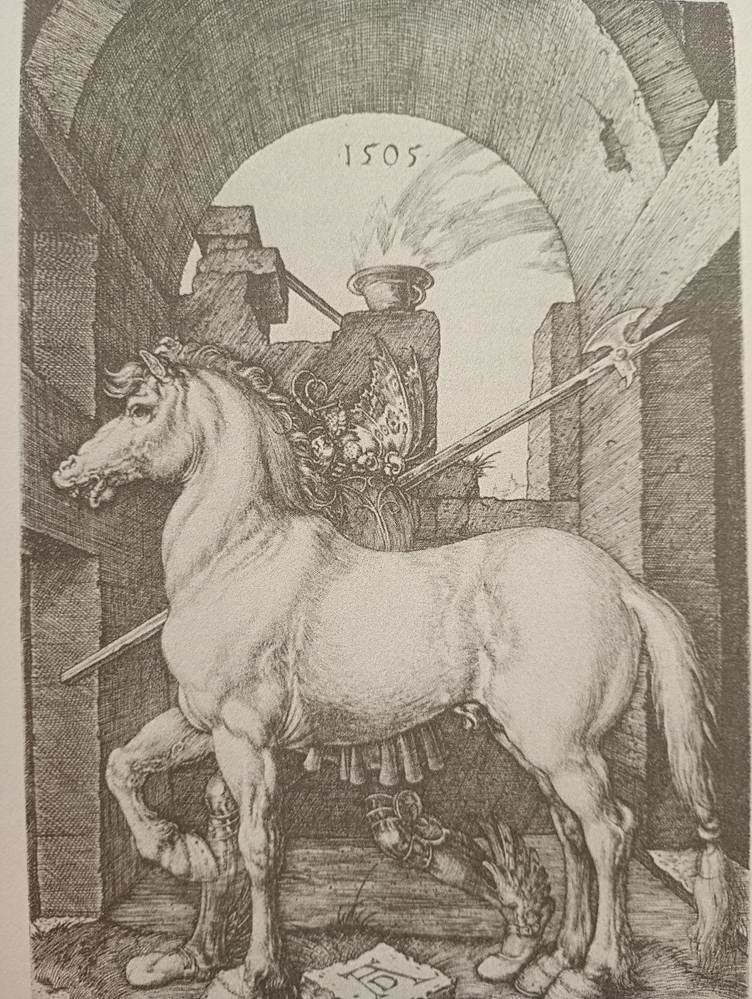
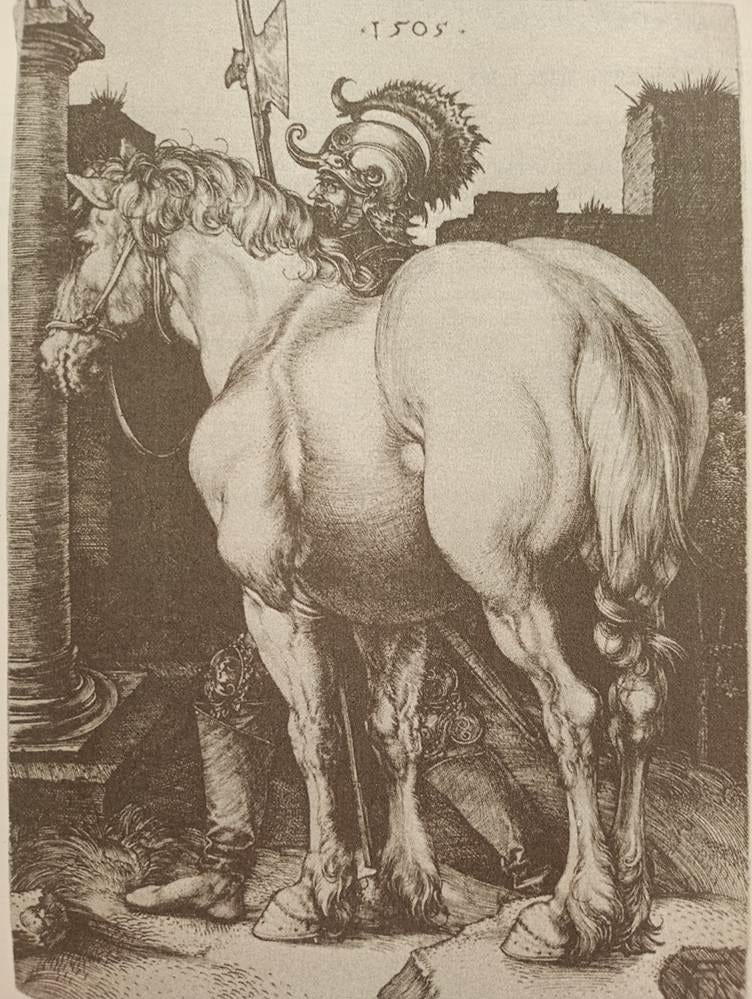
Capital and Industry; perhaps as an anti-piracy measure, but mainly for his ego, Dürer incorporates his signature-sign not only into his pictures but as a diegetic item locked directly into the scene, like there is literally an actual physical sign in the image with ‘Albrech Dürer Did This’ in effect. He DRM’d his etchings.
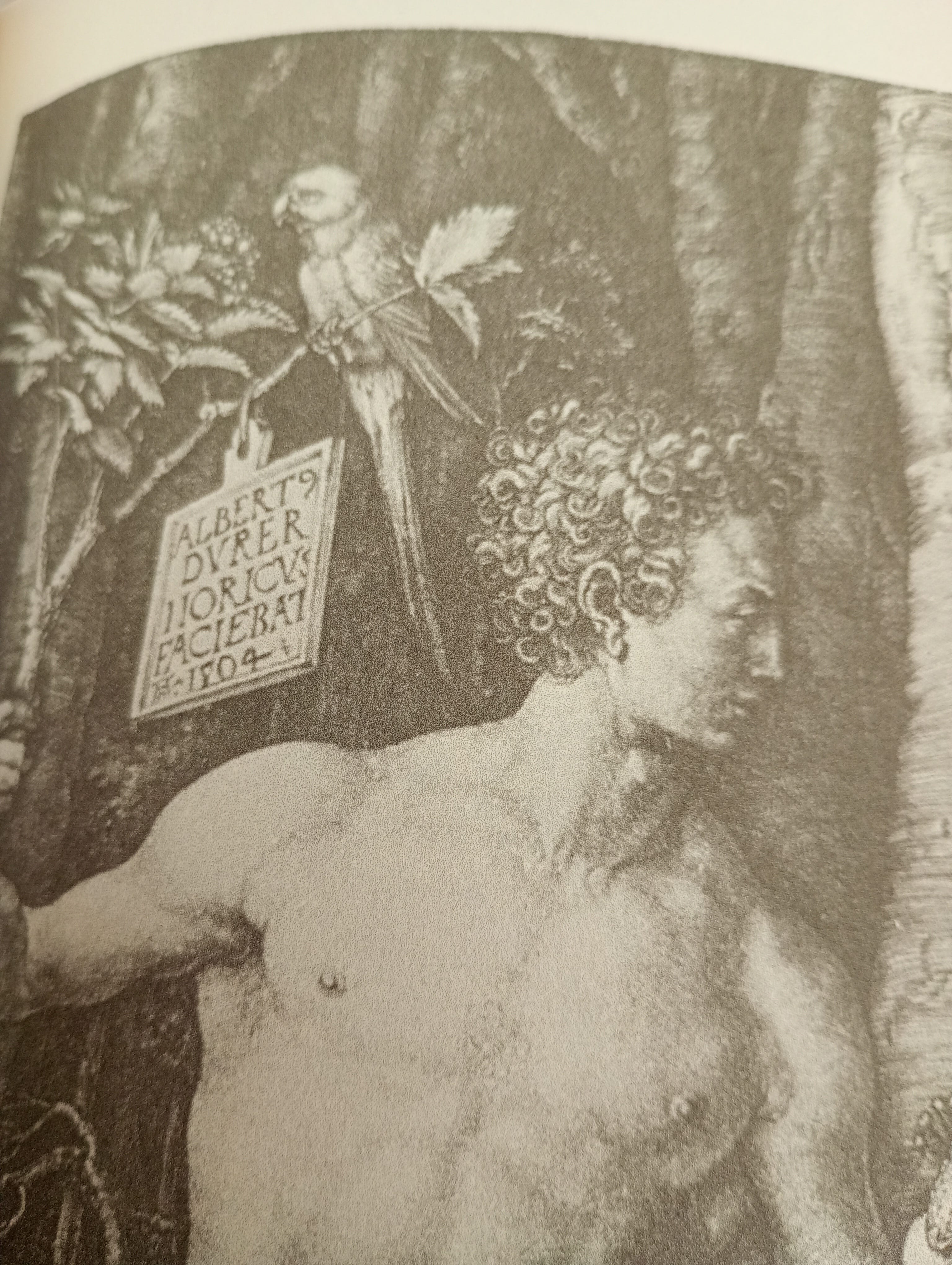
The strongest single stamp upon my mind, from all the Dürer rambling, is the legend of Capital being born. From the moment mass replication becomes a thing, the business changes. Dürer insists on staying his own publisher - He controls the prints, the plates, the creation, maintains patronage links by handing out free prints, and even plates, to the most important people in the land. Market reach, investment and control. If you can replicate it, so can someone else, so now you are a lawyer too. And the stacking of artistic, industrial and business skills; you don’t just draw, you carve, etch, engrave and drypoint-cut, and you know how the press works. Perhaps you own the press. And you sell them yourself, (in fact your wife and mother do on your behalf). Now, instead of assistants in the studio, we have the goblin-men, those calm, careful and unrecognised men who fill studios and complete the work of the engraver on the plate. These workmen, who apply the lines with human hands, last five hundred years hidden behind the scenes of the scenes of the world.
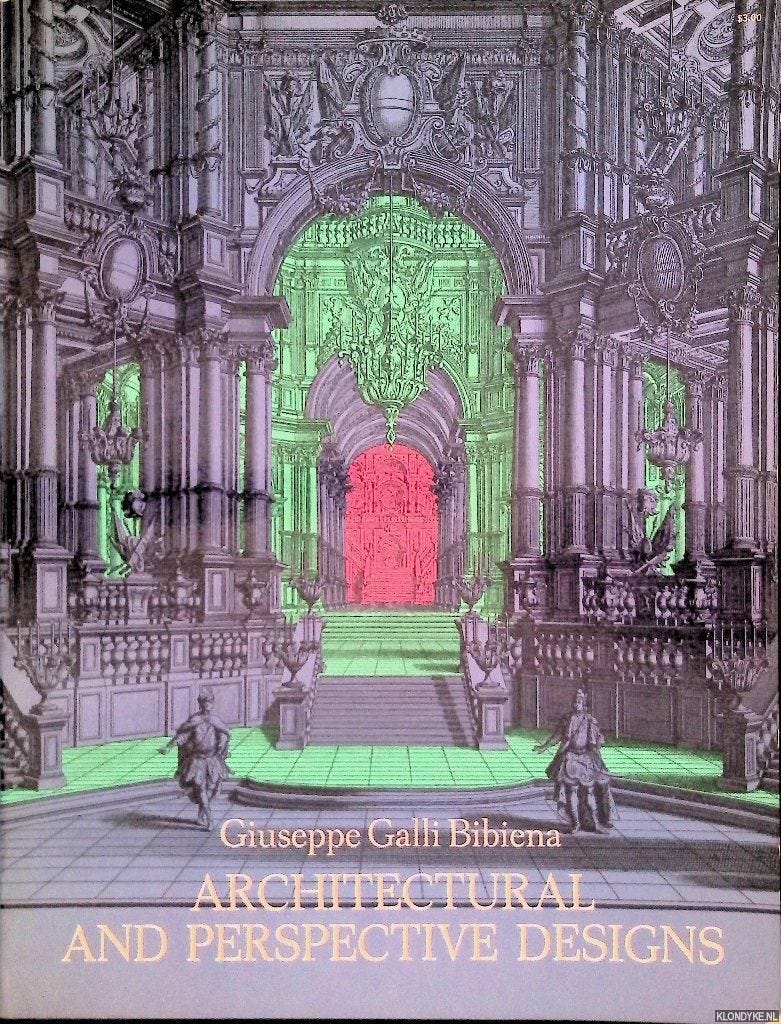
Architectural and Perspective Designs by Giuseppe Galli Bibiena
The ink-scribed world expands, out into architectures that cannot exist. This, isn’t Bibiena;
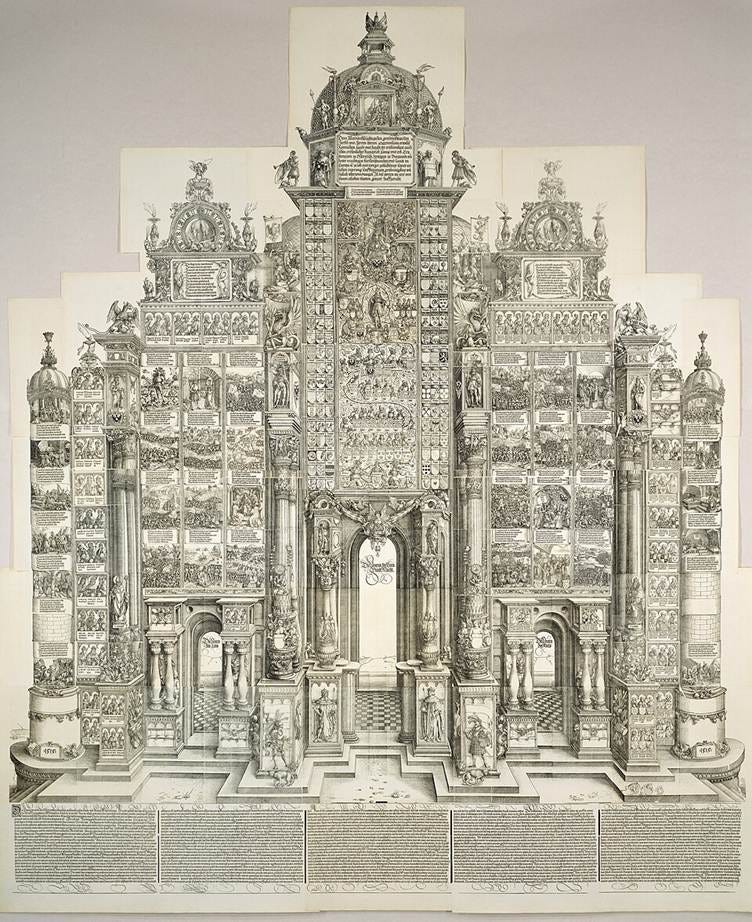
Its Dürer again, building an Emperors Triumph out of imaginings. The real arch was never, and perhaps could never, have been built, but printing allows us the great, mad systematic dream of what it could have been.
This is Bibiena;
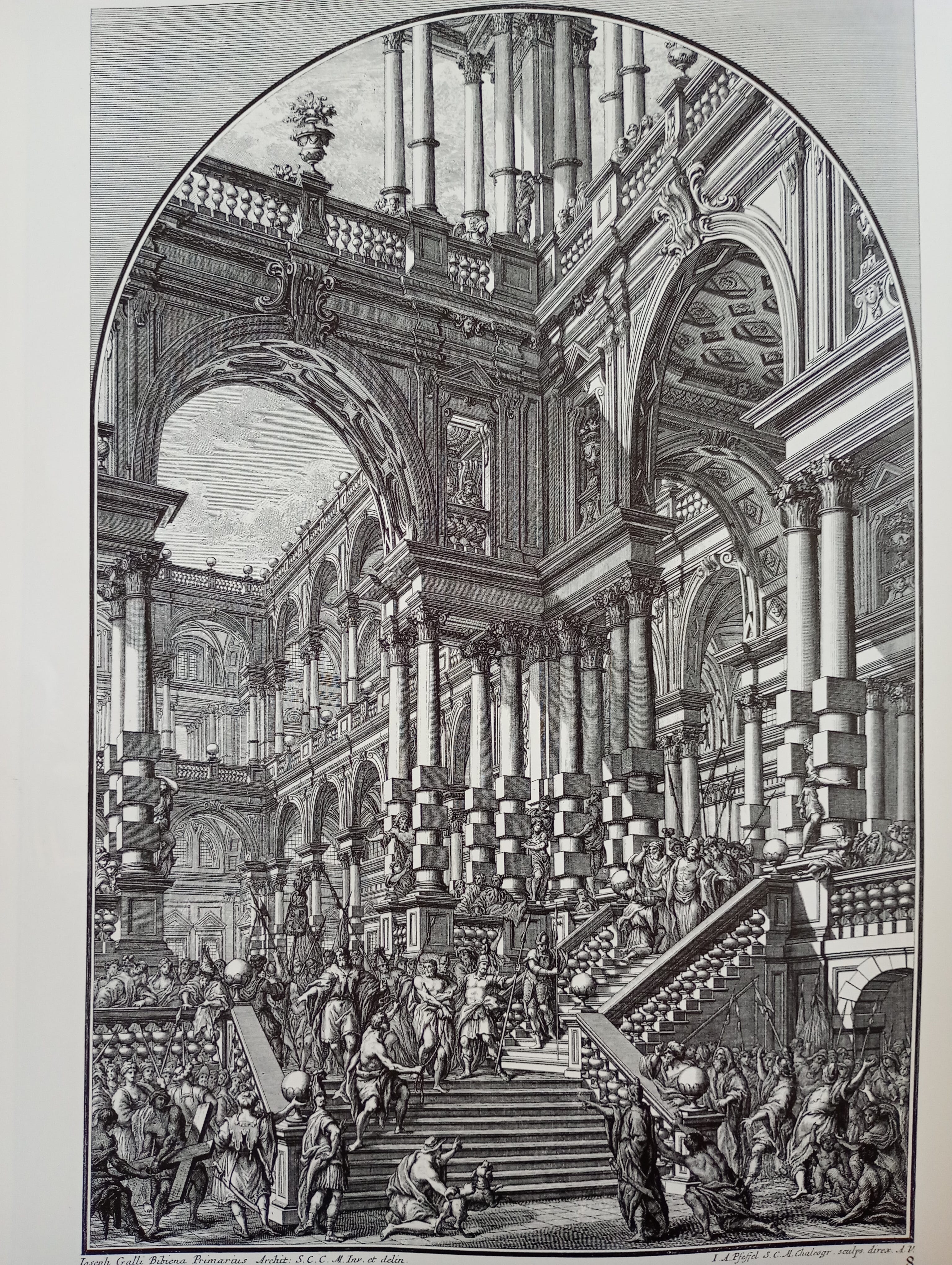
Operating several centuries after Dürer, but gifted with advancements in that bleeding-edge tech-philosophy perspective. Now we have multiple vanishing points, often located totally outside the image as it is intended to be seen.
Baroque Escher, mad experiments in the intensification of perspective, overwhelming in their detail, like a mad kind of paradise, a hyper-baroque Backrooms, wonderous yet awful palaces of light. More Baroque than any real building could possibly be, almost science-fictional, fantastical, with the slight tenor of fear behind the luxury.
I have no idea if these theatre designs were actually used, if they were, they would have been torn down quite quickly afterwards, but if they were, we now have another layer of simulation running, not just an abstracted stage-set, but a world.
What is happening in these densely layered, caked and colonnaded, ornamented super-columned statue-scattered palaces - I imagine being trapped there, I want to close my eyes and turn away, as if surrounded by a loud and constant noise, so much detail that only a mad-man could apprehend it all, everything seems to have a meaning but if everything in one image means something, every statue and ornament, then the verse or poem each image, each imagined space is speaking, is more like Black MIDI or some hyper compressed deep fried digital artefact than classical music.
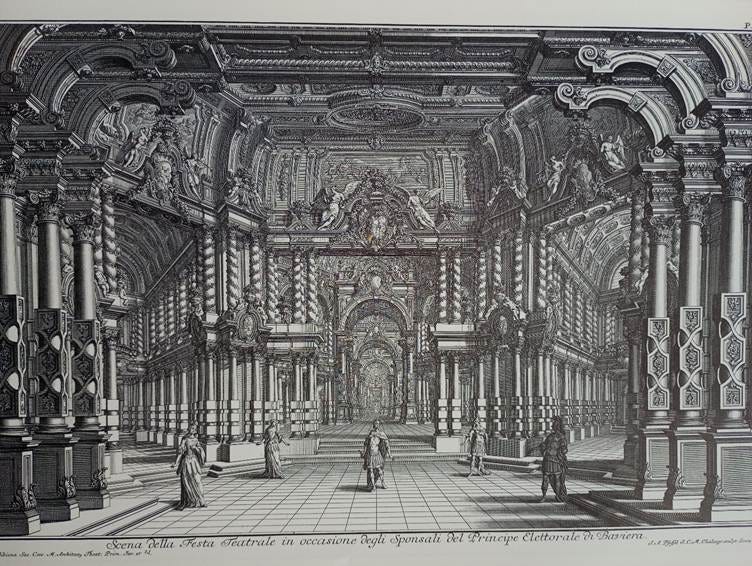
The enormous fineness and terrible density is like a beautiful attack, like a cold fairyland made by a mathematician, an ultra-Europe or meta-court, perhaps humanist, certainly not sacred, but nothing human could survive or be noticed there –
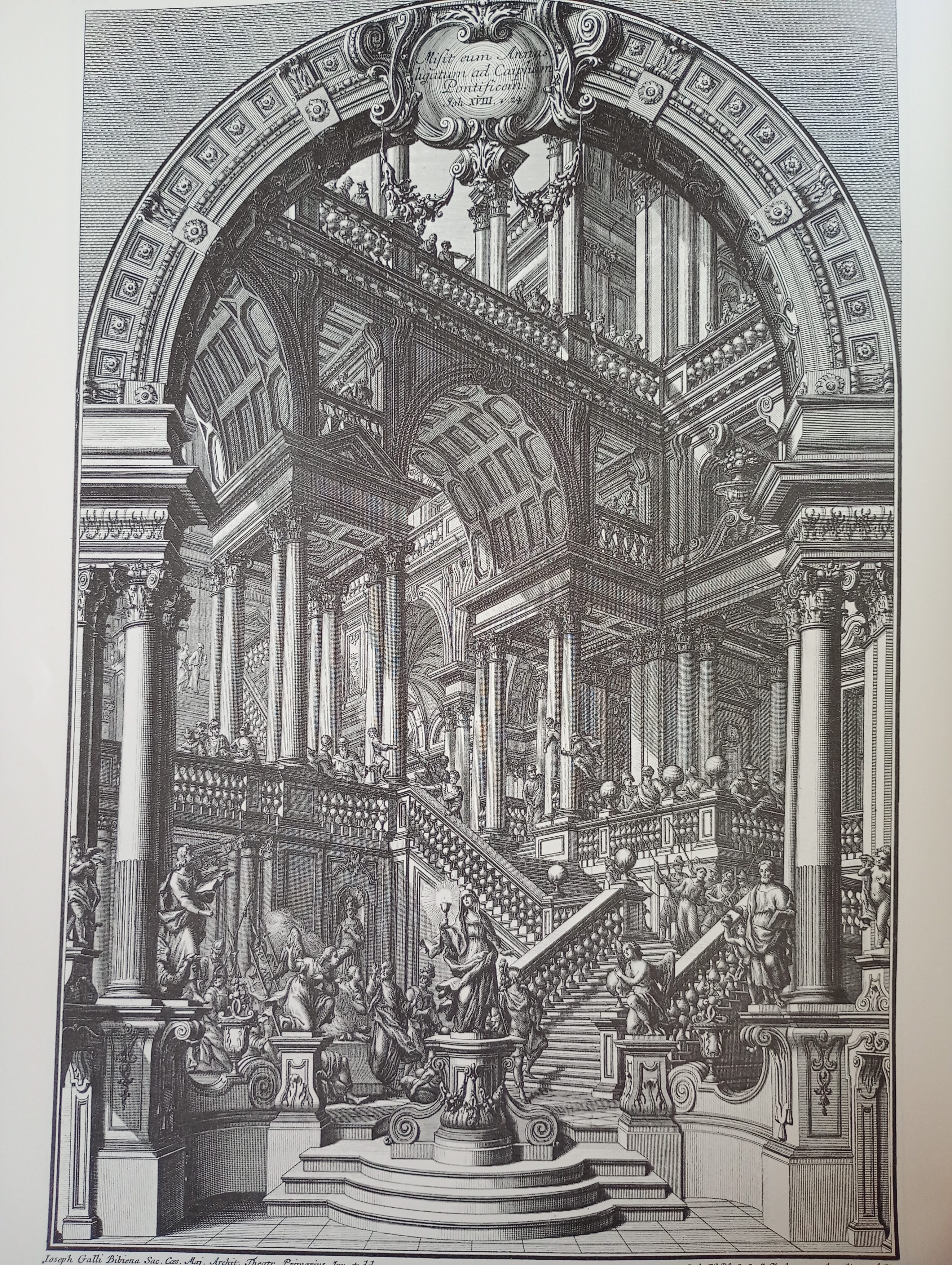
Piranesi is the other equivalent, it is surprising to find that light can be more terrible than gloom, that finery can be more awful than decay, there is a kind of tension within these images, a frantic mania, as if we are in the juddering hands of an amphetamine addict. So different to the soft, nearly warm fear of decay, torture and the unseen that infiltrates the ‘Carceri’, here the nightmare is that we can never leave, that turning our way into these explosions of Baroque mania, we will find ourselves in yet another statue-covered hallway with about a million columns setting off into infinity, each with individual floriate tops.
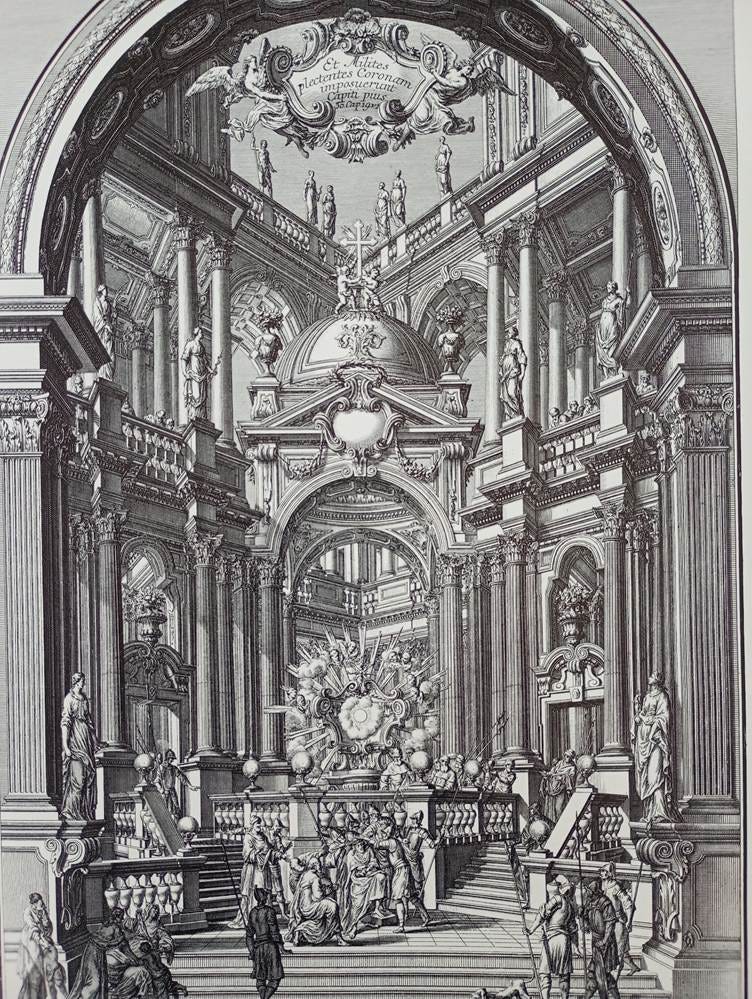
Bibena is an employee, and the history of printing, and the mass replication of images, seems to be passed regularly back and forth between slightly manic Tony Stark owner/operator/artist figures, and honest decent clock-punchers, and it is very much a fey Iron Man figure that we hop along to next. The strange gift of perspective flows through Piranesi, John Martin, and finally emerges again into the popular stage. We have had the world most autistic German, an extremely Italian Italian, now prepare for the Frenchest man Alive;
The Fantastic Gustave Doré by Alix Paré, Valérie Sueur-Hermel
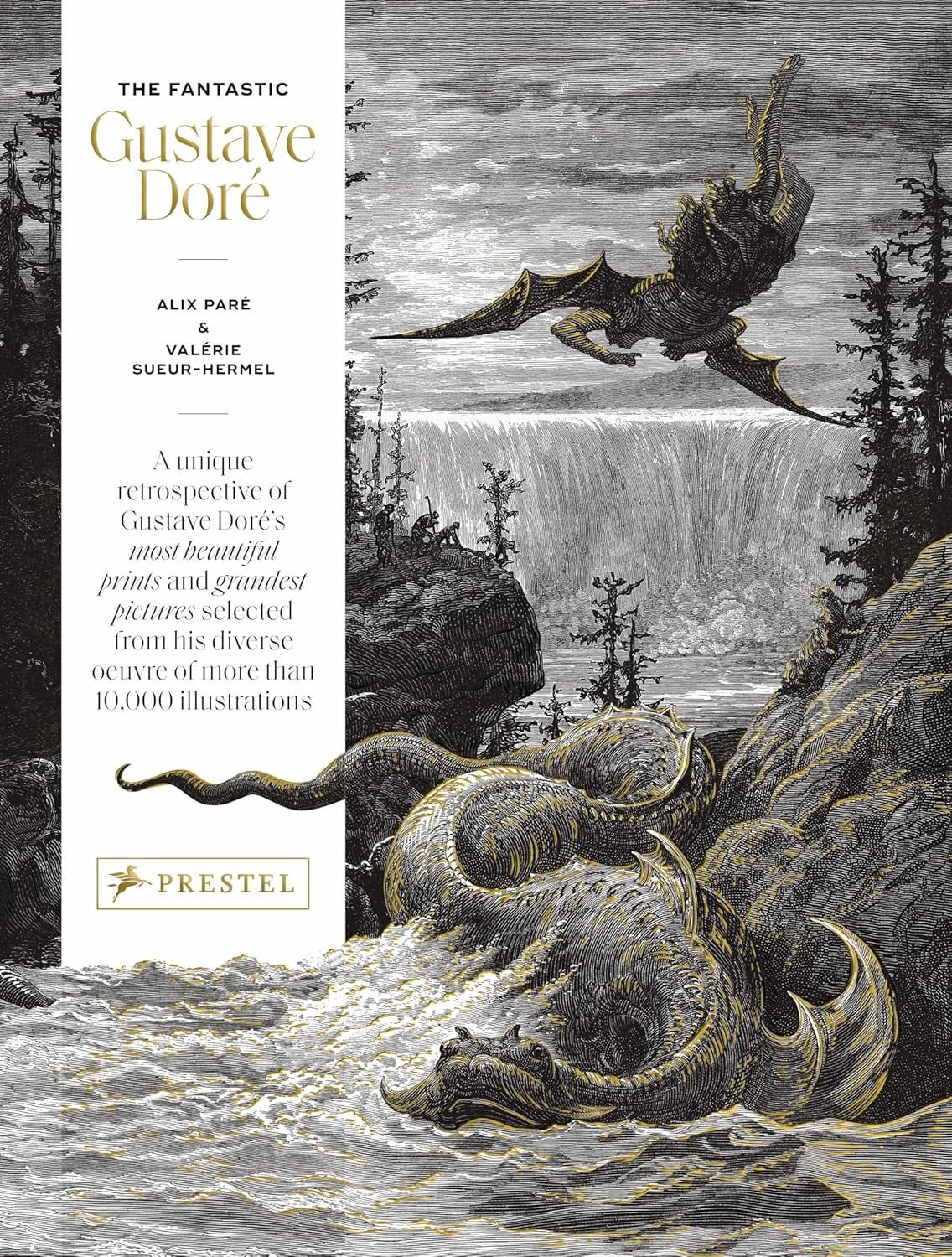
This is one of the best art books I own. Mainly because Gustav Dore’ was dedicated to smashing out absolute populist bangers and just never stopped engraving, and partly because the creators of the book manage to, first, select good pictures, and second, get the fuck out of the way of them, (which many art-book creators do not do).
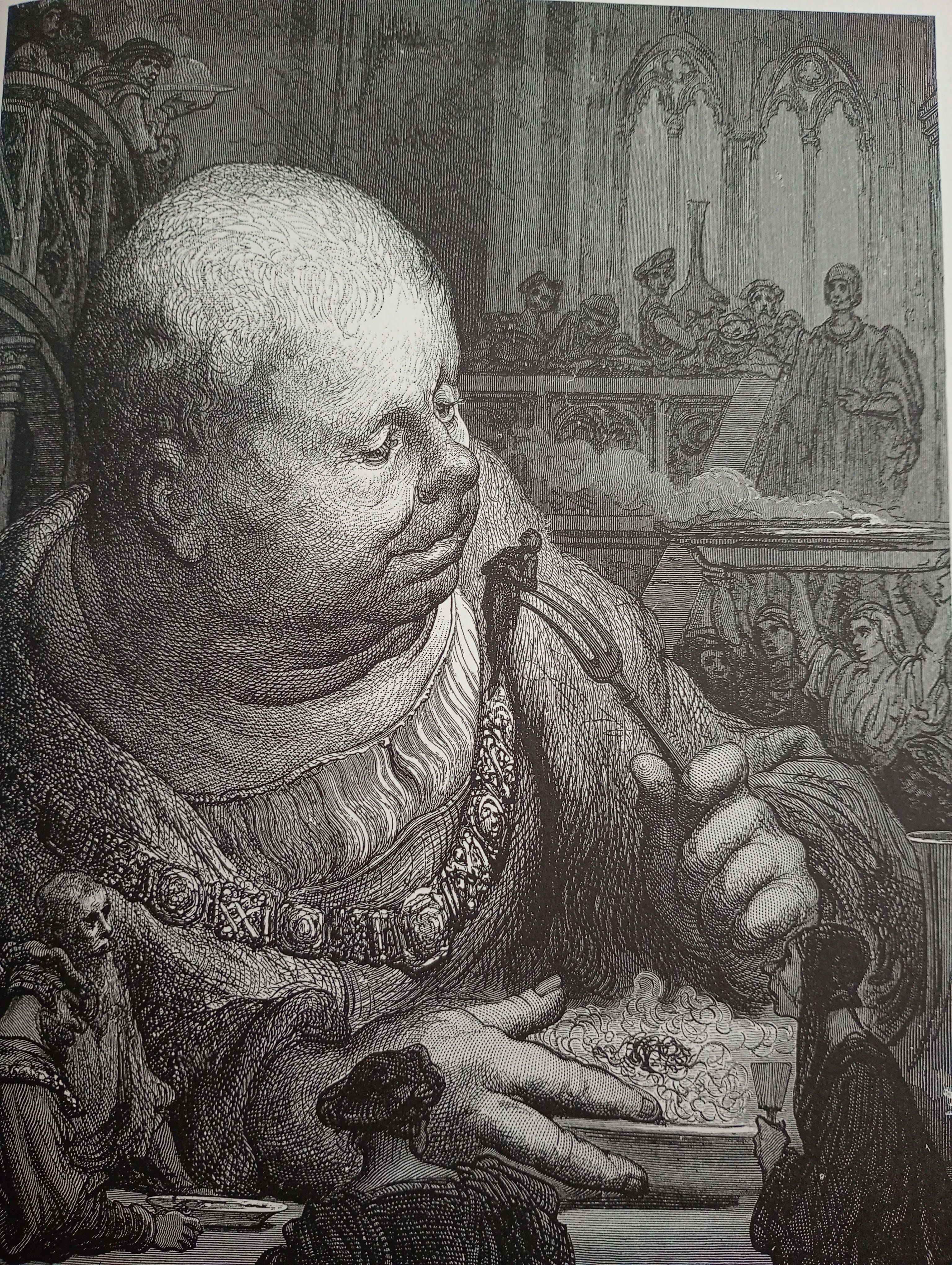
Dore’ feels to me like the far end of a great tradition of engraving and printmaking which defined the renaissance, and certainly the enlightenment, more even than painting. The book gives us some lovely diagrams and information about the various methods of production, and these fascinate me with their use of raw materials like stone and copper, their graven lines, acid baths and the intermediate profession of engraver, a human being to transfer the artists lines to a new medium, and with the position of a print, being both proto-industrial, capable of producing hundreds or thousands of copies, but also pre-modern, having still a direct physical connection between creator and creation which is lost in our world of infinite dreams.
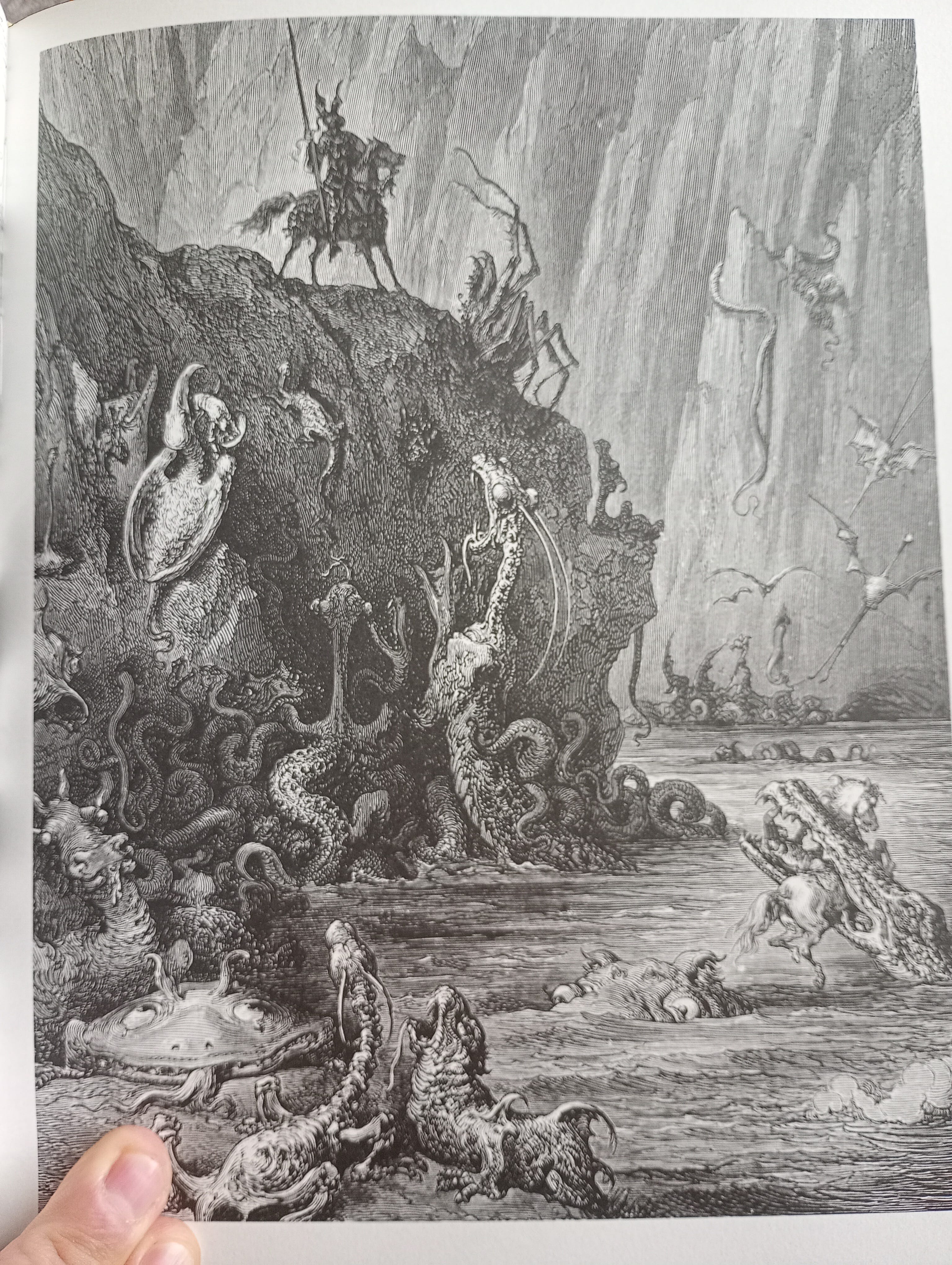
This visual world of lines, of sea, shadows, and of a global reality revealed not by colour but purely by light, of the careful delineation and distinction of light, and all of this delivered through the lines of pens and brushes, transposed into the scrapings of engravers, and all of this coalescing with the European age of Exploration, and the wundekammer collecting and organising of reality, of the globe, as seen by Europeans, a sphere of cartesian lines binding oceans themselves made of waving engraved lines, making little monochrome windows in walls of millers houses; here the Great Storm of 1773, here a Mighty Wreck, or Lucifer falling from Heaven, or a Mughal Prince hunting Tigers, tiny apertures in ink onto a collected and comprehended world.
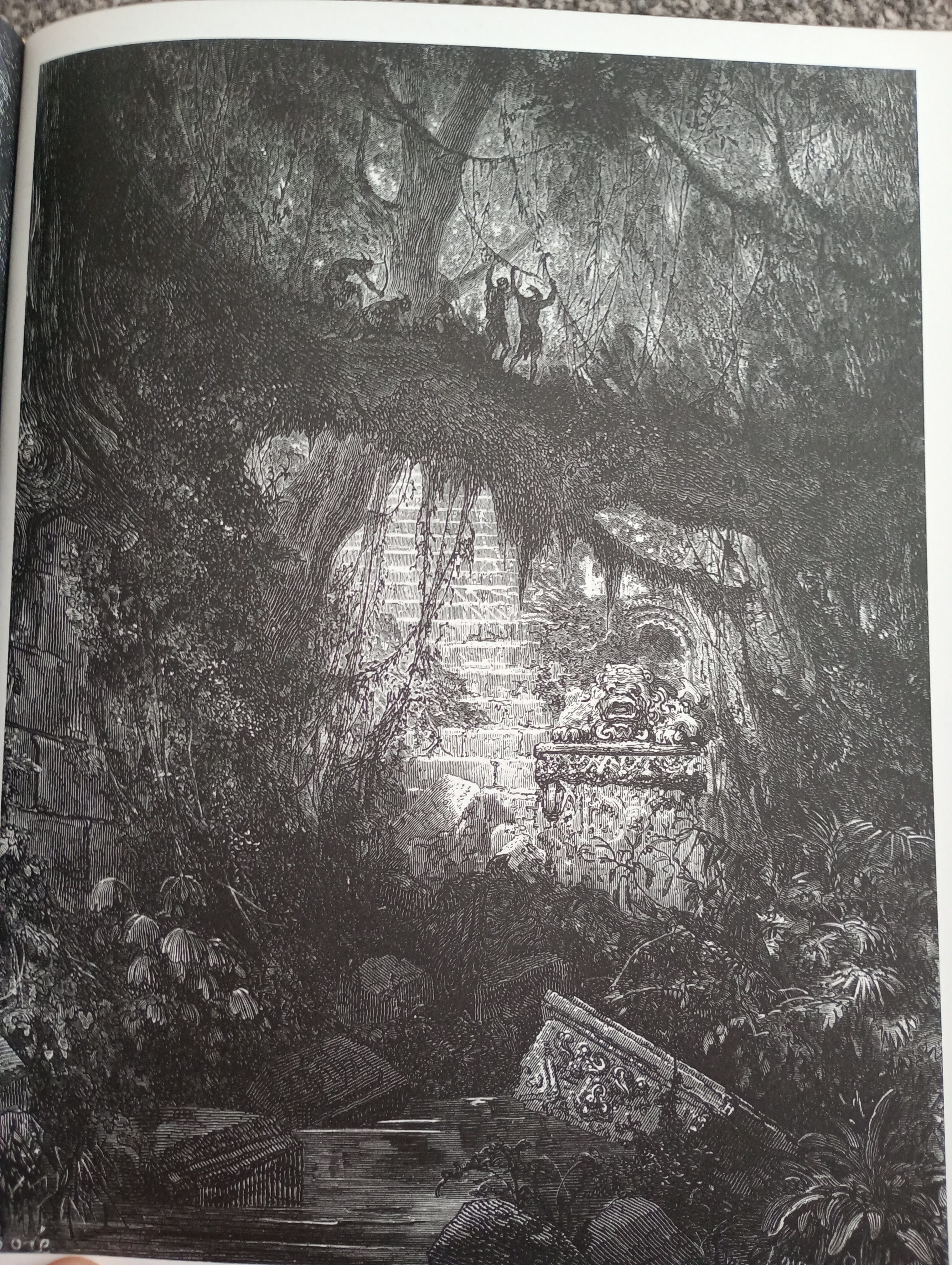
This Great Age of Illustration was shaped, and limited, by advancement in technology. From the artist drawing directly to the block (we are back to wood now, the end grain of a boxwood block), then interpreted by the engravers, (involving similar dramas to those between Comic Book artists and inkers) to a photograph transferred to the block, but still engraved by hand, to finally, photography directly to etching, with no human hand interposed. The frozen image will devour the World of Lines, but the Tsunami happens slowly and there is much beauty in the belly of the wave.
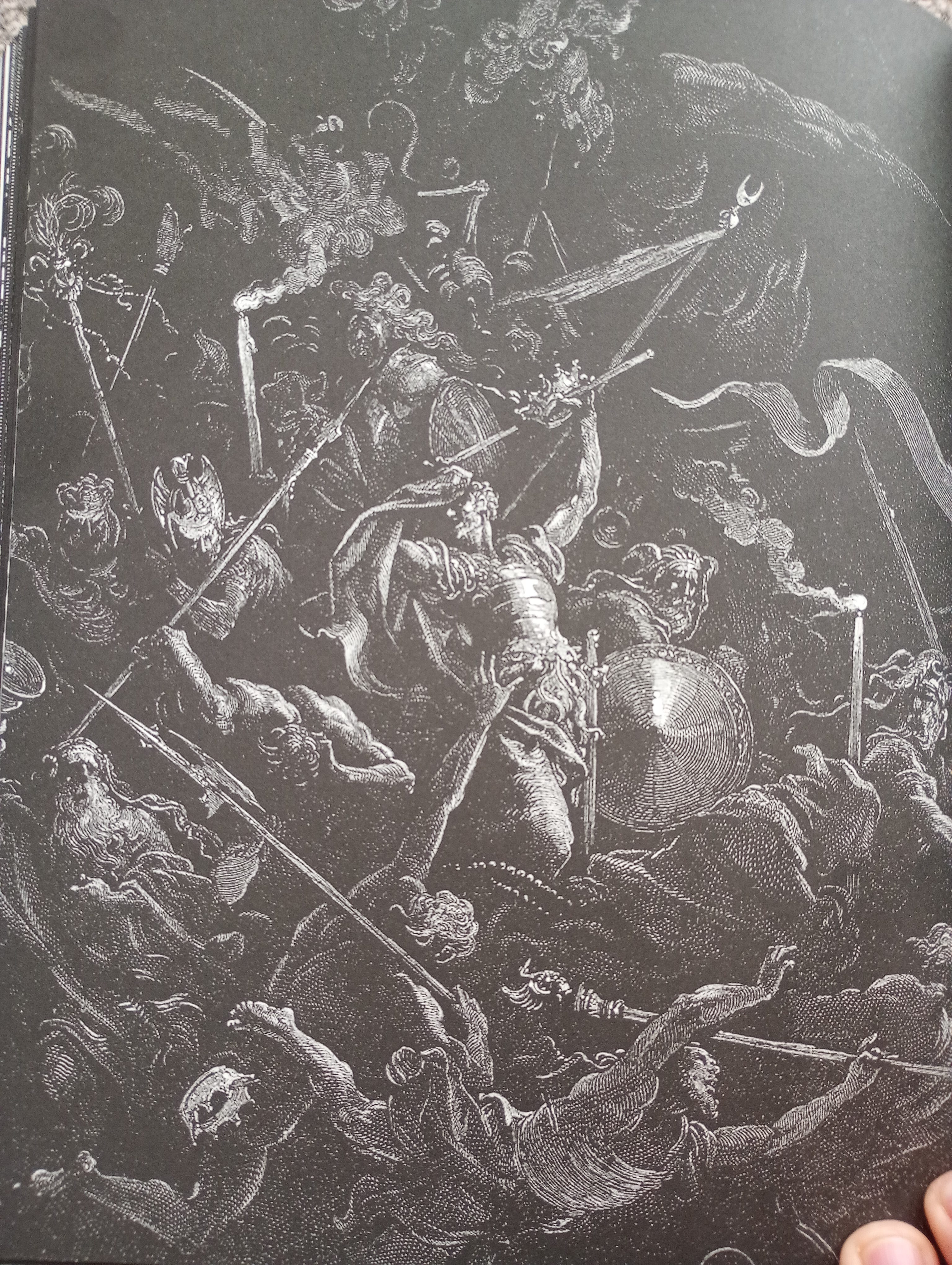
Dore’s bible was so popular that Americans in the sticks projected his scenes with Magic Lanterns, (Franklin Booth was one such schoolroom preacher) it fed into theatre, into cinema, he shaped what it meant to tell an Epic Tale, you can find fragments of his light patterns and his grand scenes even today.
I don’t need to persuade you that Gustav Dore is great! But before we reach the our final stop, a brief detour into the completely innocent and universally beloved worlds best Empire.
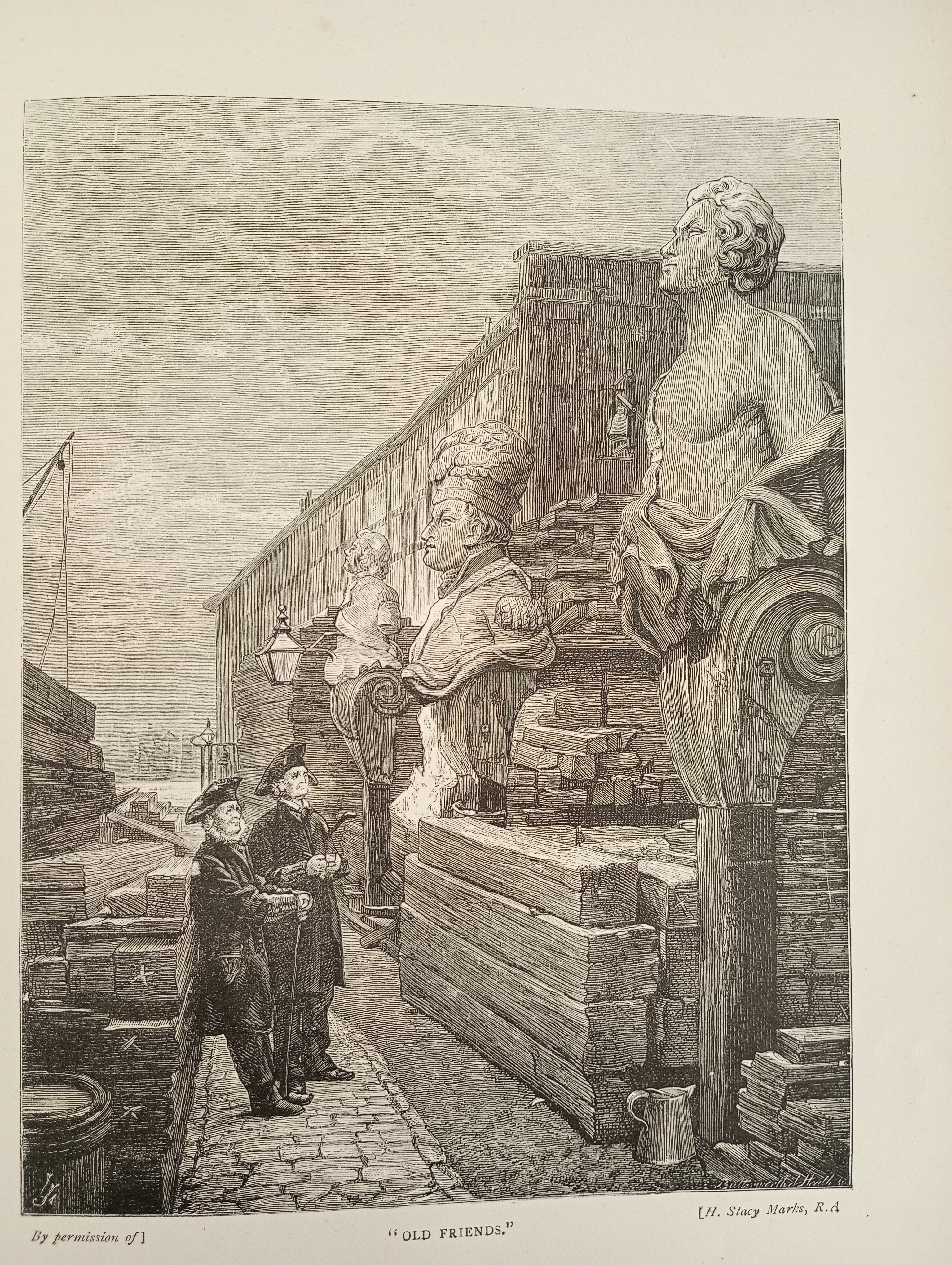
Sea Pictures Drawn with Pen and Pencil by James Macauley
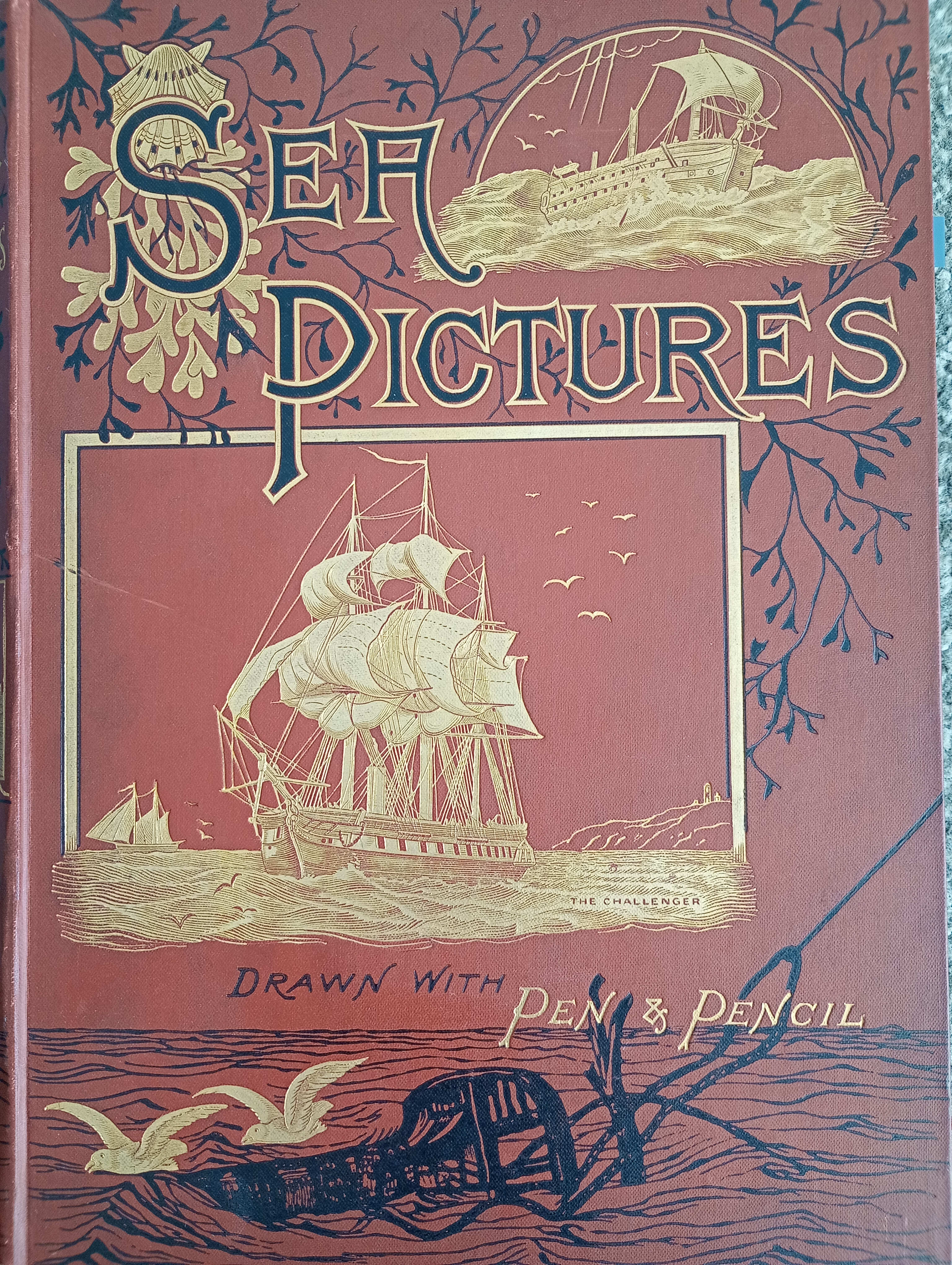
Made to be a window for its time onto the waves, making it now a window for the reader onto its time. ‘Sea Pictures’ is the image of a a liberal, positivist and Christian British Empire, just before the terrible precipice of the 20th century that will send Europe into Trench War, World War and Cold War, ending with the dissolution of the dreams which fuel this book.
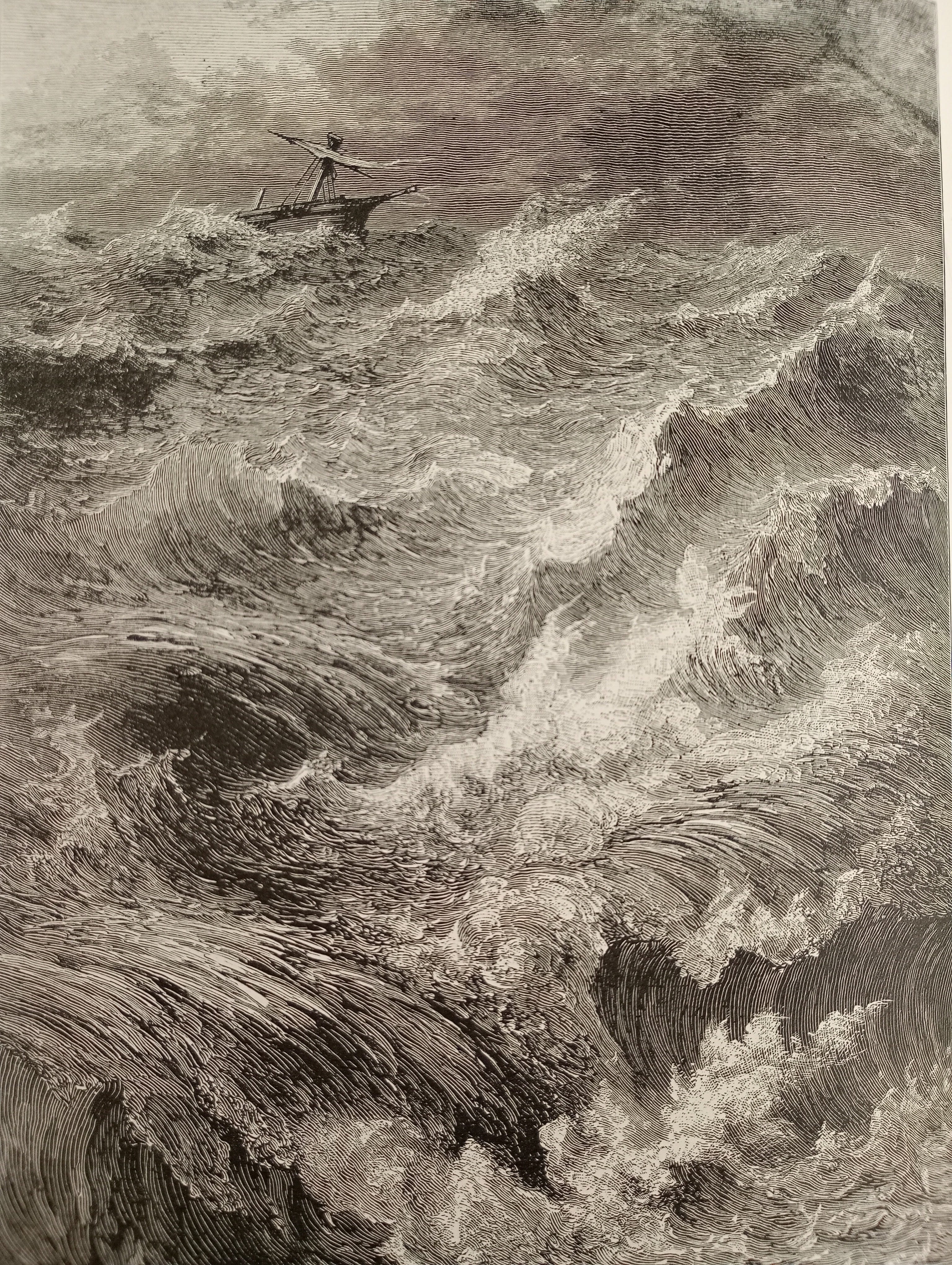
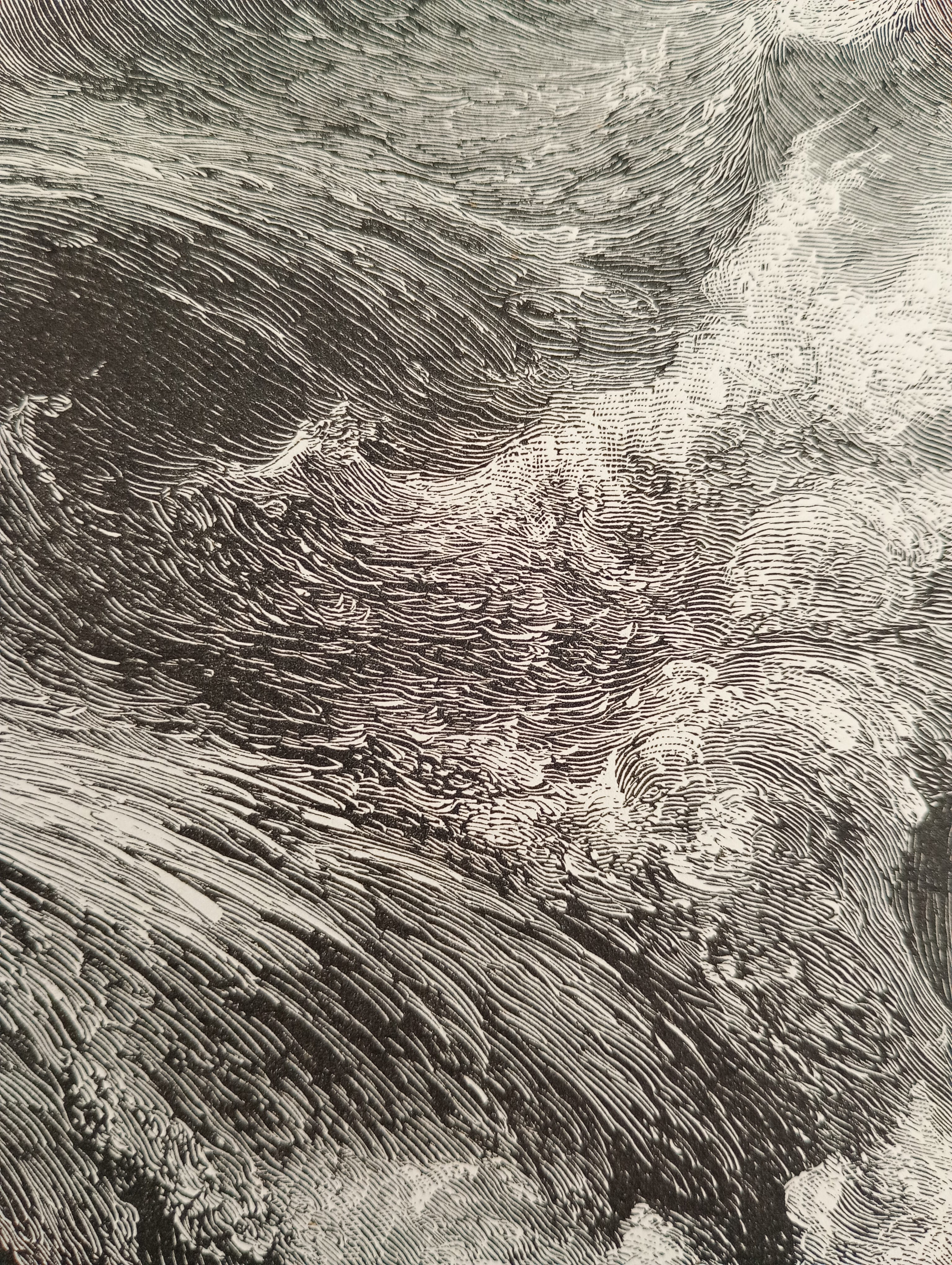
The text and is set throughout with graven pictures of the deep. The most strange end excellent of these are the pure seascapes, images of wreck and storm, of ice, and of the strange technology of its time.
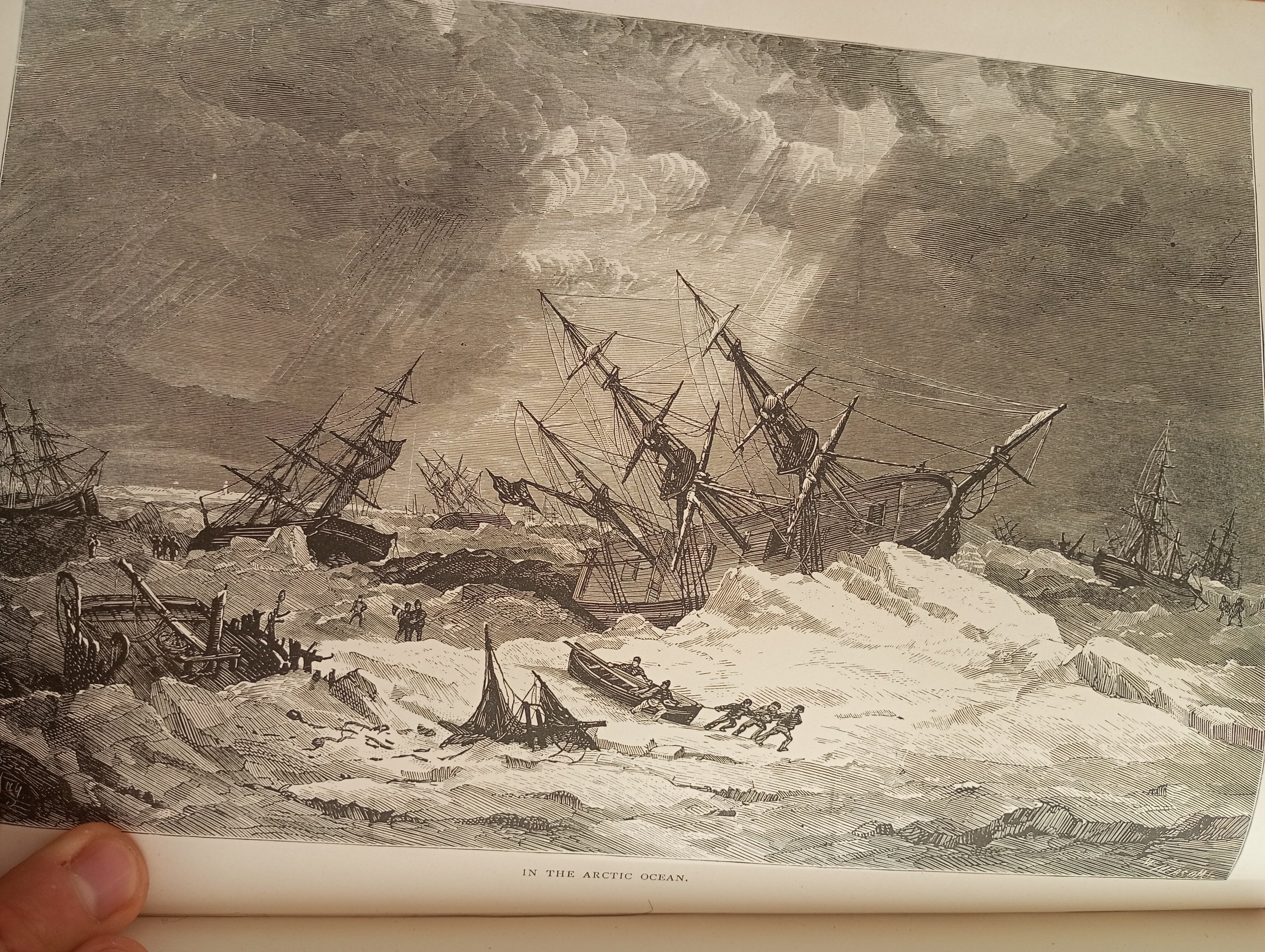
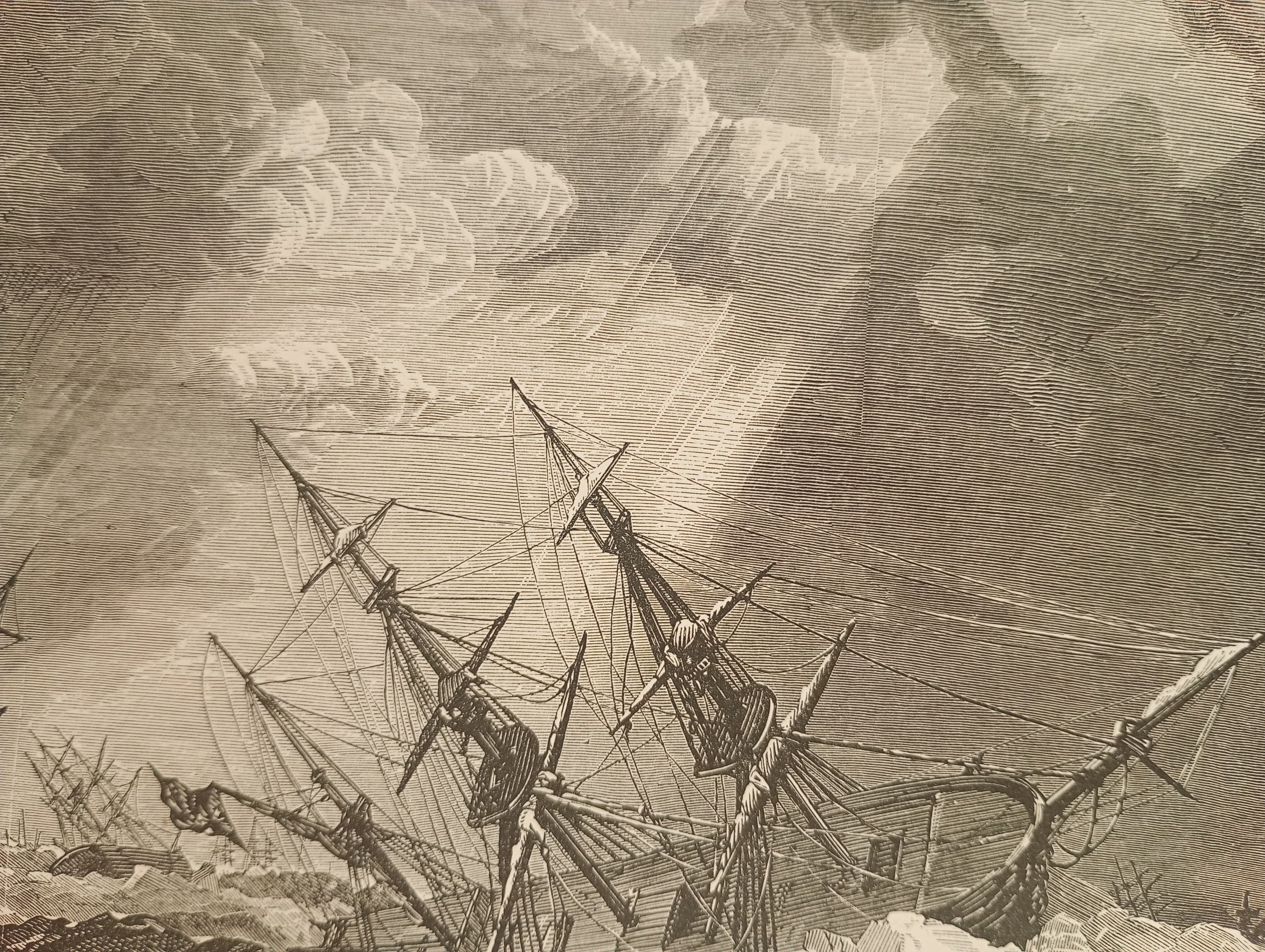
Materially this is fascinating because, set in the mid-point of complex developments in science, the book does not know, exactly, how deep the sea is, at its deepest, or how continents are formed. Deeper than this is a frame or way of seeing reality, and the ocean, as a kind of great device, or engine, and the things in it and part of it, all, are all dedicated to doing something.
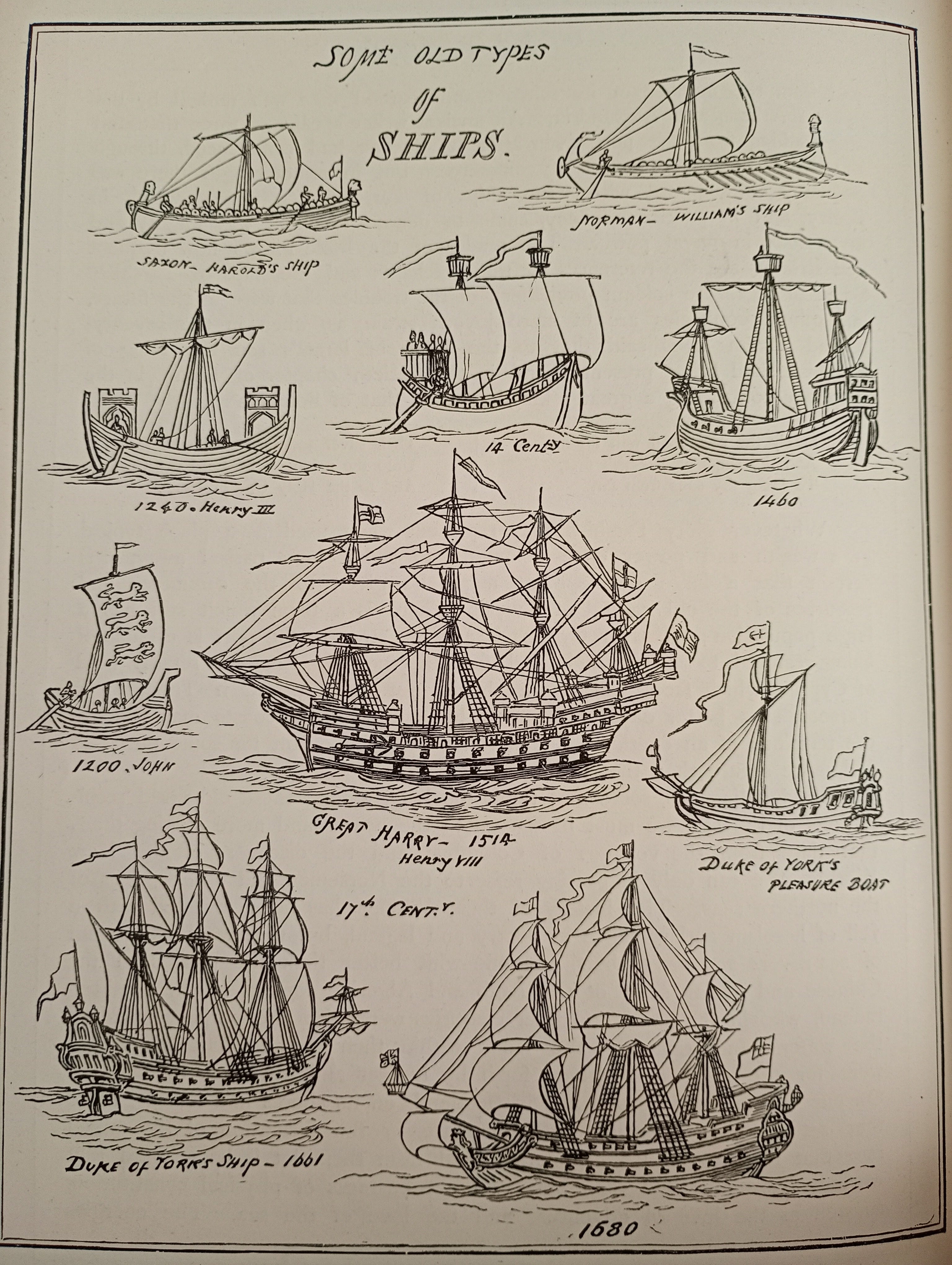
“’The currents of the ocean’, says Maury, ‘do not flow by chance, but in obedience to physical laws ; they no doubt, therefore, maintain the order and preserve the harmony which characterise every department of God’s handiwork.”
...
“In the world as now existing these decompositions and reconstructions are so balanced in amount as to leave the chemical condition of the ocean substantially the same although the elements abstracted from it are inconceivable in amount. Still, the rivers continue to pour down the saline and other constituents to the sea water, to be there diffused and intermingled, and the different portions segregated and utilised for great geological and biological objects, leaving the composition of the ocean little changed, and ever adapted for its grand offices in the system of the globe.”
This beautiful, broadly innocent, and wrong conception lies, perhaps, at the far end of Dürer’s elaborate humanist cryptograms, or Bibiena’s infinitely receding perspectives. The whole world is now encompassed with the reason which they dreamed of. Explored, described, set down in lines. And Christ is still there, walking happily hand in hand, with Reason on one side and the British Empire on the other, with hardly a shadow between them. Nothing could possibly go wrong.
James Macauley is an intelligent, kind, well-travelled and deeply innocent man, and of course this lovely book of popular art was produced by the Religious Tract Society.
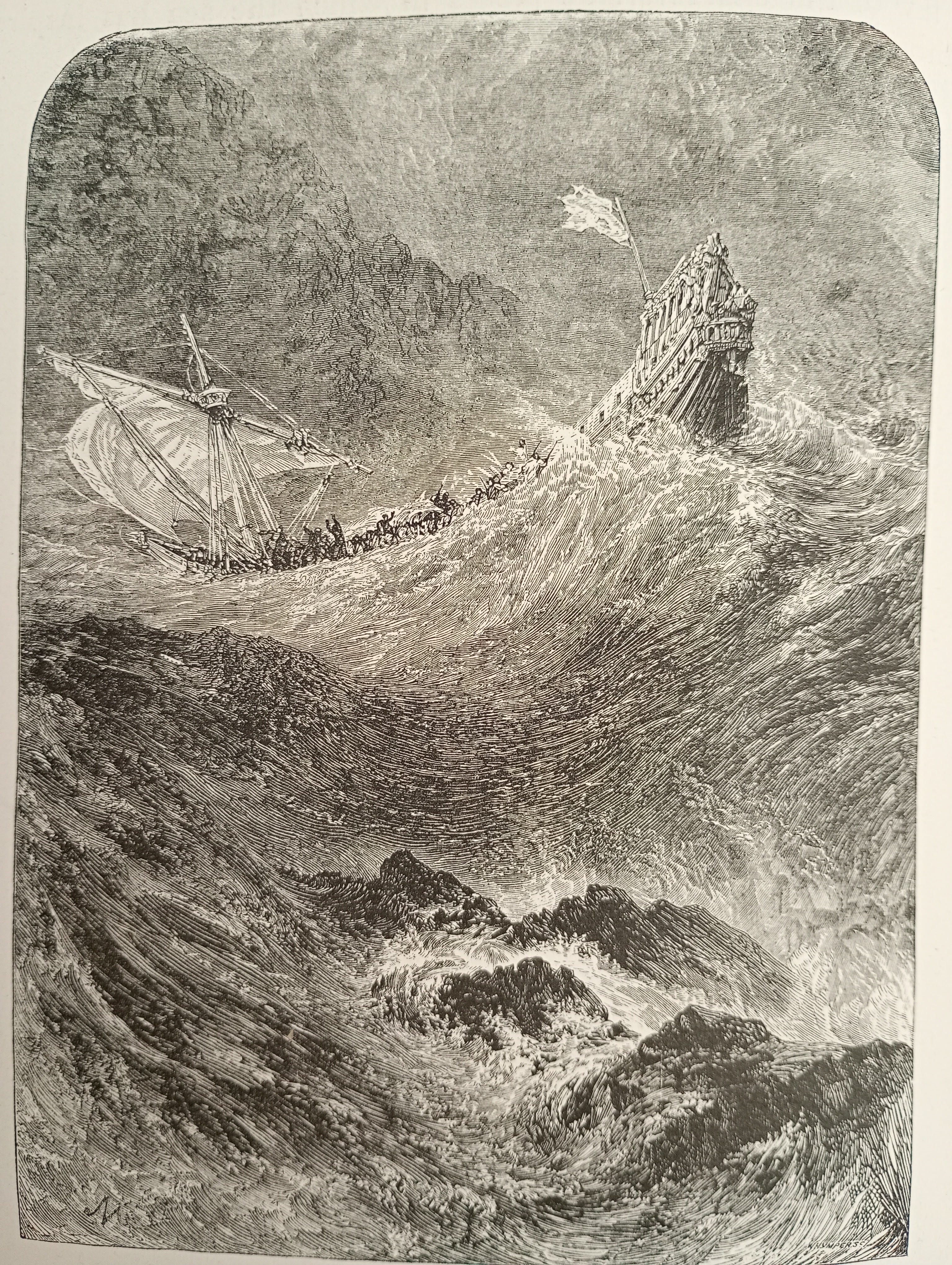
They did a damn good job. Over one hundred and twenty years old and, apart from some slight staining and discolouration; completely readable, opens well in the hand, no loose leaves etc. It is also visually beautiful and designed with some, occasionally curious and quixotic, but always pretty typesetting.
Broken into four sections, ‘The Sea in Poetry’, ‘The Physical Geography of the Sea’, ‘The Harvest of the Sea’ (inexhaustible, apparently), and ‘The Sea in History’, in each part ‘Sea Pictures’ represents the image of a decent, kind, soft, respectable, intelligent and patriotic Briton.
“To rancour unknown, to no passion a slave,
Nor unmanly, nor mean, nor a railer,
He’s gentle as Mercy, as Fortitude brave,
And this is a true English sailor.”
Perhaps one day I will add his ‘Excellent Women’ to my collection.
Now we must cross the boundary of the 20th Century and enter an age that does not yet know that it is Gold;
Treasury of American Pen and Ink Illustration 1881-1938 edited by Fridolf Johnson
(Also Pen & Ink Illustration Showcase by Steve Archibald, which had a wider range of images, though I made far less notes on that one.)
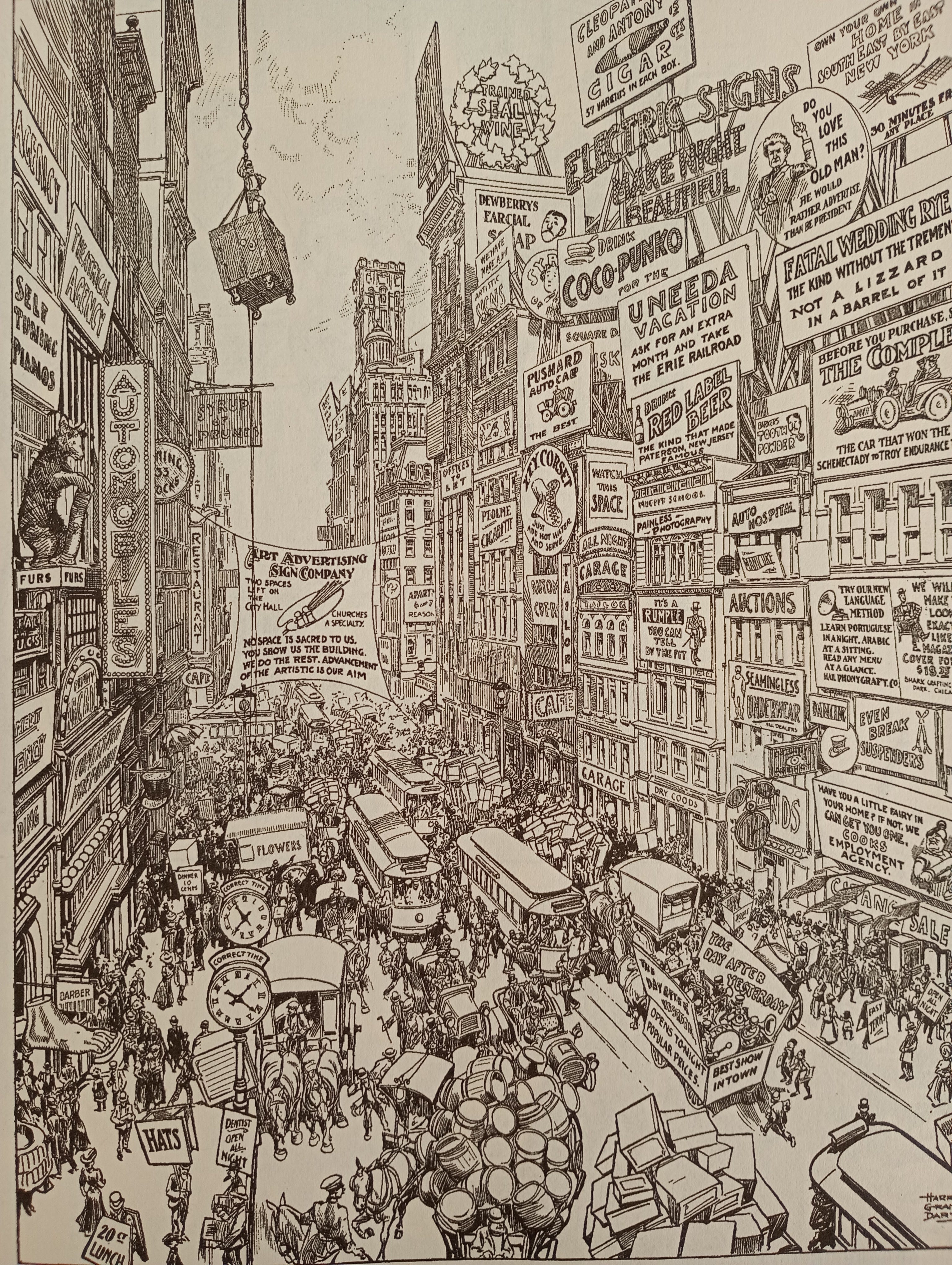
America!
Pen and Ink Bitches! The line is free at last! The relief zinc process means you can photograph the drawing right onto the plate and chemically etch exactly that linework, and the limits of the technology, and of the cheap, plentiful and now-industrial paper supply, decide what it can do and the world that will be seen via its artifice.
The rag paper used by Durer is gone, replaced by huge stripped logs of raw wood and Spanish grass being cooked in big pots, mixed with sulphite to keep it from tearing. (Early-modern rag paper prints from 500 years past can actually last better than the yellowing husk of newspaper, its made to burn out. True disposable culture. (Oddly, arguably, environmental too.))
But the Golden Age Illustrators largely didn’t work for Newspapers, the brute grey paper blotched their fine lines and demanded simple strength of form, perhaps not unlike the original Woodcut/Plate divide. These people work for Magazines.
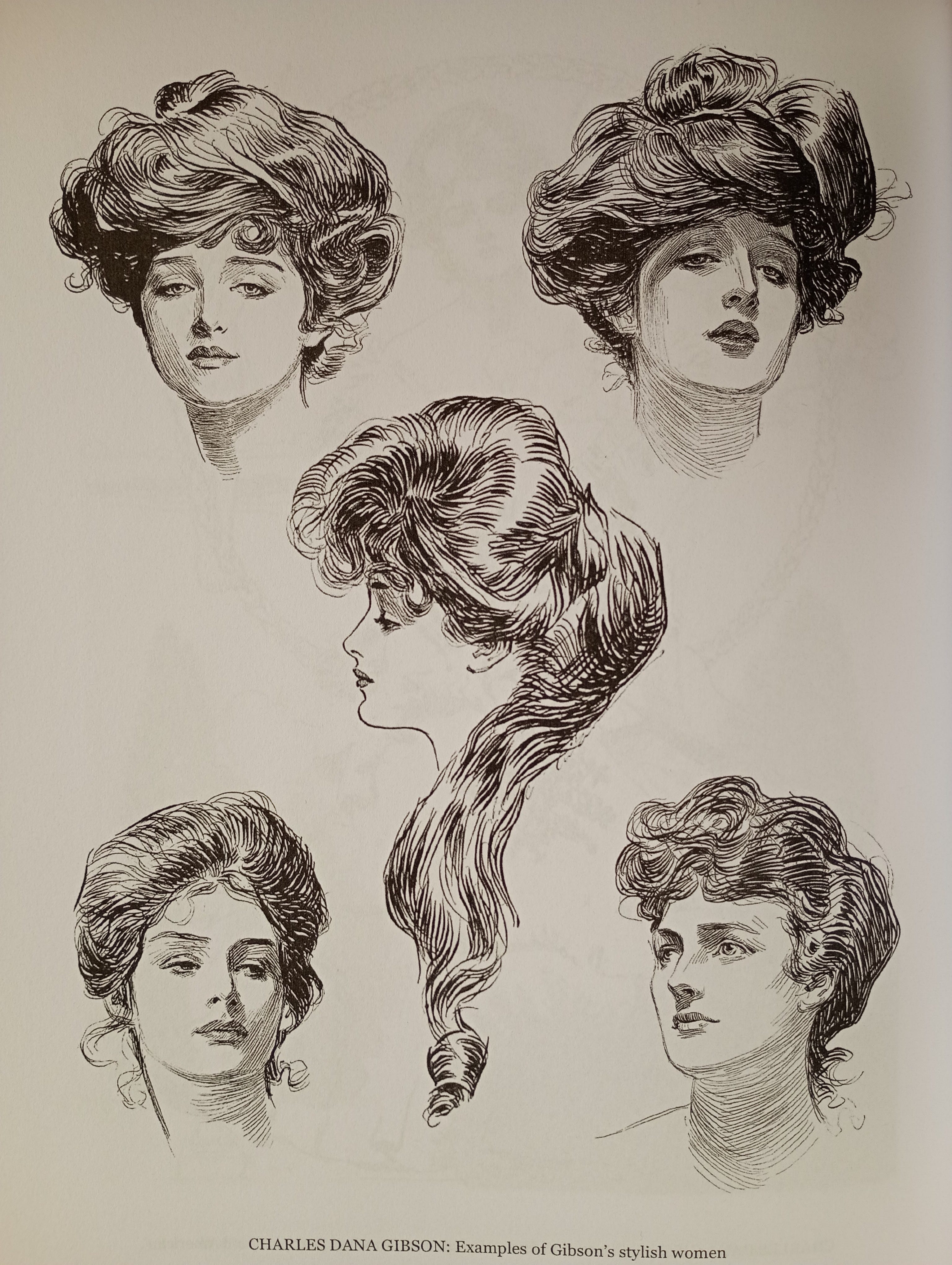
Gibson Girls! This is the idealised form of beauty for the 20th Century Woman, and beauty is the sale; the fine-paper magazines that fuelled much of the Golden Age were sold below the cost of production with the profits coming from advertising. The Ads drove sales and made artists rich; the dream sold, just as it had in Nuremberg, no longer pfennig-Saints, but gags, drama, Gibson girls and product.
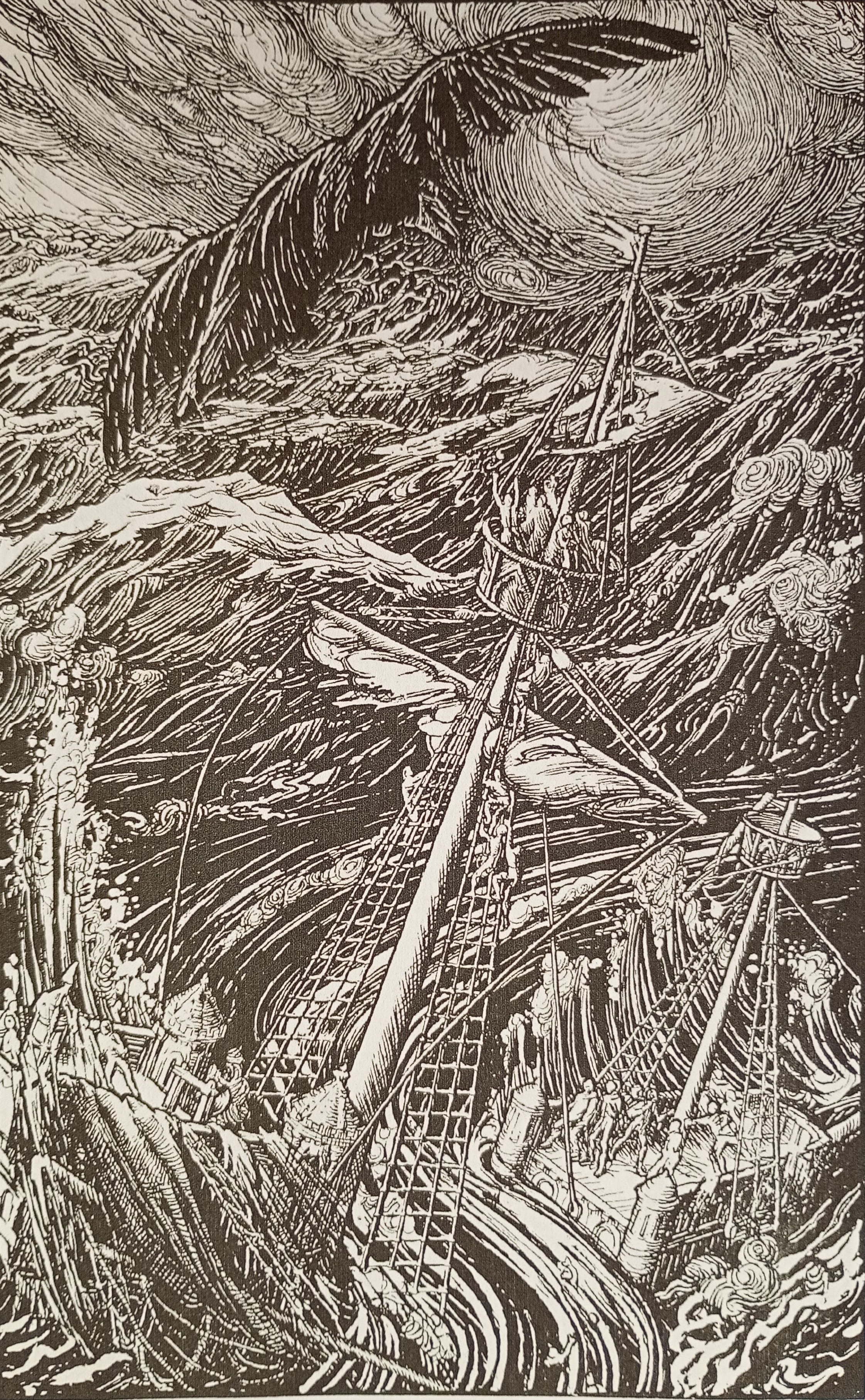
‘Treasury’ has a substantial and excellent introduction from Fridolf Johnson which gives a lot of context to the cross-development of printing technology and pen & ink illustration in the U.S. This is a good, capacious and excellent collection.
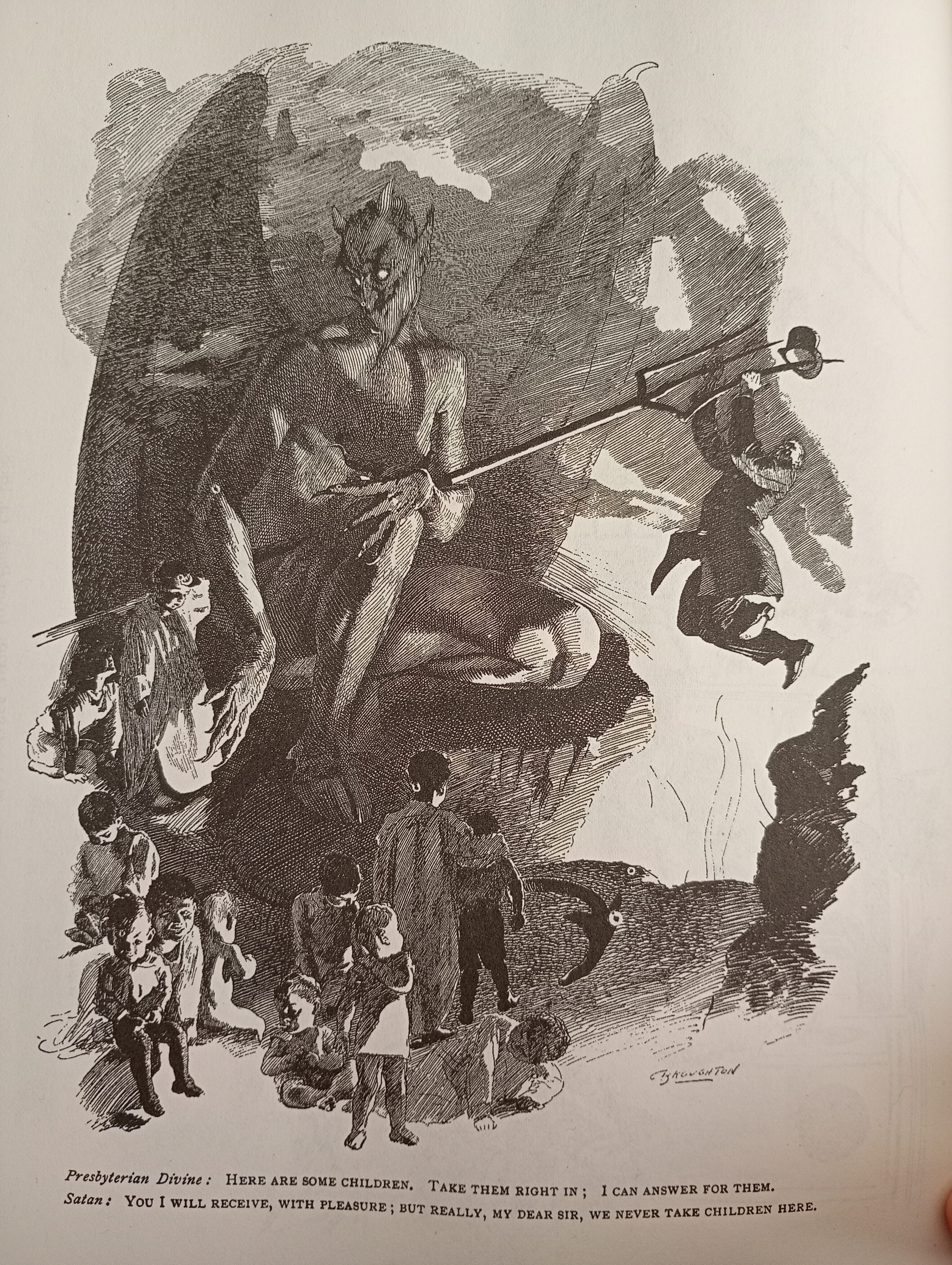
I am not sure if any image or cartoon ever published in ‘Punch’ has ever been funny ever. Certainly many seen here are, through close reference to a social milieu now long forgot, almost hieroglyphically strange, which pleases me. Others are arch and curious in a differently pleasing way, characters like ‘The Flapper’, ‘The Punch Sportsman’, ‘Huntliegh’ and ‘The Jazzberries’ crop up in a pre-war and interwar, international, anglophone high-status high culture.
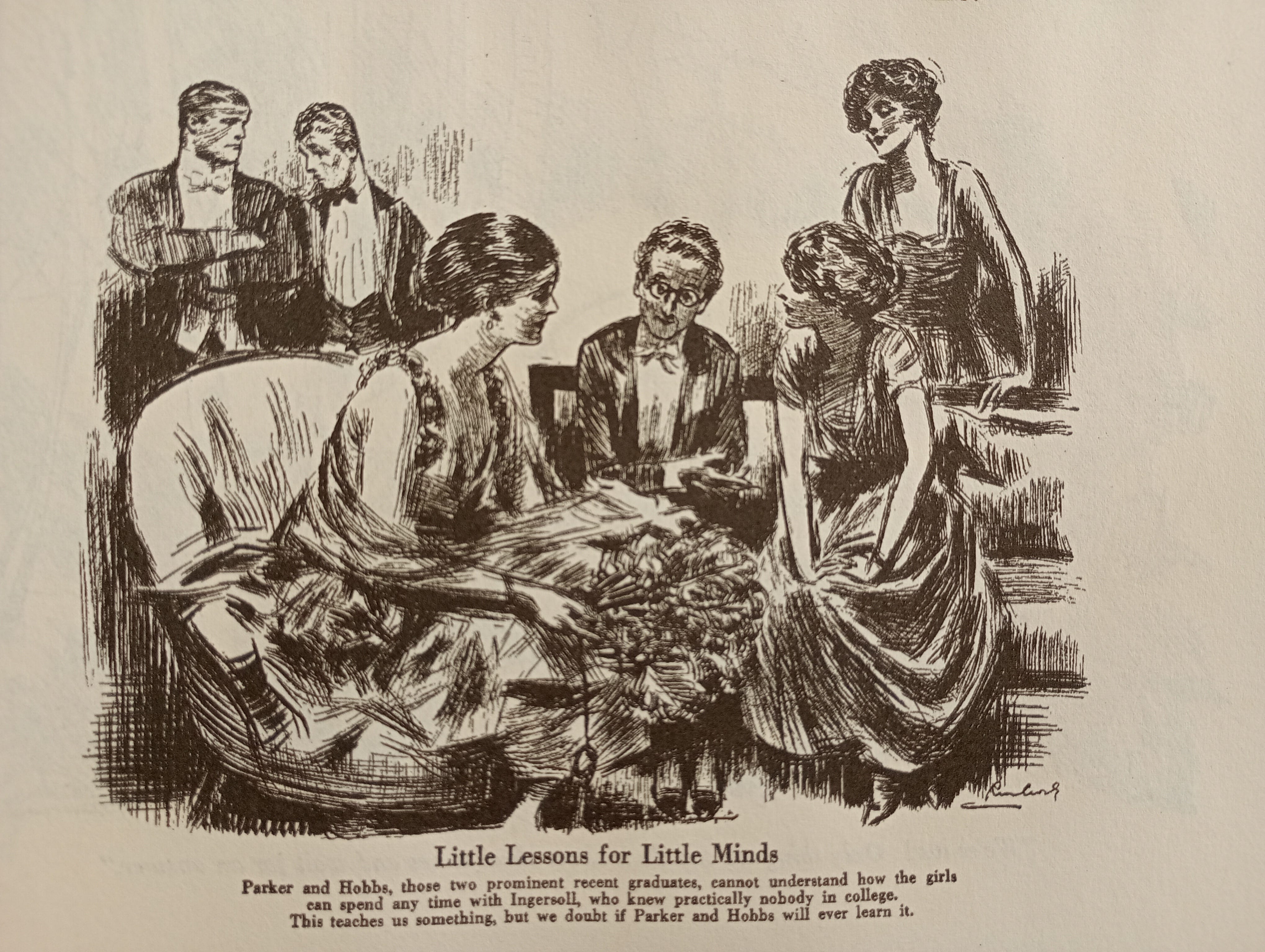
What strikes me both artistically and socially is the curious flow of forms and fashions, lines and styles, between a formal, classical 19thC style and something that at times feels like a real interruption of the Modern. Some feel as if they would lie neatly alongside a cartoon of the Napoleonic War, others would fit fine in a modern day New Yorker.
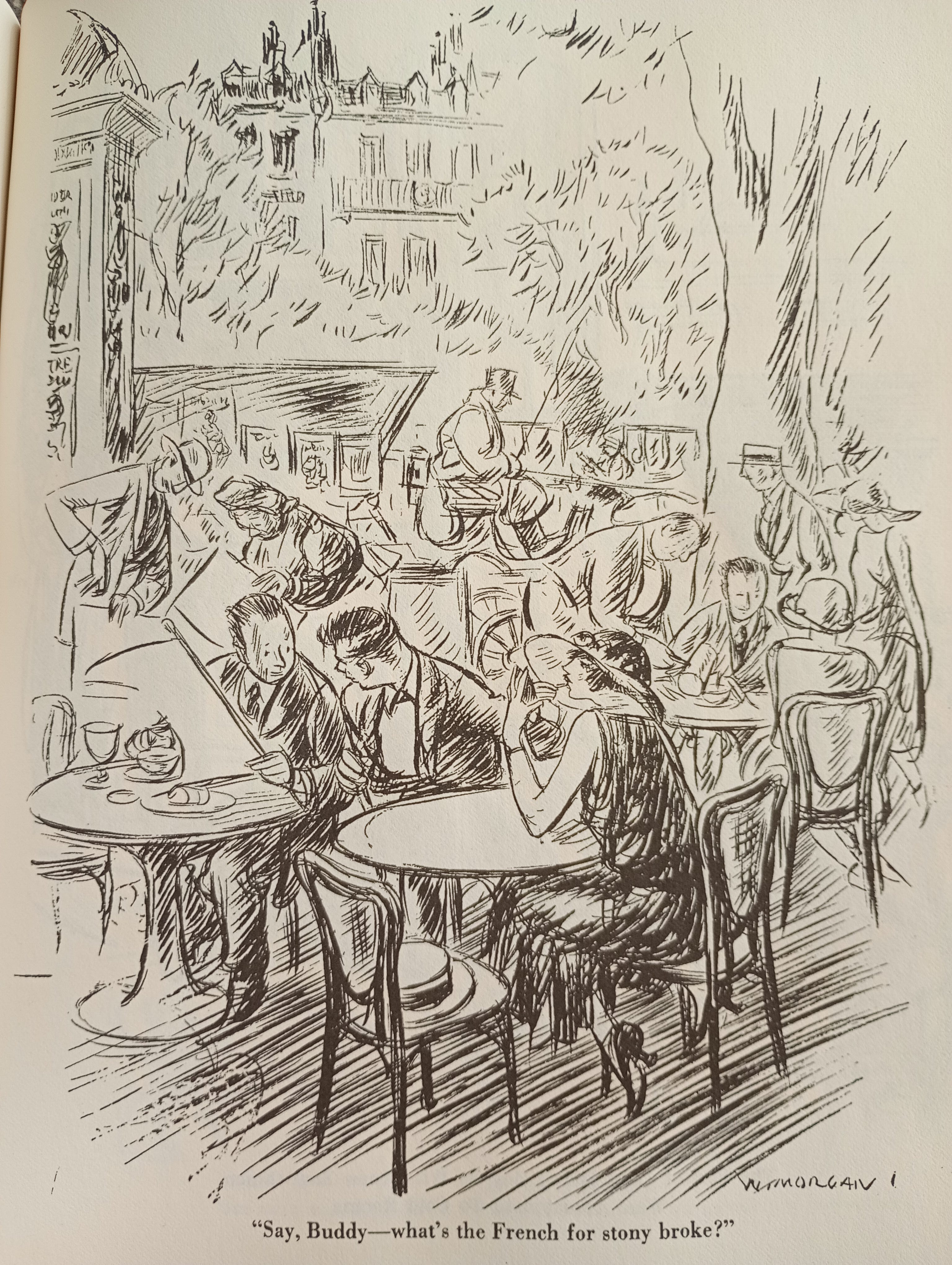
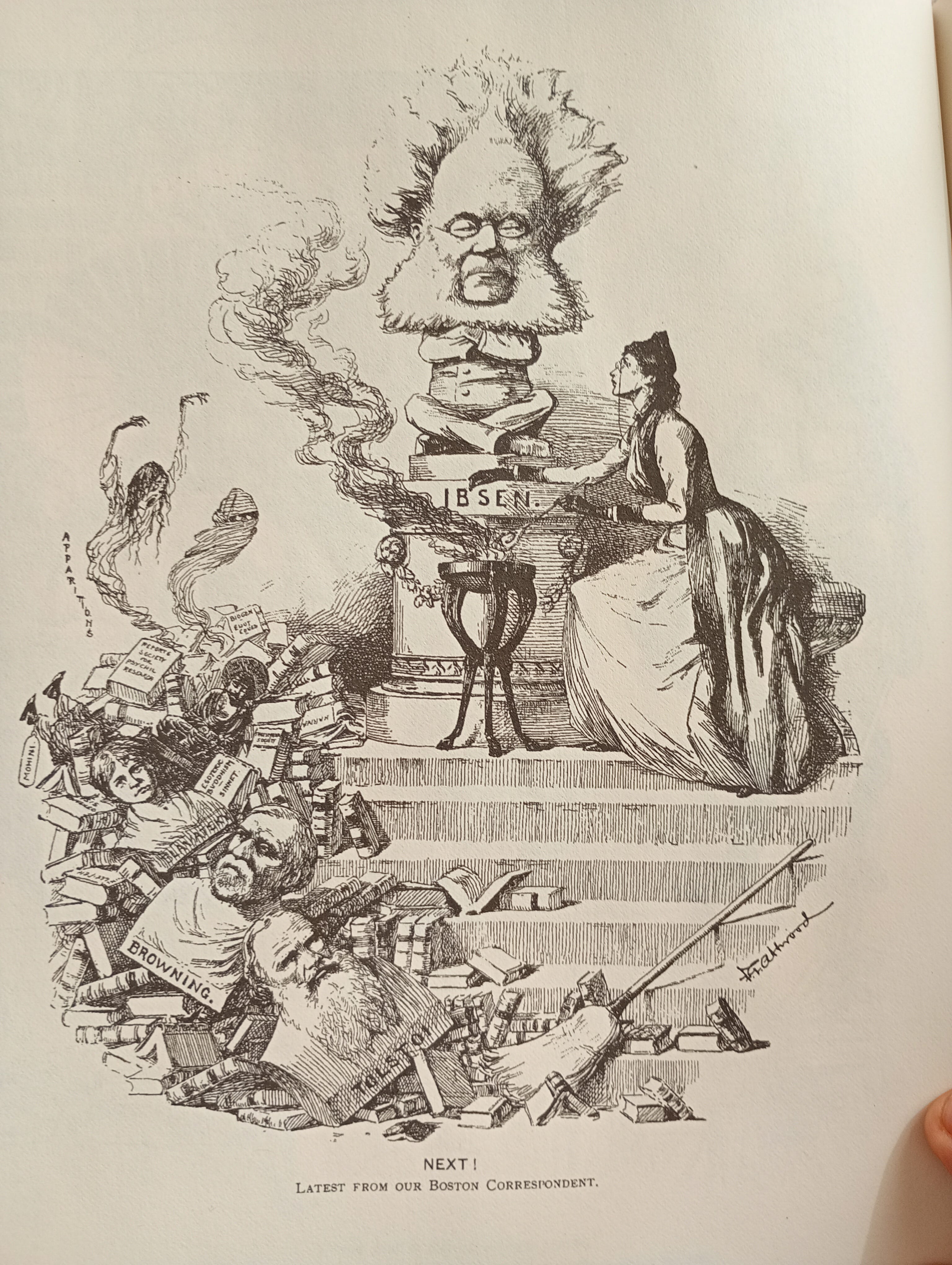
Thank you to everyone who stuck it out this far. We are nearly at the end of the journey, or at least, of my book collection. We have one final stop to make.
Franklin Booth Silent Symphony by Alice A. Carter, John Fleskes
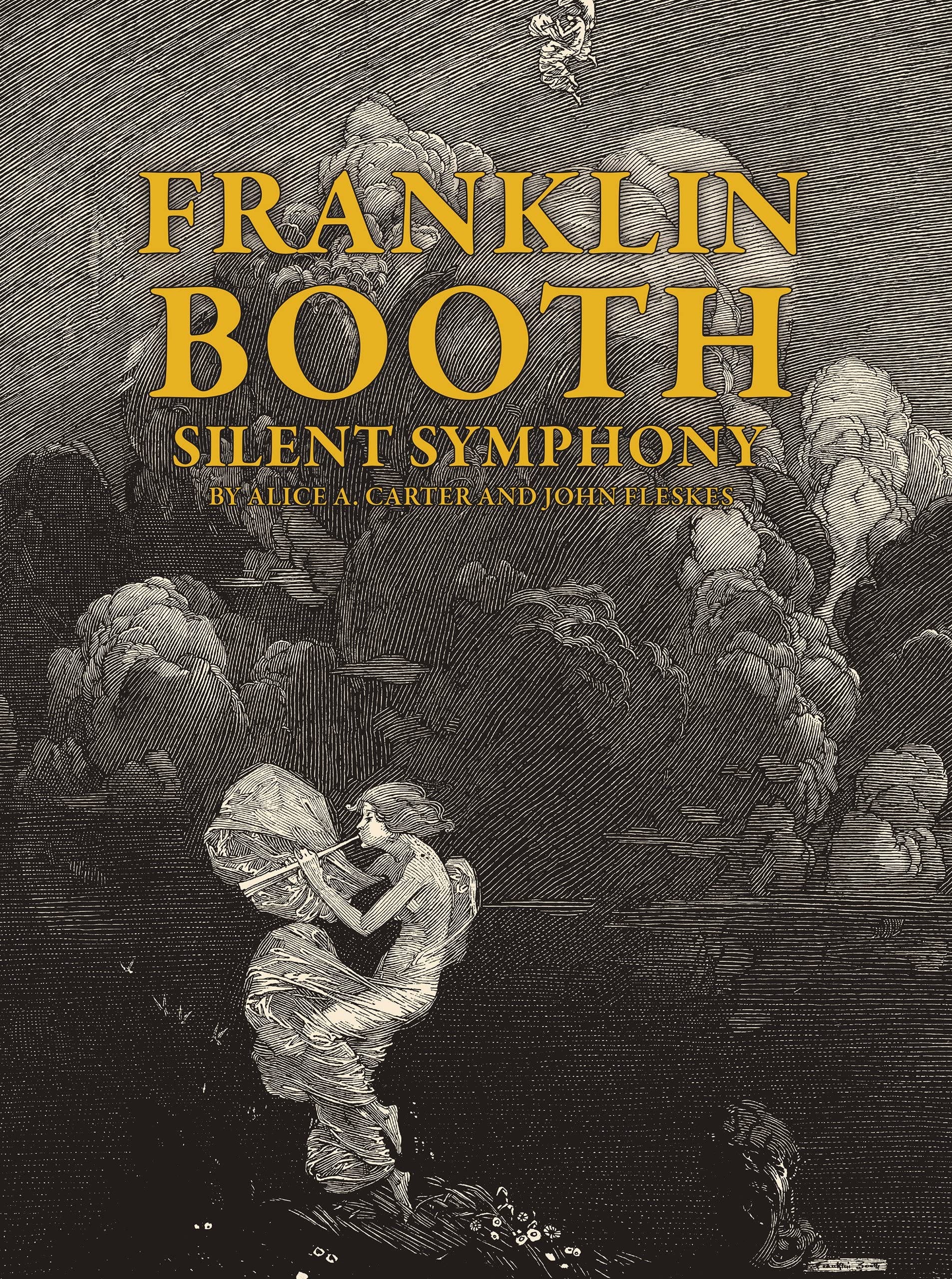
This fucking guy. Its like Clark Kent with Rumplestiltskin hidden in his shirt. They call him the ‘Painter with a Pen’, but he was more an engraver with a pen, because Franklin Booth was self-taught, and drew his first inspiration from the Bible of Gustav Dore. The lines he makes are an engravers lines, reproduced in pen and ink
(The opening essay/novelette about the life of Franklin Booth, by Alice A. Carter, is very extremely good.)
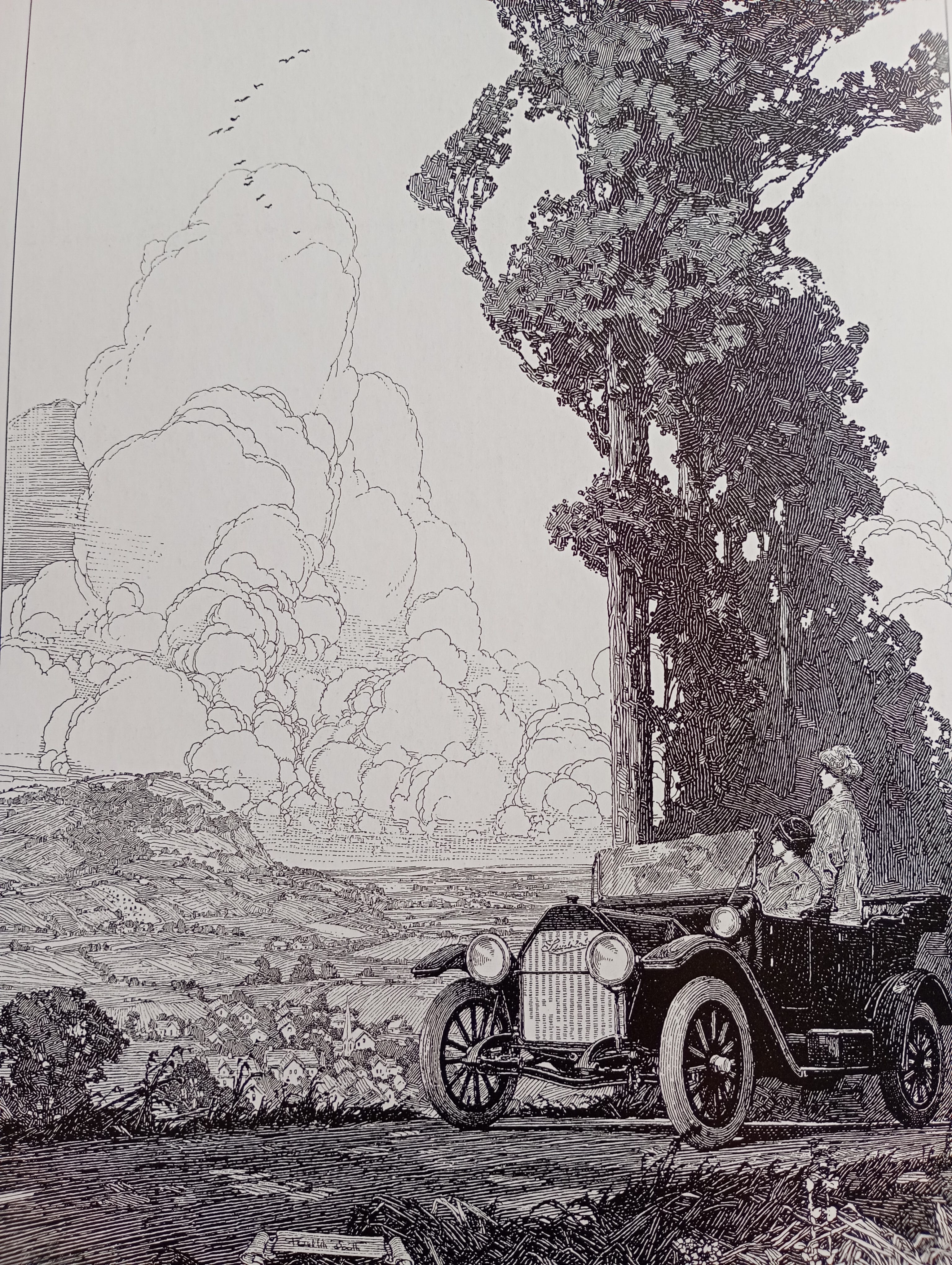
Franklin Booth had a ridiculously emblematic American (always cap the A) life. His father was a veteran of the (Confederate Side, he claims he deserted) Civil War, his mother was a beautiful Farmers Wife who loved poetry but never got to be an artist.
Franklin grew up on a Farm in Illinois, surrounded by brothers and sisters, literally husking corn, or stringing beans, or whatever they do on farms. There are many stories of Young Franklin sitting on his plough gazing at sunsets, forests, light and shade, vibing out. In Sunday school they projected imaged from Dore’s Bible onto the wall and Franklin got the job of drawing his bible lessons for the class. He literally built a log cabin.
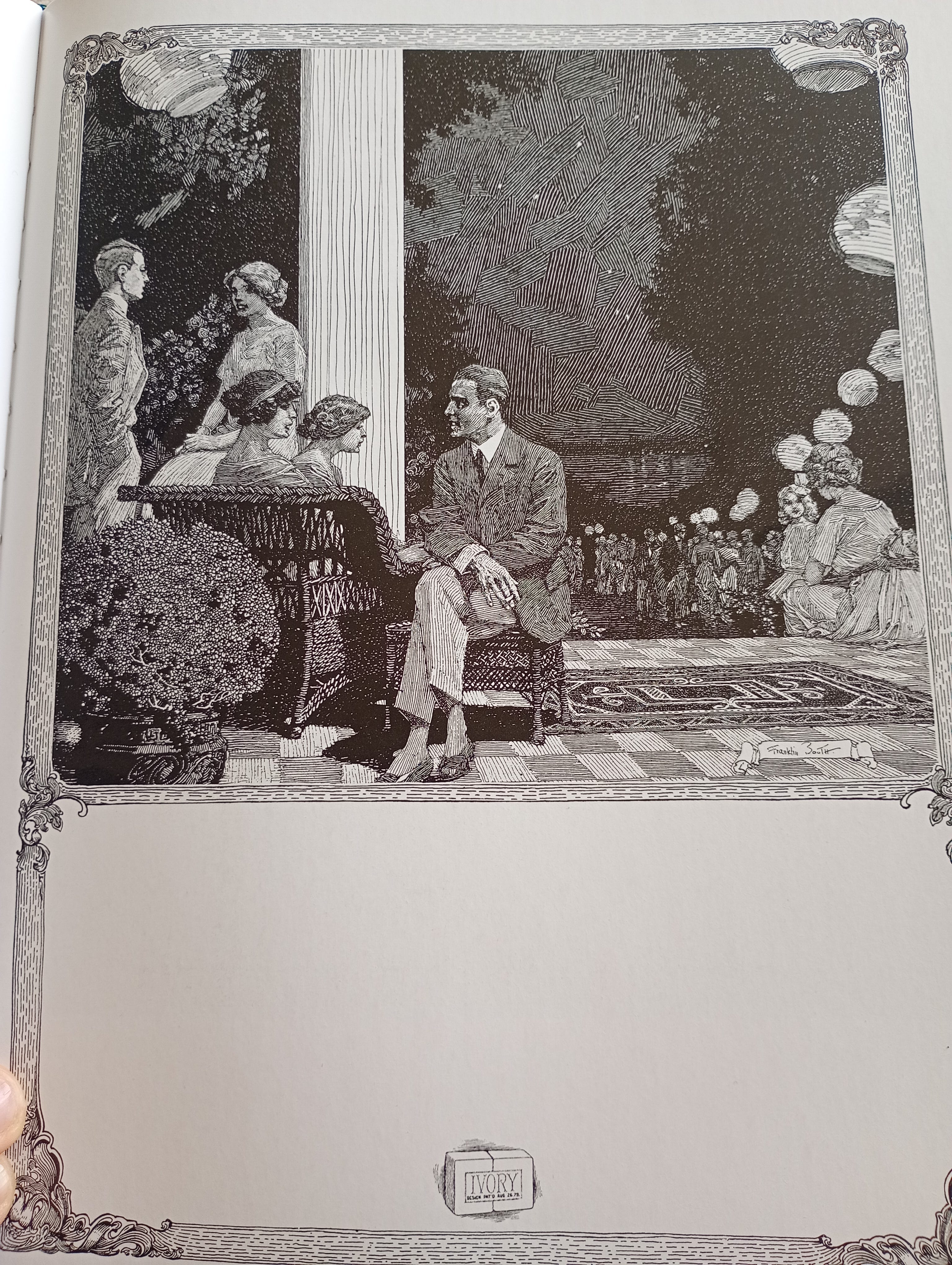
This is the most normal man imaginable, and a true American Patriot. He doesn’t really seem to have had attitudes, or policies, or very much self-conscious political ideas - he has values and they are stamped in directly, like he came out of a press.
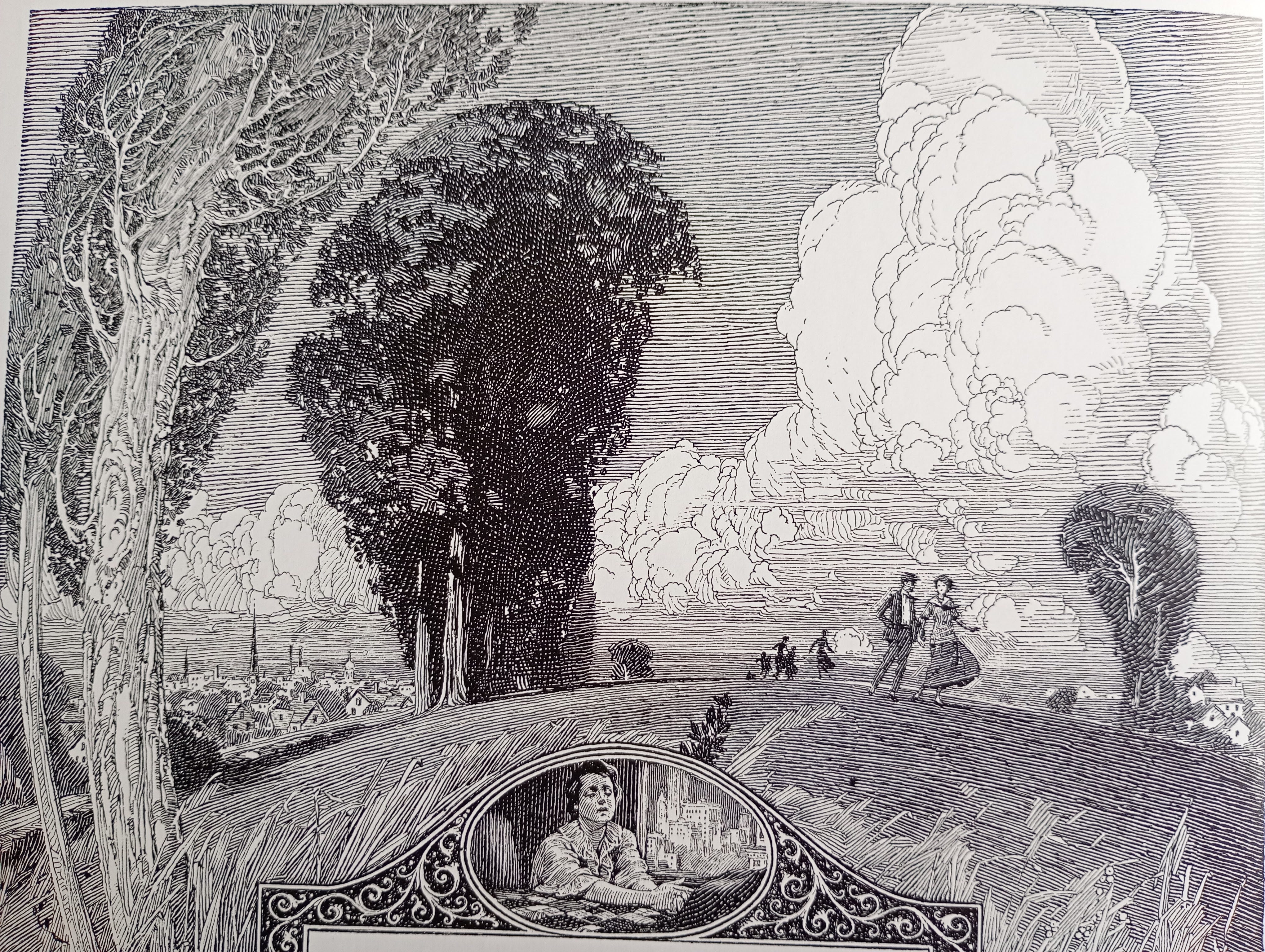
His climb from farm, to New York (corner, large windows) apartment and core member of the Society of Illustrators, is as emblematic and axiomatic as any story of the 19th Century; Farm. Dore Bible. Carving wood with axe and knife. Recognises all the trees by grain. Local paper. Multiple submissions - art and poetry combined. Art already good, poetry not so much. Twenty dollars. Father finally persuaded. Art class. Not great. Correspondence course. Art Institute of Chicago. No money. Back to farm. Chicago. Fail. Back to farm. New York. Fail. Back to Farm. Carmel. Back to farm. New York. Back to Farm. New York - SUCCESS.
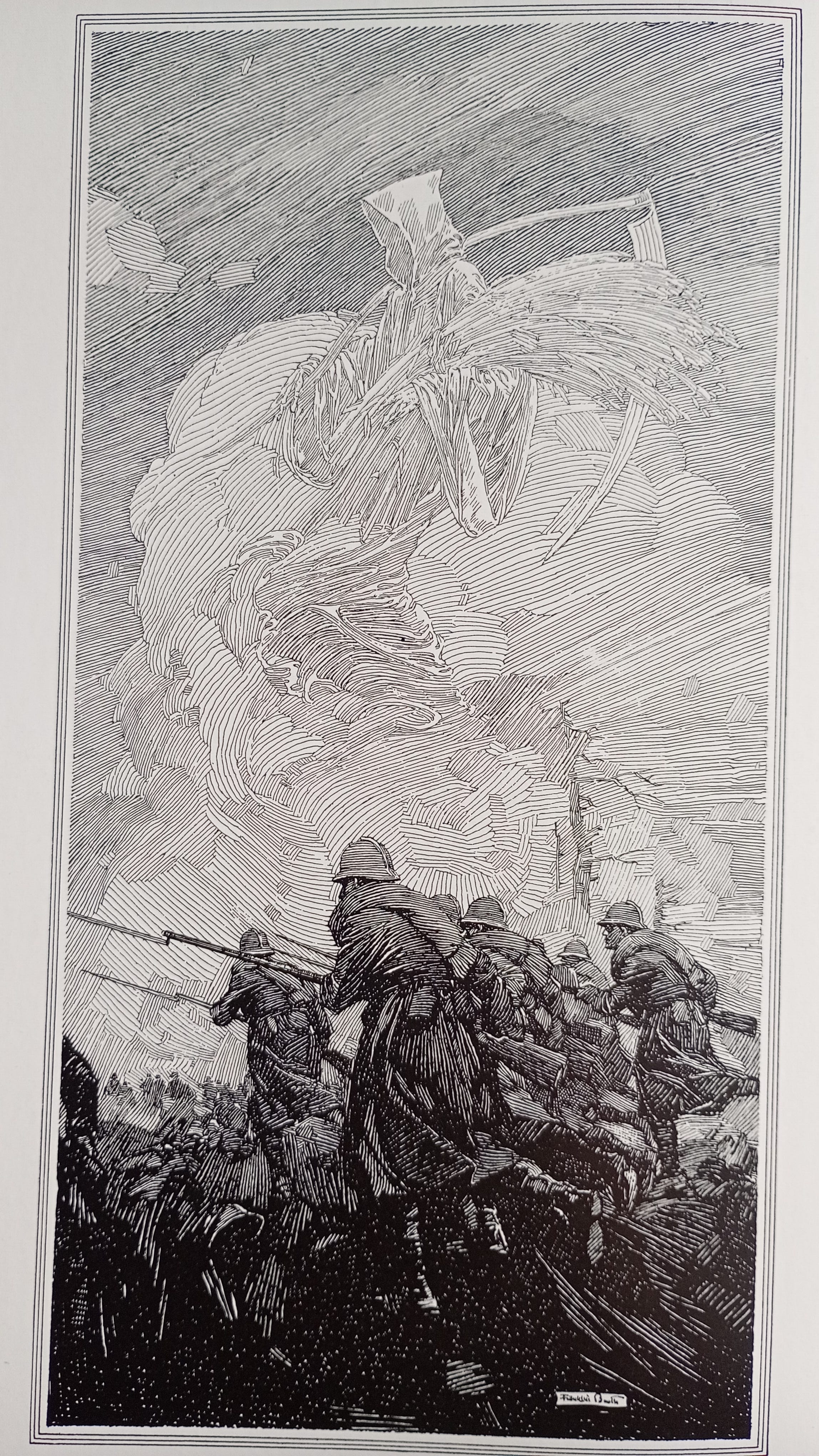
He had talent, he had GRIND. True American hero. Boring? No - also visionary prophet of light.
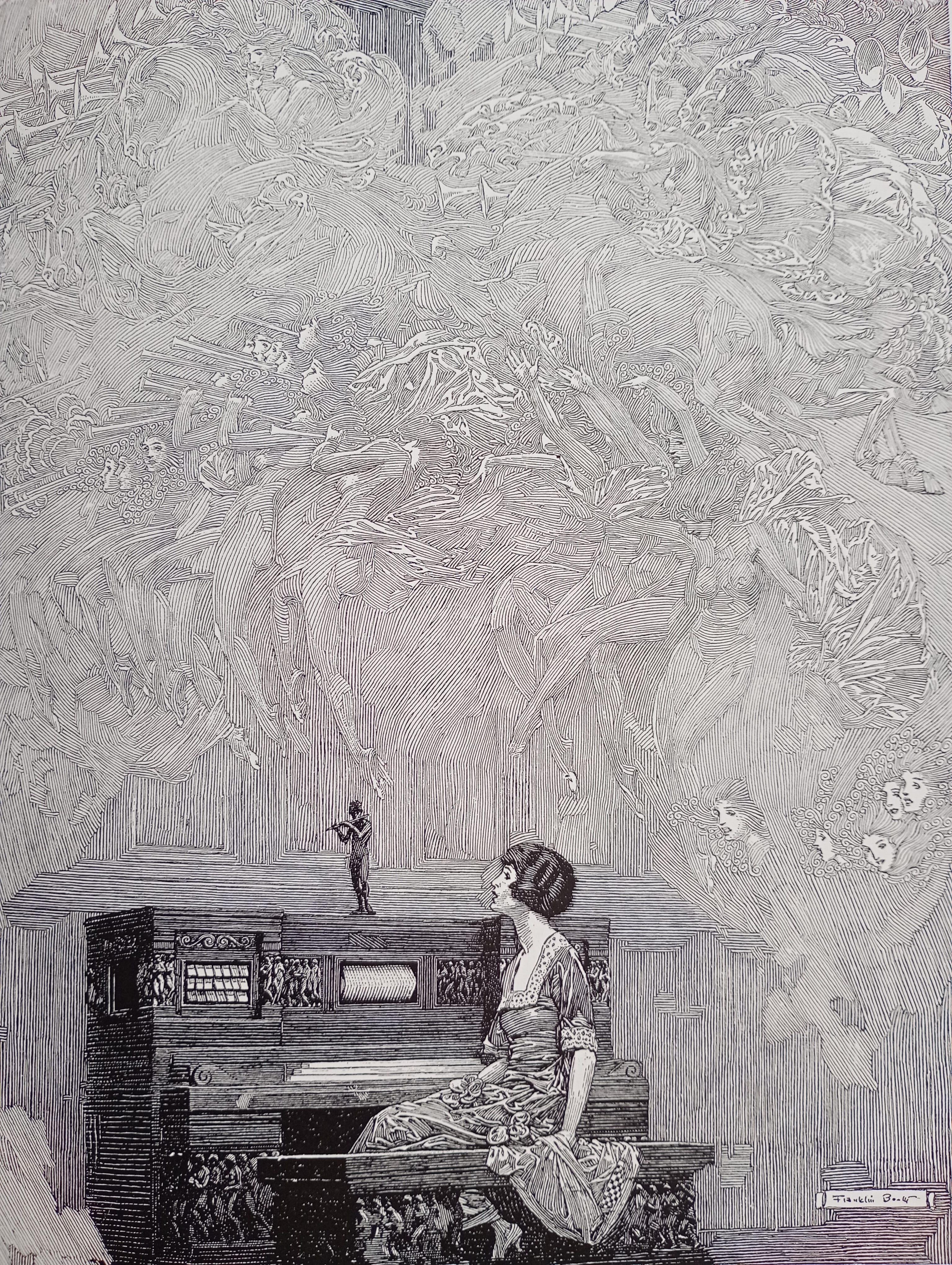
Franklin Booth learned to draw but he never learned to draw like anyone else. Best I can describe is that when you zoom in, say, at the ink that makes a tree, (lots of trees), the linemaking reveals itself as truly very strange. That’s a simple version. Booth was the most normative man imaginable, on top, and the most ordinary corporate illustrator - Studebakers, Spoons, Etsy Organs (for anyone who loves music) Buy War Bonds.
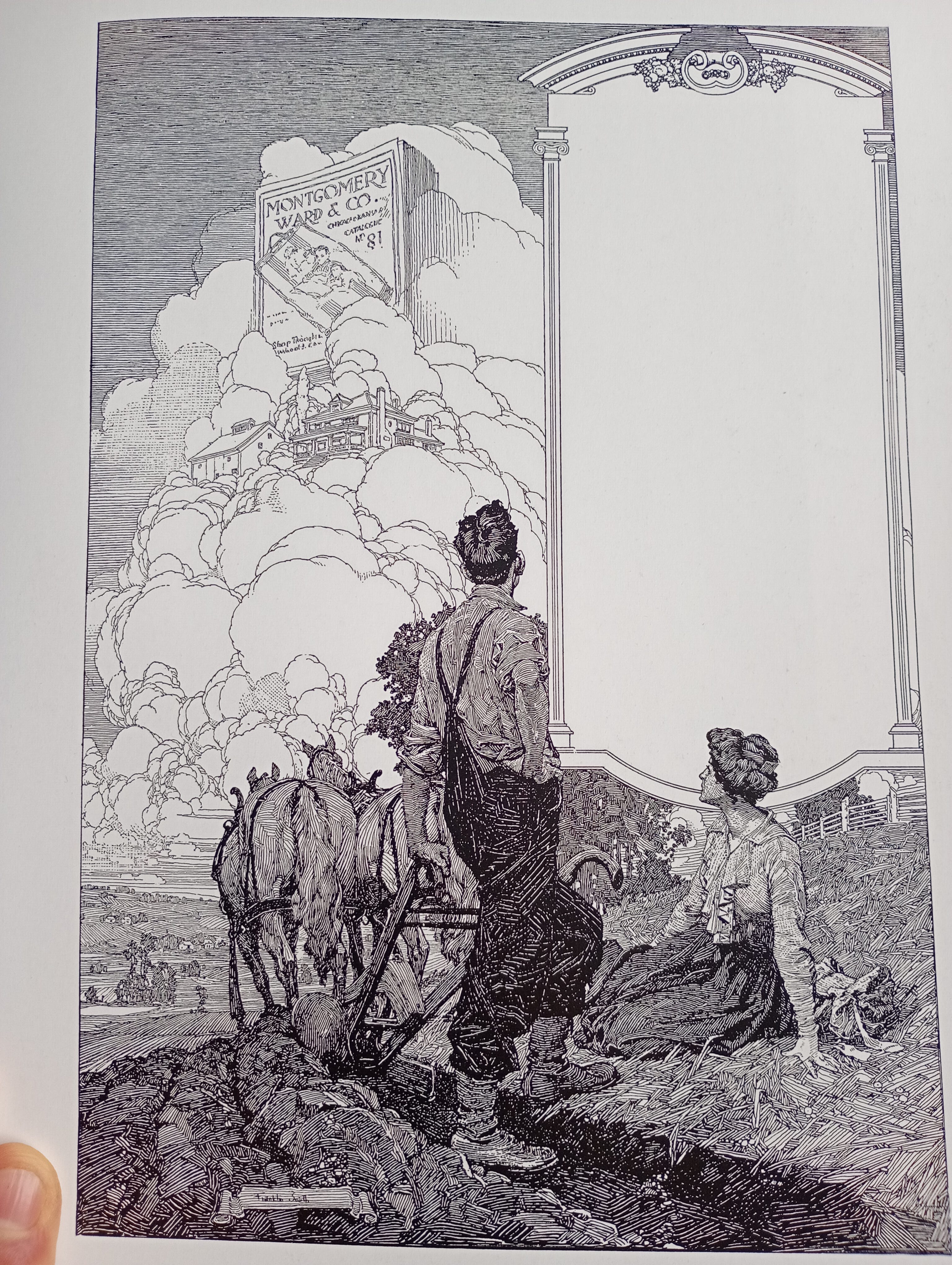
His images are directly beautiful and anyone could tell that at a glance, its only when you dive into them, try to make sense of the lines the way shadow and light are amassed, the way he conceives of an object, a texture, a pattern of light, trying to work out what the hell is going on in this mans mind, that you begin to realise that, in crudely modern terms, Franklin Booth has hacked his own visual cortex and stripped out and re-wired large parts of the ‘world comprehension’ HUD, that he is, likely being due to being something of a genius, to being self-taught, to those long hours on the farm as a youth, to appending all of that to a titanic level of both inherent, and also deliberately years-long developed, skill, he is showing us the world through a completely different mind, and hence a different world.
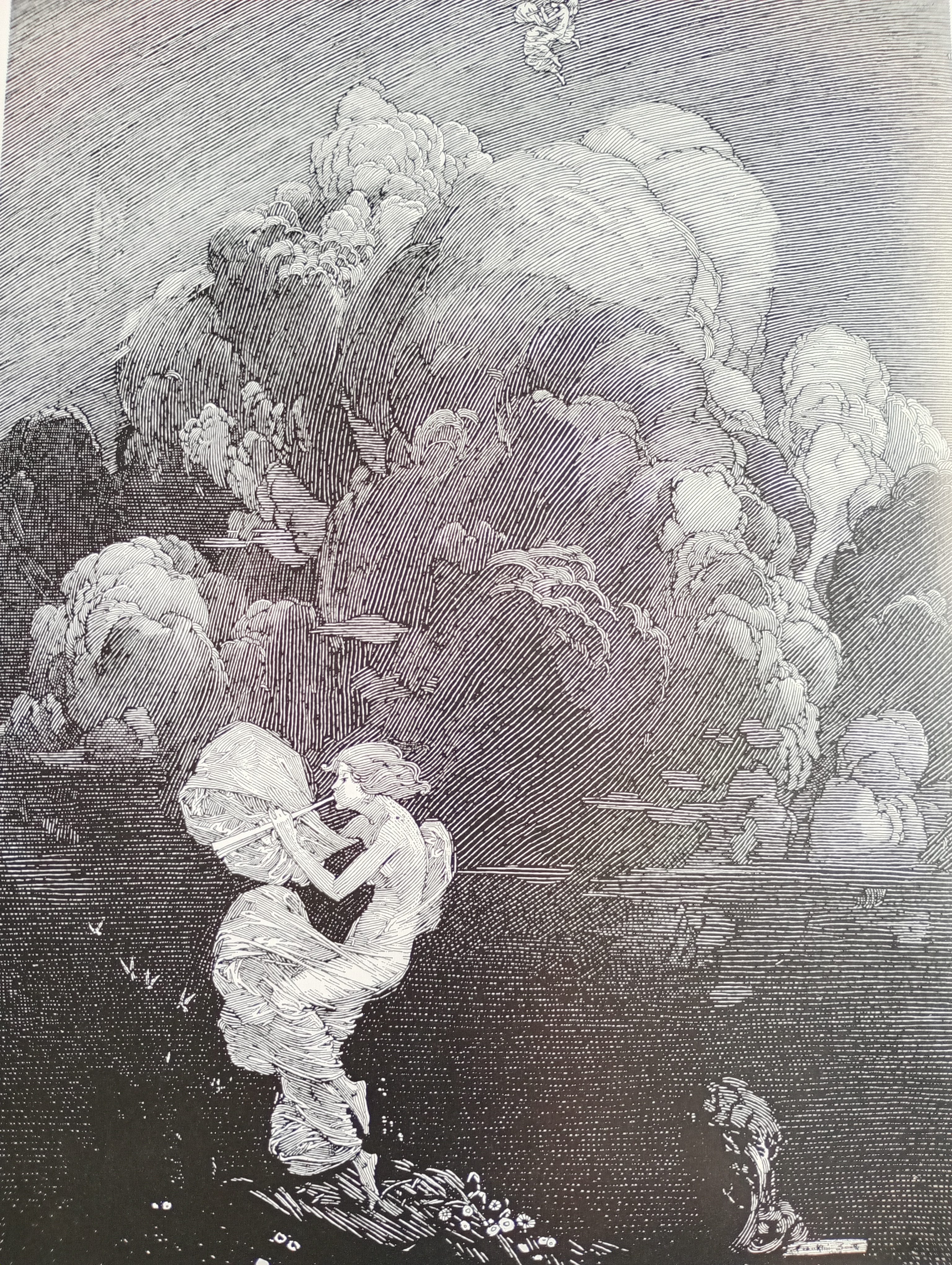
Originally, the closest thing I could come to was someone like Ian Miller, but Miller draws grotesqueries with an arguably-grotesque line.
Imagine if, instead of being a weirdo drawing wierd thing, Ian Miller was actually a very extremely normal man, drawing very normal things, but still had that utterly different image-making software, but was also kind of a genius, but a genius that advertises spoons.
Then I thought, looking back, all the way back; isn’t Miller essentially Dürer? I mean an awful lot of his art seems to be inspired by the German. And if Booth is a spiritual inversion of Miller isn’t he really a spiritual inversion of Dürer?
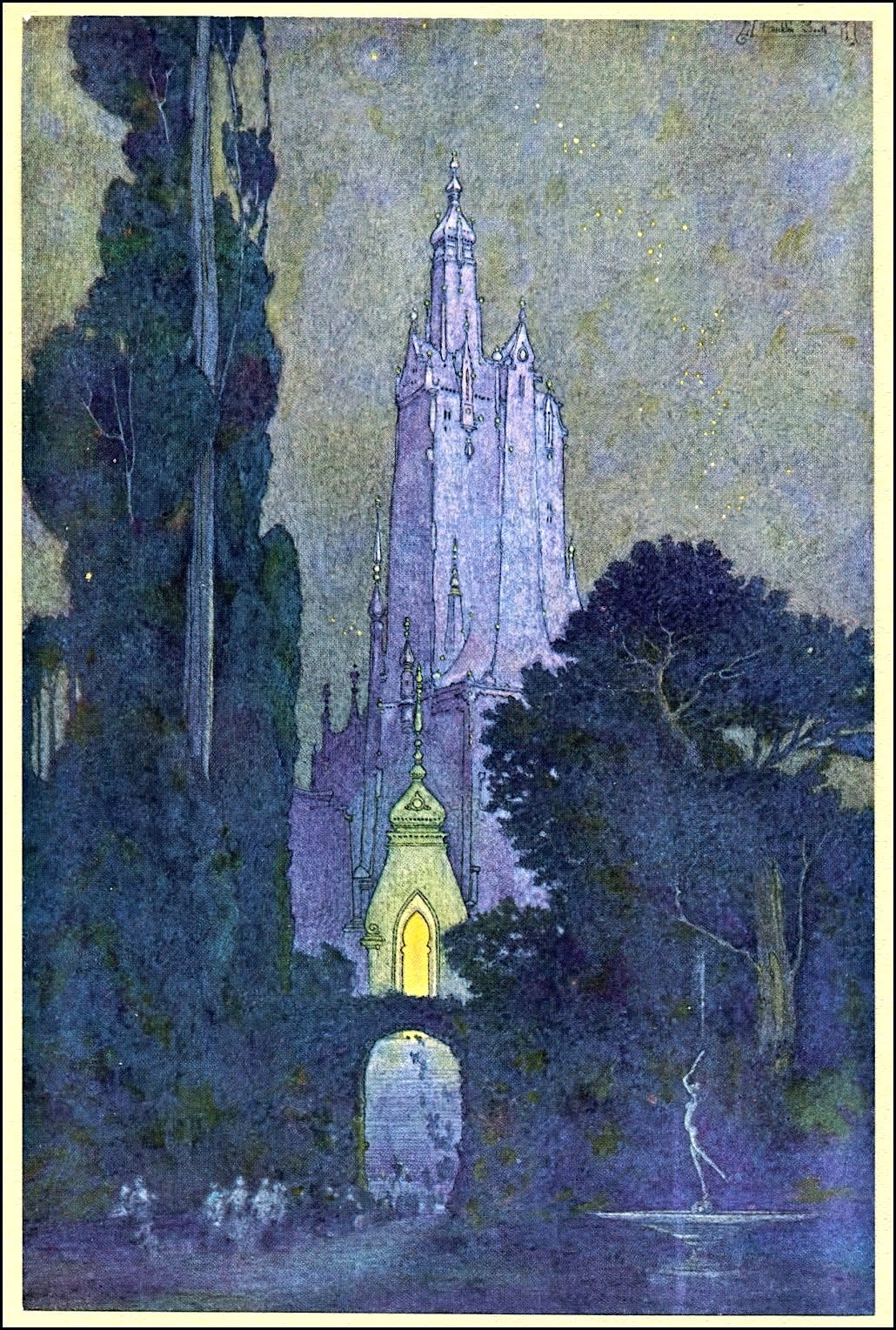
The sensation of absorbing Franklin Booth and his visual world is historically, emotionally and sensually fascinating and maddening and slightly Lynchian, or dreamlike, with this vast calm beautiful pastoral and patriotic mind floating like a sunbeam across a world of cortical queerness and wonder. Very much a Fairytale guy. Also this is a very good book in a variety of ways. Would heartily recommend.
The End of Lines in Black and White
Perhaps not the end, but certainly a change. Remember, these wonderful translations of Pen and Ink are only possible due to the element of photography transposing them into the plate.
The engravers are disappearing, by 1930 they are gone. Those gangs of little goblin men, directly transmuting, by alchemy and by hand, the image into form, and back to light, all passed away like Fairies in the dawn. Now comes the age of the Photograph. Improvements in the photographs themselves, in the print, in the paper to show them, slowly and gradually all the in-betweens are overcome and you can finally, finally get a photograph looking good on the page, and then really good.
What use for the linesmen now? They were usually selling something other than themselves; Saints and Studebakers, Bible Tales and Gibson Girls. There are still illustrators but they no longer define reality. For about 500 years there, if you wanted a vision of the world outside your immediate sphere, you were looking at engravings, at lines in black and white, at human hands cutting wood or metal.
What changes once the Photograph deposes old-king-Line? The ‘Captured Moment’ finally does actually capture the moment, and transmit it. What fills our screens and pages is not ‘types’ but examples, a world of distinct particular things, all locked to a context in time and space. It’s notable that line work illustration survives in medical textbooks and in botany. Both areas where the physical thing under study is slightly fluid, irregular, and where a photograph of one particular example might not give you the platonic ideal version of a wound or leaf which you need to recognise something in the wild, and distinguish it from similar forms. Here the true, but slightly fluid nature of the world still holds itself apart; it cannot be captured, any more than a relics sacred power, it must be translated to be understood.
And the presence of the hand is gone, at least from mainstream images - though survives out in the world of pure illustration. In particular, the relationship between comic artists and their inkers reminds me a lot of Durer hovering over his engravers insisting on line weights and shading. But the direct transmission, via alchemy, of hand to physical form, to eye, is gone.
The age of photography may itself be coming to an end, at least as a vector of truth. There is no reason any more for anyone to believe a photograph. We are thrown back onto older forms of certainty, of reputation, direct testimony, physical presence. The information in an image now only really counts if there is a living person who will bind their reputation to its truth, mortal presence leaking back into the machine at last.
Use of the Machines
I made use of A.I. as a research tool in creating this post. Though all of the text is mine, many of the facts and some of the ideas came up in conversation with Claude.
Here is a link to a full transcript of every conversation I had with Claude on this subject.
If you have opinions on this, let me know in comments. These could range from; ‘Kill yourself’, to ‘Never use A.I. in any form ever’, to ‘Use but always disclose and credit’, to ‘Fuck it, we ball’ (though I expect few of those.
For clarity - I have promised generative A.I. will never show up in any False Machine product and I will maintain that promise. If you are a very very anti-A.I. purist you could say that this blog is a product, and that even A.I. for research is too far, in which case, I guess you got me there.
Again - any word, image or layout you see in any False Machine product will be the work of human hands.
If I use A.I. to research anything on the blog I will disclose in full.
Future Posts
In any case - I am going to have to knock off or reduce the size of my blog posts for a long while. Working on VotE; ReDux and Scrapworld Project and my day job is just eating too much of my time. I spent multiple days on this engraving thing which probably no-one will even read to the end. Future blog work will be shorter, though hopefully not slop-short. Maybe I can do a version of ‘The Order of the d12’? Are any dice not yet taken? Maybe the d7??
Love the essay. Dürer was a weirdo, for sure. Well, most great artists are/were. We did remixes of his work in art class here in Germany, cutting apart animals and reamaking them into new creatures.
With regards to AI: If you use it as a research tool, it's fine. I like your disclosure. Like someone else said: Don't let it shape your text. And, if possible, double check claims.
I wonder if AI for research is really worth disclosing on a blog post? It's not like people demand a high standard of factual accuracy from a blog. If you were an academic or journalist, then maybe. But I typically don't expect a blogger did any original research, so why would I care if they outsourced it? What you need to protect in a blog is your personality, your voice.
Anyway, thanks for the introduction to Franklin Booth, this stuff is amazing!